Showing posts with label setters. Show all posts
Thursday, 22 April 2021

Remembering Chaturvasi / Gridman / Rishi

Gridman / Chaturvasi

I learned of CV Sir’s passing through messages from crossword friends last Wednesday. I had not been in touch with him since over a year, and infrequently even before that.

And yet, his absence feels like a huge personal loss.

I found myself going back to our email exchanges over the years, thinking about how our interactions evolved with time.

I met CV Sir first on Orkut in 2007, before this blog existed. He and TSG (Ganesh) managed a cryptic crossword community there. Joining their community was a transformative experience for me. I felt like a lone Martian stranded on Earth discovering my planet’s settlement.

CV Sir was brimming with ideas for the crossword community. He had a point of view, a distinct personal style, and he was always up for a challenge. My mailbox twelve years ago would find messages like this from him:
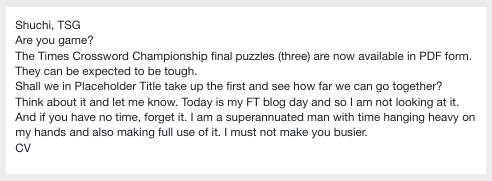
Are you game mail

TSG and I would of course go along with the “superannuated man”.

Interestingly, my interactions with CV Sir were not always conflict-free. When I started this blog, CV Sir had strong views about content and writing style and would have liked me to follow them. I did not quite agree and did not follow them. Through the years, I have often sparred with him over what I saw as occasional want of sensitivity in his clue surfaces and social commentary.

His response to non-acquiescence and criticism from someone less experienced than him is something many of us can learn from. He knew how to keep debate civil and never let differences over ideas affect our regard for each other.

CV Sir had great personal pride and childlike enthusiasm, at the same time the groundedness and maturity to seek inputs for improvement. He would reach out when he was unsure about a clue, and would receive suggestions with open-mindedness and appreciation.

MIDDLE OF THE ROAD clue

(I now googled to check what finally happened with this clue: found that he did revise it.)

Our interactions of late had dwindled to his alerting me to interesting discussions in various forums. This is the last communication I had from him, in 2019 (Viresh – it mentions you):

THCC Spoonerism discussion

Remembering CV Sir has prompted me to reconnect with other crossword friends who knew him since the 200x early internet days. (Anokha - I was unable to reach you. If you read this, please drop me a line, would love to have your inputs too.)

Sharing their thoughts as sent to me:

Ganesh (TSG), THC setter Neyartha:

I got introduced to Mr. Rishikesh in early 2005 through the Orkut Hindu Crossword Community. Around that time-frame (in the early days of social networking), I had just started out graduate school in the US and Orkut was the online meeting-place of choice for youngsters. Having joined it a few months earlier, I created discussion groups for something I used to attempt every day - the daily cryptic crosswords from The Hindu and The Economic Times. Other Indo-centric crosswords discussion fora such as Yahoo! Groups and Mayyam also existed. Mr. Rishikesh was an active participant in all these sites, pitching in to help clarify any questions that members had with the annotations of the clues. In those days, there were few online resources to explain cryptic crosswords, and Mr. Rishikesh's posts helped drive up the analytical capabilities of the forum members significantly. As one of the administrators of the Orkut communities, I developed a personal line of communication with Mr. Rishikesh, as he provided inputs on how to make the communities more appealing. Slowly, I sharpened my crossword skills enough to act as a test solver for the puzzles he was contributing to The Hindu. This gradually helped me to start writing clues and eventually prepare puzzles for private events. Mr. Rishiskesh was already quite adept at using technology for his crossword compilation tasks, and I was able to share findings from my own research (in terms of software tools) for him to evaluate further.

In early 2006, I made my first visit to India after joining grad school. I took the opportunity to meet up with Mr. Rishikesh in person at his residence in Gopalapuram, Chennai along with a few fellow enthusiasts as part of a 'Chennai Orkut Crosswords Club Meet' - a precursor to the THCC meets that pop up now and then on The Hindu Crossword Corner. We had an enjoyable discussion, and Mr. Rishikesh also gifted me a few crossword books from his collection.

After I flew back to the US, I continued to act as a test solver for Mr. Rishikesh's puzzles while slowly building up a library of my own compilations with his guidance and mentorship. The retirement of a few puzzle contributors to The Hindu around the end of 2007 opened up slots for new compilers, and Mr. Rishikesh was kind enough to recommend my name to the publishers for the same. I am indebted to Mr. Rishikesh for opening up this opportunity - his encouragement and inputs have enabled me to keep improving at my job over the course of 14+ years and 240+ puzzles.

With the development in our personal rapport, we exchanged family visits whenever I was in India. He also graced my wedding with his presence in 2008, and called up with personal wishes after the birth of my daughter. Over the last few years, as my trips to India became more spaced apart, our communication was limited to regular e-mails. I used to send each puzzle compiled for The Hindu to Mr. Rishikesh for vetting. He graciously took time out to point out inconsistencies and issues with the clues, if any.

His passing has left me, as well as the global cruciverbalist community, bereft of a treasured guide. His online contributions (including his comments in The Hindu Crossword Corner blog posts over the last couple of years) were always courteous, mild-mannered, and witty - a combination of qualities that has become difficult to find in today's online discourses. He will be fondly remembered by many, and his public posts will continue to guide crossword enthusiasts well into the future.

Tony Sebastian, THC ex-setter Cryptonyte:

Long ago, in a time before Facebook, IPL, and Crossword Unclued, a 19 year old put up an amateurish crossword (with a skeleton he has copied) on his blog with the 30 minutes internet access he had in the college library. Little did he know that a few squares in black and white in an obscure corner of the internet would summon a real life superhero - Gridman!

That's how I first interacted with CG Rishikesh AKA Chaturvasi AKA Gridman and TBH, I was in awe. A few words of encouragement, a nudge to try creating skeletons, and efficient guidance from a superstar in the Indian crossword scene like Gridman is an unimaginable feat in any field today. And yet, he made no big deal out of it. He pointed out nuances and ways of improving from time to time though he was by his own admission "up to eyebrows in work". But he continued to guide me and the many others around him, always hoping that there would be new and original setters from India.

Looking back now, the kindness, patience, and guidance he gave a young setter he had never met or known in person, was rare and very special. And special is what Gridman was. The many who know him from the crosswords he's set will know him as fair and approachable for 20 years. To me, he was a guide and mentor who pushed me to keep improving my clues, nudging me to seek all possible avenues to publish my crosswords. A gentle guide who reminded me that he himself got an opportunity to set a crossword for The Hindu only in his third decade(!) of setting grids. And in the end, made sure that I and several better setters did get our chance to put our pseudonyms in The Hindu.

Time sometimes moves too fast, and at other times too slow. And rarely, you find moments when you wished it would stand still - where everything was black and white. With one fair clue and only one correct answer. With a beautiful, symmetric grid and the man who took pride in making them all just right. Go well, Gridman. You've left us, but you've made sure we're not clueless.

Anish Madhavan (Maddy), THC ex-setter Spiffytrix:

As I try to wrap my head around the terrible news, I am transported back in time some 12-13 years ago, when my first interactions with CV Sir began over the Orkut groups, Col’s blog, Crossword Unclued followed by many many exchanges over emails. The lively discussions over the small Orkut group while solving/commenting on an old Times crossword (syndicated in The Hindustan Times) are among my fondest memories from that era. His contributions to popularizing crosswords and making it accessible is unparalleled and the fact that there is now a respected sub genre of original Indian crosswords with a desi feel and tadka is all credit to him.

It was CV Sir who molded and morphed me into a setter from a casual solver. In fact, I just realized I was one of the very first setters, if not the first, who got empaneled for the Hindu Crossword purely due to his mentoring and recommendation. Once I ceased setting/regular solving of crosswords in the last 7-8 years due to my work commitments and busy schedule, our regular correspondences also petered out till we reconnected about a few months back. How I wish I could turn the clock back and make amends for not being in regular touch for so many years.

Gridman going off the grid is truly the passing of an era. But his legacy will live on not just through his impressive volume of work but also through the work of many many others whom he has mentored and converted into setters. Au revoir Sir, you will be missed, They don’t make ’em like you anymore.

Richard Lasrado, THCC regular:

The news of our dear Rishi's passing away was a shocker. We had become friends pretty much before we met in person. I had happened to bump into Col Deepak's blog by sheer chance, a few months after it was launched. The earliest regular participants in the daily discussion were CV, Suresh Dorbala, Shuchi and a few others.

Having been a cryptic crossie aficionado since college days, I too began chipping in with my two-pence. Whenever there was a difference of opinion or doubt, Chaturvasi aka CV had the last word. As time rolled, I got to discover the genius in him. We began to regularly communicate by email. Both of us having had the background of journalism might have led to a strong rapport being built between us. The _nom de plume_ Chaturvasi had impressed me to the core. He breathed and lived within the confines or protocol of the _chatur_ (four) corners of the crossword grid. In one of his initial emails alone, he revealed an additional facet of his identity. It was a pleasant surprise to learn that one of the most popular setters on The Hindu panel, Gridman, was none other than CV himself. That took my admiration for him a few notches higher.

Before I first met CV, I somehow had visualized him as a tall, well-built man with a booming voice. But our first conversation changed all that in entirety. Here was a fine gentleman, soft-spoken in nature and receptive in temperament.

Although I drifted away from crossword-related activities during the last few years, I was in communication with CV through e-mail. There was a motive, call it selfish or whatever. For many years, I have been planning to bring out a book. I could not think of a more suitable person to edit and fine-tune the text than Chaturvasi. He graciously agreed to do it for me. But, alas, he has left this world, with a question mark looming large on my project.

Fare thee well, CV. I am sure you are not the one who would rest quietly. You may have found many other crossie enthusiasts already, with an old acquaintance like Raju Umamaheswar in company, to engage others in the battle of words. Om Shanti: Brother!
Col Gopinath of THCC:
I am still getting used to the fact that Rishi is no longer with us. It came to me as a rude shock.

He was amongst the first few to have commented on my blog and had been taking keen interest in the upkeep and well-being of the blog. He had sent me a message just a few days ago on the 11th pointing out a spelling mistake. He would sound me out occasionally on unwanted comments on the blog even though he had full admin rights.

His dedication to crosswords was unparalleled and he was in touch with me even while in hospital during his illness in March.

His absence will be a great personal loss to me and my blog.

CV Sir, you will be deeply missed. I am remembering your full-throated laughter as I write this and breaking into a smile.

Chaturvasi with DS
Pic above: at Col's home (2010): CV Sir on the right, Dr DS on the left.

Links to guest posts written by CV Sir on this blog:

More about Gridman / Chaturvasi from the blog archives:

Tributes from other sites:

If you wish to keep track of further articles on Crossword Unclued, you can subscribe to it in a reader via RSS Feed. You can also subscribe by email and have articles delivered to your inbox, or follow me on twitter to get notified of new links.

Wednesday, 24 April 2019

Crossword Software To Make Puzzles With Multiple Letters Per Cell

In the article Crossword Grids That Hold More Than One Letter Per Cell, cryptic setter eXternal (Steve Bartlett) gave us a detailed tour of “rebus” crosswords, with tips for setting and solving such puzzles. In this article, he walks us through software that can be used to create crosswords with the many-letters-per-square gimmick.

Steve is the editor of Enigmatic Variations crossword in The Telegraph. He also sets advanced puzzles in the series of The Listener and Inquisitor, and standard cryptic puzzles for The Daily Telegraph (as proXimal), The Independent (as eXternal), Financial Times (as ARTEXLEN), The Herald (as Boz) and The National (as Claymore).

Handing over the reins to Steve for this article…thank you!

- Shuchi

It is quite simple to create a puzzle with more than one character per cell by using crossword-creating software. I will describe how to do this using Qxw, which can be downloaded for free from Quinapalus. I use this tool for all my barred puzzles and thoroughly recommend it, as it enables the setter to produce complex puzzles relatively easily.

I'll demonstrate how to use Qxw to produce puzzles with multiple letters per cell with reference to a couple of puzzles I created: one called Odd One Out in collaboration with Serpent for The Inquisitor series in The i; and one called Disappearances, which appeared in the Enigmatic Variations series in The Sunday Telegraph in 2017.

Odd One Out by eXtent

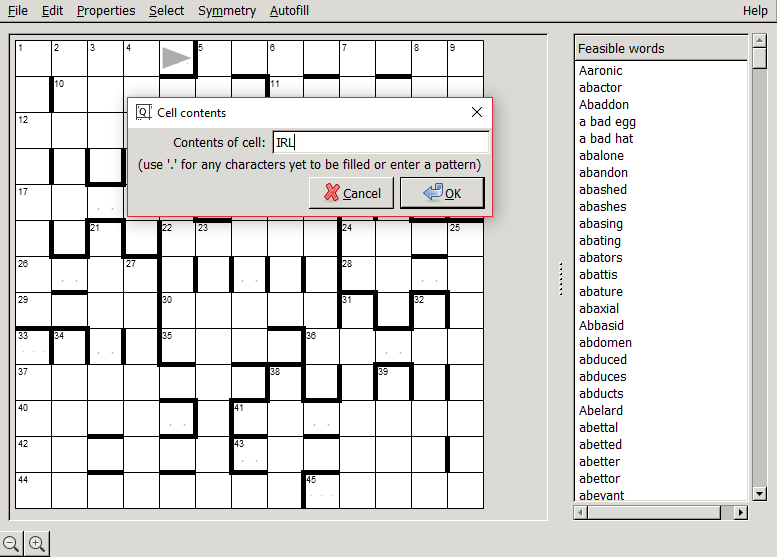
Serpent and I decided to theme a barred puzzle on Brexit. We wanted a grid which would include IVR codes of members of the EU in single cells. The number of letters in IVR codes for these members ranges between 1 and 3 — for example, Portugal is P, Czech Republic is CZ and Ireland is IRL.

Below is an outline of the grid we prepared:

Odd One Out by eXtent - The Inquisitor - Grid Outline

In order to get the three letters IRL in one cell, we needed to do the following:

Click on Edit — Cell contents. Then just enter IRL in the dialog box.

Qxw - Edit - Cell Contents

Qxw - Edit - Cell Contents - IRL

Qxw then suggests a number of feasible entries (show in the panel on the right) for insertion.

We simply repeated this procedure for other cells around the grid for each of the two- and three-letter IVR codes. The final grid appeared as follows:

Odd One Out by eXtent - Filled Grid

A blog of the puzzle by HolyGhost at Fifteensquared can be found using this link: Inquisitor 1588: Odd One Out by eXtent.

Disappearances by proXimal

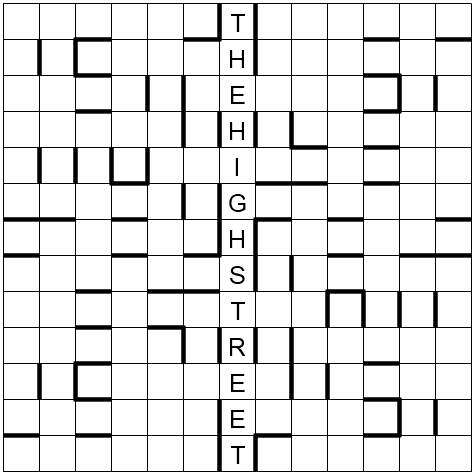
I had decided to base a puzzle on a theme of the decline or disappearance of stores from High Streets. The phrase THE HIGH STREET lends itself really well to being used in a barred crossword, as it has 13 letters and such grids are often 12x12 or 13x13. I decided to have THE HIGH STREET as a thematic unclued entry running down the central column of a 13x13, with names of shops which have disappeared produced by clashes on both sides of THE HIGH STREET. The clashes could be nicely thematically represented just by leaving the clashing cell blank, thus the stores are disappearing.

So, I started with a grid as follows:

Disappearances by proXimal - THE HIGH STREET

I decided to have five shops either side of THE HIGH STREET to produce a nice range and an interesting challenge for the solver. Firstly, I searched for shops which would lend themselves easily to being divided, to be produced from clashing words using Across and Down entries, but also ones that were relatively well-known. One of the most famous which I decided to use is WOOLWORTHS, which could be split as WOOL and WORTHS.

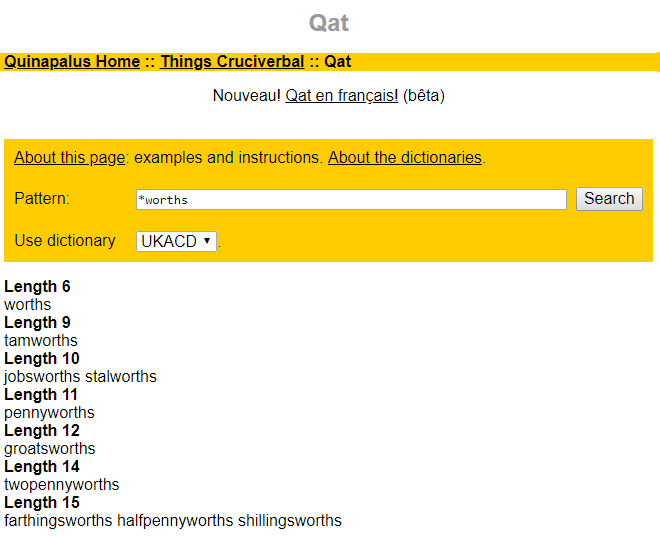
There is a useful pattern-matching tool on the internet called Qat, designed by Quinapalus, who also developed Qxw; I used Qat to check which words could end in WORTHS and which could start with WOOL. The picture below shows the search for words ending in WORTHS (using search term *worths):

Qat - Word Pattern Search

I liked the look of JOBSWORTHS and decided to have this entry in the grid to provide a clash in the last cell of a five-cell entry; the number of words starting with WOOL, to provide the Across clash, was much higher.

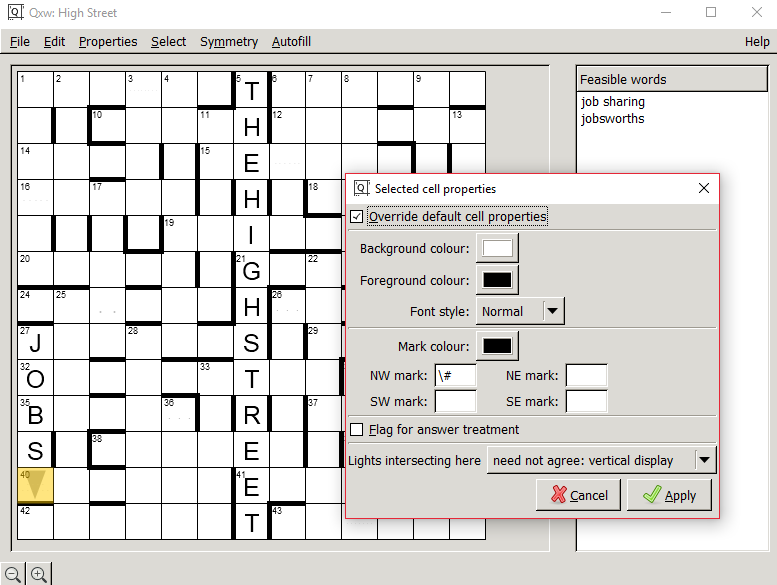
Back to Qxw, I put JOBS in the entry at 27 Down with the last cell blank to accommodate WORTHS in one cell. To enable Qxw to work with clashing entries, one does the following:

1. Select the cell which you want to use (shown in yellow below), by clicking Select and then Current cell, when the cursor is in the cell.

2. Click on Properties — Selected cell properties. Then tick the box which says Override default cell properties and further down, change 'Lights intersecting here' to 'need not agree'.

Disappearances by proXimal - Qxw - Intersecting Cells Need Not Agree

This now meant that I could specify an entry beginning with WOOL at 40 Across, with the four letters of WOOL being accommodated in the first cell, to clash with WORTHS provided by the down entry. In order to do this, the following is required:

Click on Edit — Cell contents. Because I have previously specified that the cell can accommodate clashes, a box appears which allows us to enter multiple letters for the Across and Down entries meeting in this cell.

Disappearances by proXimal - Cell Contents

Hence, once I had specified that the contents of the cell for the Across entry should be WOOL, Qxw provides me with a number of feasible entries: WOOLDINGS, WOOLFELLS, WOOLIEST, WOOLPACKS, WOOLSHEDS, WOOLWORTH.

I then repeated the same process in various cells around the grid to accommodate the nine other shops. The completed grid appeared as follows:

Disappearances by proXimal - Filled Grid

So, for example, SKEETER at 1 Down clashes with COMPASS at 16 Across to create COMET. In this puzzle I also wanted to have real words left when the clashing cells were deleted, so the deletion of the COMET clash would leave words SKEER and PASS in the final grid.

A blog of the puzzle by Dave Hennings at Fifteensquared can be found using this link: Enigmatic Variations No. 1296: Disappearances by proXimal.

Related Posts:

If you wish to keep track of further articles on Crossword Unclued, you can subscribe to it in a reader via RSS Feed. You can also subscribe by email and have articles delivered to your inbox, or follow me on twitter to get notified of new links.
Monday, 12 November 2018

Crossword Grids That Hold More Than One Letter Per Cell

This NYT Wordplay article Yes, You Can Write More Than One Letter in a Square and an ensuing twitter discussion got me to discover some fascinating grid-fill gimmicks used in advanced cryptics. One such is to set aside the one-letter-per-cell norm that we take as a given in blocked grid puzzles.

The word or group of letters that goes inside a single cell is called a "rebus". [Long ago, rebuses were probably "squashwords" – more on that later in the article.]

If the idea of many-letters-per-cell is new to you, then you're probably brimming with questions at this point. When did this trick originate? How does the setter go about crafting a puzzle with rebuses? What should the solver do to crack such a puzzle?

Cryptic setter eXternal (Steve Bartlett) offers us insights into these questions. In this article, he looks at the history and development of puzzles in which individual cells contain more than one letter, and supplements his research with rare images of decades-old puzzles.

Steve sets advanced puzzles in the series of The Listener, Inquisitor and Enigmatic Variations. In addition, he sets standard cryptic puzzles for The Daily Telegraph (as proXimal), The Independent (as eXternal), Financial Times (as ARTEXLEN), The Herald (as Boz) and The National (as Claymore).

Note: The article primarily uses Listener examples, for consistency and because it has the longest history of the barred series.

Over to you, Steve.

- Shuchi

Many Letters in a Square: Dive into History

1. Listener (1950): #1047 Space Saver by Babs
    Compressed repetitions; LILO = LI/O

Here is a Listener crossword and solution from 1950, one of the oldest-known crosswords to employ the many-letters-per-square trick.

Listener 1047 Space Saver by Babs
[click #1047 to enlarge]

The preamble of the puzzle states that only half the number of squares is to be used for each answer, hence an answer of four letters has a light containing only two squares.

For example, the answer to 1 Across:
Refuse the odd bits (8)
is RIFF-RAFF. This to be entered in four cells as R,I/A,F,F, with the I and A sharing the same cell, divided with a slash.

This crosses with 2 Down:
Disinfectant used to make Eliza ladylike (4)
in which the answer IZAL is hidden in 'Eliza ladylike' and entered as I/A,Z/L, using just two cells for the entry.

Listener 1047 Space Saver Solution

The preamble gives several examples of how the answers should be entered, to help the solver understand this unusual entry method.

Grid Fill Examples in Preamble

2. Listener (1951): #1118 One or Two. by Stephanus  
    Random distribution: one letter in a cell or two

A Listener crossword from the following year, 1951, uses a simpler concept. A short preamble merely states that a 'space' contains either one or two letters.

Listener 1118 One or Two Stephanus
[click #1118 to enlarge]

For example, the answer to 5 Across:
Post of Prometheus' hope - and fateful pain? (8)
DELIVERY is entered as DE/LI/V/E/R/Y, in six squares.

This crosses with 6 Down:
What's put the L in AIR? A tree, at least (6)
in which the answer LINDEN (L in DEN) is entered as LI/N/DE/N in four squares.

Interestingly, the solution notes allow an alternative, as the V of DELIVERY and N of LINDEN are unchecked, meaning that DE/L/IV/E/R/Y and L/IN/D/E/N would be equally valid. We seldom see such ambiguities in today's barred crosswords.

Listener 1118 Solution

3. Listener (1961): #1640 Three-in-hand by ffancy
    Alphabetical sum

This example hails from a decade later, 1961. The puzzle has a complicated preamble to explain that each square accommodates three letters. This puzzle uses a gimmick commonly seen in modern barred puzzles, where Across and Down answers clash. Cell entries are derived from the letters of clashing Across and Down answers and the alphabetical sum of these two letters.

Listener 1640 Three-in-Hand
[click #1640 to enlarge]

For example, 1 Across CRACKER clashes with 1 Down KILDERKIN in the first cell. K and C are written in corners of this cell, with the sum C(3)+K(11)=N(14) in the centre.

1640-Solution

A further point to note is that, unlike the previous examples, the 1961 puzzle is thematic. The solution leads to a quote on diagonals from cell 11 — PLEASE TO REMEMBER THE FIFTH OF NOVEMBER etc., using the central cell entries derived from the clashing letters.

So far, the examples have not attempted to coin a term for this particular genre. They merely describe in the preamble what needs to be done to solve and fill the grid.

4. The (Almost) Impossible Crossword Book (1984)
    The name’s Squashword

The next example is from Gyles Brandreth's The (Almost) Impossible Crossword Book (1984), with the actual puzzle probably dating much earlier.

Shared Squares by Convar - Squashwords

Beside the title, appears the line, 'Shared Squares is a squashword'. This might lead us to believe that there was once such a term in usage for puzzles where squares contain more than one letter.

5. Listener (1998): #3479 Belt Up by MynoT
    Symbols for Clashes

The next example is from 1998, after The Listener crossword had moved to its current home in The Times.

3479 Listener Belt Up by MynoT
[click #3479 to enlarge]

Here the clashes are generated using more than one letter contributed from crossing answers. This is typical of modern barred thematics, with the clashes resulting in a thematic word.

For example, the clue to 9 Across is:
Car's before them to perform — by the grace of god (4) DODGEM
DO + DG(Dei gratia) + 'EM

The clue to 4 Down is:
Note's small money (3) MINIM
MINI + M

Both answers are too long for the available space (6 letters for 4 cells; 5 letters for 3 cells) and clash in the crossing cell, with the clash of GEM from DOD/GEM and INI from M/INI/M to give GEMINI, entered as the sign of the zodiac.

Aside from the entry lengths (rather than answer lengths) being given, we can also note that there is no reference to clashes in the very short preamble. The solver must deduce the fact that some answer are overlong and therefore clash.

Listener 1998-10-03 #3482 Belt Up Solution

6. Listener (2002): #3673 Journey by Gioconda
    Abbreviations for Clashes

The final example comes from 2002 and has four entries sometimes clashing in one cell. As opposed to the previous example, answer lengths rather than entry lengths are provided.

Listener 3673 Journey by Giconda
[click #3673 to enlarge]

In this puzzle, 2 Across has four clues but only two lights. The solver can thus deduce that the first two clues will clash somewhere in the first light and the second pair will clash somewhere in the second light.

The first light of 2 Across is made up of 6 cells, but the answers to the first two clues have lengths of 5 and 7 = 12. Therefore, there will be a clash of 7 letters in one cell along that light.

The first two clues of 2 Across are:
Endless joke about half clad women (5) JADES
JES{t} around AD

Amount of water in pool crushed a dog-pen (7) PONDAGE
A DOGPEN*

Therefore, we have JADESPONDAGE to enter in the first light of 2 Across. We can see that DESPOND is a likely 7-letter candidate to be the clash in the third cell.

Then, we look at the Down clues on the column where the large clash from 2 Across occurs, ie column E. The first two clues in column E have answer lengths of 3 and 8 = 11, but a light length of only 4. Therefore, a clash of 8 letters will occur. The first two clues of column E are:

Court Henry with soft centre (3) HOF
H+{s}OF{t}

Cast off sledge bearing frightened Hugo (8) SLOUGHED
SL(HUGO*)ED

Therefore, we have HOFSLOUGHED to enter in the first down light in column E. The clash occurs in the second cell down, the same location as the clash in the across light, providing OFSLOUGH as the contribution to the clash. This is how the solver arrives at SLOUGH OF DESPOND, to be abbreviated as SOD as instructed by the preamble.

Listener 2002-06-29 #3673 Solution

Clashes from multiple entries form places visited by Christian in The Pilgrim's Progress.

This is only a tiny overview of the multitude of ways in which setters have used this gimmick over the past 70 or more years. The puzzles where clashes of more than one letter spell out thematic words or names are particularly common and are often used to set the theme in advance of a further endgame which needs resolving.

Tips for many-letters-per-cell setters

In addition to the generic dos and don'ts of cryptic setting, be mindful of the following points when creating a crossword with more than one letter per cell.

1. Keep an eye on checking

Remember that overlong entry clashes reduce the amount of checking in the puzzle. It is more helpful to the solver if you minimise the proportion of the answer which clashes, or apply some technique to offset the effects of reduced checking.

As an example, take a theme of Santa's reindeer to be produced by clashing answers. When deciding how to generate DANCER, a nice 50/50 split of DAN/CER could be achieved with DAN/GEROUSLY and NECROMAN/CER (~27% clashing). The solver will have more help with checking from cells already populated than using, say, DAN/DY and UL/CER (~60% clashing).

You can also offset the effects of reduced checking by offering easier clues for those answers that might otherwise be troublesome for the solver – for example, through whole anagrams or hidden words.

2. Decide: Answer lengths or number of squares?

When setting many-letters-per-cell puzzle, you have a decision to make about clue enumeration: should you give the lengths of answers or the number of squares available for each entry?

If answer lengths are given, the solver has more guidance as to which answers are likely to clash. For example, in the clashing entries for DANCER to appear (see above), the number of cells needed to enter NECROMAN/CER will be 9, but the answer length is 11. Hence if the setter decides to give the answer length (11), the solver knows this is a clashing entry, as the number of available cells is fewer than the answer length.

It is a lot more common to provide entry lengths (ie number of available cells), so that the solver has to work out which are the gimmick clues.

3. Represent the clashes elegantly

Finally, you also need to decide how the clashes are to be represented in the grid. It is a little inelegant and fiddly to expect the solver to enter a seven-letter word, say, in a single cell.

Solutions to the problem could be for the solver to insert a symbol, abbreviation, first letter of answer or to leave the cell blank.

The method should ideally fit with the theme of the puzzle.

Tips for many-letters-per-cell solvers

From the solver's point of view, the more quickly the theme is uncovered, the easier the solve becomes. So you should be on the lookout for:

  • answers which obviously extend for longer than the given number of cells
  • likely crossing clues which could create a clash

Sometimes only a couple of clashes are needed to get an idea of what the theme might be. Once you have zeroed in on the theme, you can consider the identities of the other thematic items which might be hidden in clashes.

eXternal Steve Bartlett
My thanks to Dave Hennings, Roger Phillips and John Tozer for their help in the research for this article.

– Steve Bartlett


A follow up article will talk about using crossword software to make puzzles with multiple letters per cell. Stay tuned!

Update (25-Apr-2019): The follow-up article: Crossword Software to Make Puzzles with Many Letters per Cell.

- Shuchi

Related Posts:

If you wish to keep track of further articles on Crossword Unclued, you can subscribe to it in a reader via RSS Feed. You can also subscribe by email and have articles delivered to your inbox, or follow me on twitter to get notified of new links.

Wednesday, 9 March 2016

Coincidence or Plagiarism: How do we tell?

Plagiarism or Coincidence in Crossword PuzzlesThe crossword world has been abuzz with this FiveThirtyEight report for the past few days. The investigation and its aftermath have spawned several threads of conversations about plagiarism in puzzles.

In this case, the data is so overwhelming that it leaves no doubt - but often the difference between plagiarism and coincidence is not so marked. A few clues with shades of similarity, a brilliant clue that was done before, an identical theme, even a full puzzle almost like another – any of it can happen by sheer chance.

In 2015, two consecutive Guardian prize puzzles by different setters carried the same theme of US Presidents – the grid fills naturally shared common entries, and what was arguably the cleverest clue in both employed the same wordplay device.

In 2009, two American crossword setters produced crosswords with a theme that, on the face of it, doesn't look like it could get repeated: phrases with the word RAVEN embedded inside. Both puzzles had near-identical theme entries in the exact same places in the grid. Matt Gaffney, the setter of one of those puzzles, wrote about how such a thing could happen independently and coincidentally.

Earlier when I spotted similar clues across crosswords, I used to blog about it (DĆ©jĆ  Vu, The Times Squires). I discontinued doing so as finding such commonality turned out to be too frequent to be post-worthy. Talented wordsmiths can surely see without external prompting that a TARANTULA is "natural at spinning" or a RHINO is a "one-horn animal" – it surprises me no more to find these words clued by different setters in the same style.

Arden Anax Clue Similarity

Some words (extra risotto, anyone?) are grid-friendly and will show up often in crosswords. Some words can be treated for clueing in only so many ways. Sometimes the ways of word breakup are many but two setters pick the same idea since it produces a great surface.

In clue-writing contests such as CCCWC, which do not make the entries public till after the deadline, participants cannot possibly copy/get inspiration from other participants' clues. And yet, declare the clue word CLEMENTINE and three entrants turn in "Papal cross? (10)".

So how do we identify a case of wilful copying?

If a setter does actually lift/tweak another setter's work, it is hard to tell when the instances of resemblance are few and the clues in question aren't markedly different from the setter's usual style. Only the setter knows!

I believe that we should be careful in using the P-word unless the evidence is very strong, such as:

  • Repetitions over a large volume of puzzles
  • Wide variation in quality of puzzles/clues by the setter
  • A pattern of resemblance to others' work especially in the long grid fills, where the potential for copying is the highest

The recent case reveals another tell-tale sign: expressing a disregard for the puzzle that your own work closely resembles. Not a fan, never have been a fan? If these repetitions were by chance, the setter/editor would like the crosswords that happen to be uncannily similar to his own!

Sometimes even a single clue can raise suspicions of copying. Say an amateur setter whose clues are generally unremarkable writes a brilliant clue on social media. There will be those who notice this anomaly and search for the clue online. If they find that this clue resembles a winner on another CWC, they will suspect. If this happens over and over, they will be sure. There may not be charges of theft made openly, but people watch, people know!

With publicly available puzzle databases and advanced search tools online, plagiarising puzzles/clues is easy. What is also easy is getting caught. The same puzzle databases and advanced search tools are available to consumers of puzzles. Puzzle solvers are smart and curious and driven to unraveling mysteries. Plagiarism in puzzles, if attempted, is bound to come out sooner or later.

Related Posts:

If you wish to keep track of further articles on Crossword Unclued, you can subscribe to it in a reader via RSS Feed. You can also subscribe by email and have articles delivered to your inbox, or follow me on twitter to get notified of new links.
Tuesday, 21 July 2015

20 Questions with THC's Under-25 Team: Exa, Mac, Spinner

The Hindu Crossword has, on its current setting team, three setters who are not yet 25 – but who show a maturity in their crossword construction that belies their relative newness to the game.

Exa, Mac, Spinner - Hindu Crossword Setters Get a peek into the minds of the three in question: Exa (Aakash Sridhar), Mac (Mohsin Ahmed) and Spinner (Srivathsan Santhanam).

The same set of questions were put to each of them, on topics such as their initiation into setting, their crossword-crafting methods and tools, their views on some controversial crossword techniques.

Here is what they had to say in response to the 20 questions.

Q1: How did you get into setting crosswords?

Exa: I was first exposed to a cryptic crossword in my second year of engineering (late 2011). I would solve a little, look at the solution the next day, and try to use the same techniques on paper to come up with original clues for other words. Later on I would give them to my friends who solved crosswords more often and gauge their reactions. Slowly I gained an affinity for setting clues, and eventually took part in few online clue-writing competitions (thanks to Crossword Unclued) when I had the time. Each day was a learning process. Around July 2013, I decided to e-mail Rishikesh sir (Gridman) regarding my interest in contributing as a setter and he was kind enough to guide me and empanel me immediately, despite my young age and limited experience. Some months later, around March 2014, my first crossword was published.

Mac: I'm sure most solvers try their hand at setting isolated clues. Thanks to a couple of active Facebook crossword groups that I had joined in around mid-2013, I would have set a fairly large number of clues over a few months. I then decided to compile the clues and see if I could fit them in a grid. With the advent of various crossword compiling software freely available online, grid construction and filling has become quite easy. It was then just a matter of setting clues for the remaining auto-filled words.

Having set an entire grid, I forwarded it to Rishikesh sir and Colonel for feedback, and the possibility of publishing in the paper and/or on Colonel’s blog. This was in early 2014, I think March. Meanwhile, I set a couple more grids. Now, with The Hindu's acceptance and a healthy (IMO) stock of puzzles, it was just a matter of cluing about a word a day, on average.

Spinner: I always had a thing for the English language and puzzles in general, so I took naturally to cryptic crosswords when I first came across them, in the year 2012. My college magazine Feeds had started carrying a cryptic crossword just around that time and being a part of the content team of the magazine, I gave setting a shot. After some positive feedback, I ventured into setting Sunday Specials for the Colonel's blog and after my second attempt there, I got a mailer from the Colonel asking me to contact Rishikesh sir if I was interested in setting for the Hindu. I sent him a new 15x15 set, and he liked it, and I got the coveted 'promotion' to THC.

Q2: Do you think your young age is any sort of disadvantage when you set?

Exa: No I don't, but I do believe that my limited experience with crosswords could prove as one as there are many more clue-writing techniques that I have yet to explore and there is so much more to learn. Day by day my thoughts on what exactly constitutes a good clue keep changing, and it's hard to keep up with other setters having a more matured way of writing clues.

Mac: No.

Spinner: On the contrary, I think our internet generation has probably bypassed the many years of solving experience required to get one's head around cryptic crosswords, thanks (in no small part) to excellent forums like the Colonel's blog and Crossword Unclued. I owe a lot of my crossword setting prowess to these two. So I don't consider my age a disadvantage.

Q3: Your crossword tools:

Exa: I started off with the free demo version of Crossword Compiler - it lacked an export option, so I would take a screenshot, crop the image, and manually type the clues on Word. However, recently I purchased the full version of Crossword Compiler which relieved me of that burden. I use Chambers and Collins online for references.

Mac: Sympathy for grid fills. Any of the various online dictionaries for definitions. Your website and a couple more, for indicators. I tend to stick to the fairly standard abbreviations. So no specialised crossword dictionaries.

Spinner: Crossword Compiler (for the grid fills, anagram generation, etc), Google (for synonyms, references and GK on the same screen) , Litscape.com (for word pattern searches when I want an exact type of word in a certain clue). I sometimes refer lists of indicators I've saved in addition to the ones you can find with a Google search.

Q4: The best thing about being a crossword setter:

Exa: You're often looking for opportunities to discover interesting wordplay and surfaces in everyday words and that can be a lot of fun. Especially at late night hours, it's like conducting experiments in a private lab, except you aren't really doing anything technical :-)

Mac: The added appreciation of clues with flawless cryptic grammar.

Spinner: The ability and opportunity to apply wit and language to entertain people.

Q5: Great clue surface, or flawless cryptic grammar?

Exa: I have yet to understand 'flawless cryptic grammar' completely as it's a vast subject and even the greatest setters make slips in cryptic grammar. So though I try my best to cover both aspects in the clues I write, I will safely choose 'great clue surface'. The clues I have set in recent puzzles have been fairly liberal.

Mac: Grammar takes precedence, for me. Surface is, of course, extremely important too.

Spinner: This is probably the worst answer I can give – both, ideally. If it's a challenge to clue a single word, it would be flawless cryptic grammar. But invariably any 15x15 set of mine will have clues that relax on one of the counts (and on bad days, both).

Q6: What do you identify more as: a solver who sets, or a setter who solves?

Exa: A setter who solves.

Mac: A solver who sets. Soon to be just 'a solver'.

Spinner: A year ago, I would have gone for the first option. Now, I would probably choose the second. I tend to pay more attention to the setting aspects even while solving puzzles these days. It's no longer about just being happy to solve a clue.

Q7: Nounal anagrinds are ___

Exa: Fine with me, though these days I find it more elegant to have a supporting word such as in 'fodder needing renovation' or 'renovation of fodder' for instance.

Mac: Perfectly fine, as long as they don't precede the fodder.

Spinner: Sensitive. I have not managed to completely avoid them, but after setting a clue, I see if the usage is justified. Whenever I write a clue with one, I modify it several times to see if the noun form can be avoided. I find some nounal anagrinds like 'design' okay.

Q8: Cryptic definition clues are ___

Exa: Fine with me.

Mac: Extremely tough to get right.

Spinner: Supposed to have some element of cleverness and preferably just one level of extrapolation to lead to the answer.

Q9: A clue treats ‘vent’ and ‘went’ as homophones. How do you react?

Exa: I wouldn’t bother :-)

Mac: As a solver, I wouldn't mind it, though I would probably avoid setting such a clue.

Spinner: Not my cup of tea. I believe the sounds should match, considering the most commonly accepted pronunciations of the words. I believe room can be given for accent-induced variations but not for wrong pronunciations that have developed over time.

Q10: Other than The Hindu Crossword, you solve ___

Exa: Nothing else at this time.

Mac: No other crosswords. Tried my hand at The Guardian. Didn't enjoy it.

Spinner: Currently nothing else, though I give Everyman a shot now and then.

Q11: How long does it take you to create a 15x15?

Exa: Around 5-10 days spread across night and midnight hours.

Mac: Maybe  5-6 hours, spread over 3-4 weeks.

Spinner: I like to set all clues for a 15x15 within a 2-3 day period involving 1-2 hour sittings on each day, to maintain consistency. The time taken for grid fill is the deciding factor – this ranges from anywhere between 1 hour to 8 hours, depending on grid features (theme, pangram, etc.) So, 8 hours on an average spread over 4-5 days.

Q12: One thing you wish changed in the Indian crossword scene:

Exa: A crossword editor at The Hindu, and more THC bloggers – it would be nice to have different bloggers airing their views, so that setters could get mixed perspectives from people with different tastes.

Mac: Youth awareness/interest.

Spinner: I wish more Indian dailies carried original crosswords, to provide a better connect with Indian solvers.

Q13: As a setter, what do you do best?

Exa: I'm not sure myself, but in my short venture with crosswords I find that I like to be expressive and stir interest in the surface stories for clues I write, sometimes by introducing familiar elements from TV shows, movies, institutions etc. that the solvers can relate to and hopefully, find refreshing.

Mac: Judge my own clues.

Spinner: I try my best to maintain consistency in style, so that there's a certain something you can expect from a Spinner offering.

Q14: The hardest part of setting:

Exa: There are many things, but I think the hardest would be to develop a consistent and original setting style.

Mac: Getting the grammar right, without compromising on the surface.

Spinner: The grid fill. It is time consuming and not as enjoyable as clue setting, although I feel that spending more time on it is crucial for ensuring you have a good set of clues for your puzzle.

Q15: Is there a dream puzzle that you aspire to set?

Exa: Not as of now.

Mac: No.

Spinner: When I started setting, there was an urge to do more and package more into a puzzle. I started off with themes, then pangrams and then clue acrostics and even all three in one. From my limited experience, I have come to realize the best clues are produced when I try to do less. So my dream puzzle would be one where each clue has flawless, entertaining, humorous surface and proper cryptic grammar and nothing else.

Q16: Favourite setters:

Exa: I have enjoyed most of The Hindu Crossword setters at one time or the other, but favourites are Buzzer, xChequer, Mac and Arden. I haven't picked any international favourites as I haven't solved enough.

Mac: Buzzer, xChequer,  Exa, Spinner

Spinner: Buzzer, and more recently, Mac. Incognito, for his no-frills puzzles that have most definitely led to an increase in the number of people who pick up cryptic crosswords. I've seen Spiffytrix puzzles years after they were published, and he/she is a favourite too.

Q17: Favourite clue of your own:

Exa: Toughest question:-) I'm sure others will agree that it's pretty unusual to list a favourite from one's own collection of clues. Either way, I have yet to come up with something that really stands out, so I will just share two clues that I enjoyed setting recently at DIY COW managed by Anax:
Stiff wind (5)
It's a tocsin to a navy at sea (6,8)

Mac: (twelfth of seventy-eight) + (fourth of five) + (eighth of eighteen) (3)
This one I came up with late last year.  I thought I'd try a numerical clue. I was decided on the clue type and structure pretty soon. It then took a good half an hour to come up with numbers that added up. A fairly productive day at work, I'd say :-)

Spinner: Once I had set a clue acrostic which was broken in the final print because of a clue being edited, as it did not conform to the norms at The Hindu that prevent certain words from appearing in clues. Though I was left frustrated because it wasn't brought to my notice, I silently accepted it because it was essentially due my own oversight.

So I set this clue as 1A in my next puzzle: Broken acrostic sequence? Properly sort out with silent acceptance! (12). Has to be my favourite.

[Answers to the clues at the end of the post – Shuchi]

Q18: What motivates you to set crosswords?

Exa: The solvers/setters who are kind enough to give feedback on my crosswords (via the blog, on mail, or elsewhere), solving good crosswords from fellow setters, the inspiration I get from seeing great clues on the internet, and the satisfaction I get out of churning out a good clue.

Mac: Nowadays, The Hindu's email reminder :)

Spinner: It is a great way to continue learning the English language.

Q19: Something about yourself that the crossword community may not know:

Exa: I conduct classes for keyboard and guitar at an institute in BEML layout, Bangalore :-)

Mac: So, I was egosurfing today, and I found out that I'm ranked amongst the top 400 scrabble players in the world!

Spinner: I used to be the cricket captain of my college team. I kind of owe my pseudonym to that, having been an off-spinner all my (cricketing) life.

Q20: When you are not creating crosswords, you are ___

Exa: Mostly playing a musical instrument, but also swimming, doing origami, reading unusual articles, messing with my 4x4 rubik’s revenge, seeing interesting TV shows, catching the latest movies, hanging out at some pub or just socializing at a party and oh, travelling!

Mac: Playing/watching football.

Spinner: Singing, listening to concerts, playing football, working at a digital solutions firm as a management trainee.

----------------------
[Thanks Aakash, Mohsin and Srivathsan for your enthusiastic participation. I enjoyed putting this together! – Shuchi]

Answers to the clues in Q17: SCREW dd; ACTION STATIONS anag &lit; TEN (works as fraction sum as well as letter charade); ACQUIESCENCE acrosticsequence* - sort*

Related Posts:

If you wish to keep track of further articles on Crossword Unclued, you can subscribe to it in a reader via RSS Feed. You can also subscribe by email and have articles delivered to your inbox, or follow me on twitter to get notified of new links.
Tuesday, 3 February 2015

Buzzer Trivia

What quirks and patterns do Buzzer's crosswords for The Hindu reveal? We've examined puzzles by Gridman, Neyartha, Sankalak, and Arden earlier – now Buzzer takes center stage.

The first thing that leaps out is the personal touch in Buzzer's work, starting from his first-ever THC clue:
Excited like a new setter shedding hesitation (5) ABUZZ; A BUZZ[er]

Buzzer's themed puzzles too reflect a certain signature style – the THC setters theme and the B-clues theme are strong examples. Running a few data analysis trials gives us riveting new points for rumination.

Clue Volume & Length

Buzzer-CluePerPuzzle Buzzer is extremely economical with word usage in clues, measuring an average of only 6.40 words per clue. And his crosswords, on average, accommodate fewer clues than usual in a 15x15 blocked grid: 27.39 clues per puzzle.

Buzzer-THC-Setters-Comparison

Buzzer's shortest clue is a compact CD:
K-kid? (10) GRANDCHILD

His longest is this whopper with 17 words / 98 characters:
Mary Kom's own story is hard to digest, right with couple of setbacks but showing pluck ultimately (11) UNBREAKABLE
UNBEARABLE (hard to digest), with R moved back two places and K (pluck, ultimately) inserted

Something interesting can be seen when Buzzer's clue length distribution is placed next to that of other setters. In a batch of 1000 clues by Arden, Sankalak, Gridman and Buzzer, this is the kind of clue length distribution we'd find, with clues ranging from 1 word long to 16 words long.

Buzzer-ClueLengthDistribution
[Graph based on 134 puzzles by Arden, 72 puzzles by Sankalak, 528 puzzles by Gridman, 69 puzzles by Buzzer.]

Although Gridman and Buzzer have near-identical average clue length (~6.4), Buzzers clues are concentrated in the band of 5-8 words whereas Gridman's clues are scattered across other lengths. [For the statistically inclined, Buzzer's clue length variance is 3.79; Gridman's is a much higher 5.60.]

Solution Length & Vocabulary Freshness

77% of Buzzer's clues have single word answers. Of the 23% multi-word answers, the longest is a 8-word/30-character solution spread across two 15-letter grid slots. [Given a length of (4,2,3,6,3,6,2,4), guess the answer without the clue :-)]

Here's what Buzzer's split of solution by number of words looks like, in the context of similar data of other setters.

Buzzer-SolutionWordSplit

The percentage of solutions with over two words is higher for Buzzer than the other three setters.

It's still early days to measure Buzzer's solution word repetitions, but if we extrapolate slightly to 1963 clues (the base taken in the analysis for Sankalak's vocabulary freshness), we can benchmark the word repetition counts against other setters.

THCSetters-WordRepetition

Buzzer has been giving us new words to solve over 96% of the time, just short of Sankalak's 97%. The only word he might want to put a cap on is AJAR!

Clue Type Insights

Buzzer has tracked the wordplay used each clue, which gives us valuable information into his style. 72% of his clues are based on a single clue type (e.g. anagram only), the remaining 28% use a combination of more than one clue type (e.g. anagram + container).

Buzzer's overall clue type distribution is below - the dark bar shows the percentage of usage in clues based on a single clue type, the light bar shows the percentage of usage in clues based on a combination of clue types:

Buzzer-ClueTypeDistribution

Buzzer's clue type distribution is as one would expect in a typical cryptic crossword: charades, anagrams and containment the most used, in that order, together accounting for over 60% of wordplay. One striking feature is the relatively high use of partial homophones – close to a third of Buzzer's homophones appear in combination clue types, such as:

[Charade + Homophone] A number reportedly eat a painkiller (7) ANODYNE
A NO (number) DYNE (~dine; eat)

There's a generous helping of definitions by example (DBE): 13 clues in 69 puzzles are "pure" DBE cryptic definitions or reverse wordplay clues. Many others have the normal wordplay + definition structure, in which the definition segment is by example.

[CD type] SeƱor's accent (5) TILDE
[Reverse wordplay type] Ordinary tree as seen in street? (6-2-3-4) MIDDLE-OF-THE-ROAD; s[TREE]t
[Normal wordplay + DBE] Quiet function held inside the Louvre perhaps (6) M(USE)UM

In case you've wondered whether there is any correlation between the length of the answer and the number of words per clue, Buzzer's data says no. When the number of letters in the solution, arranged from smallest to largest, is plotted against the clue length, the line for clue length does not ascend.

Check out the solution length (letters) vs clue length (words) graphs for Buzzer's clues based on a single clue type: Acrostics (21 clues), Anagrams (290 clues), Charades (303 clues), Cryptic Definitions (87 clues).

Buzzer-ClueLengthSolutionLength

If anything, there's a dip in clue length with an increase in charade solution length – that's because these clues have used bigger charade segments, as in:
Excellent landlord I say (7,6) CAPITAL LETTER

Another (rather expected) observation is the longer clue lengths for acrostics.

Clue Text Wordle

The clue text wordle is turning out to be a tool to showcase words that are the cornerstone of cryptic clue writing: "one", "around", "time" and "old", in particular, since they have appeared among the most-used words in every setter's clue database tested.

The larger the text, the more frequent the appearance of the word in clues by Buzzer:

Buzzer-ClueTextWordle

For all the differences in style, the word usage patterns of our setters, when aggregated, are quite alike.

To extend the observation about "may" vs "perhaps", though:
Gridman and Sankalak, as noted before, favour "may" over "perhaps". Arden is not categorical in preferring either, but Buzzer, with a prominent "perhaps" and a minuscule "may" on the wordle, has his loyalties firmly with "perhaps"!

Related Posts:

If you wish to keep track of further articles on Crossword Unclued, you can subscribe to it in a reader via RSS Feed. You can also subscribe by email and have articles delivered to your inbox, or follow me on twitter to get notified of new links.
Tuesday, 27 January 2015

Arden Trivia

Since 2010, The Hindu Crossword has seen a shift in its puzzle contribution format. From a small group of long-time setters who supplied 6+ crosswords per month, the crossword team expanded to include new setters who set just a puzzle or two per month. A few of them moved on after a year or so with The Hindu, our dear Sankalak passed away, and newer setters came on board.

Two THC setters who debuted in July 2011 have created a sizeable number of puzzles by now, and I thought it would be an interesting exercise to take a closer look at patterns in their puzzles.

The spotlight today is on Arden's work – a set of 134 crosswords created by him till date for The Hindu.

[Also read Gridman Trivia, Neyartha Trivia and Sankalak Trivia]

Clue Volume & Length

Arden-Clues-Per-Puzzle Many observe that Arden's style is similar to Sankalak's, and clue volume metrics apparently second that. Of the three setters' works analysed on the blog earlier, Arden's averages of clues per puzzle (29.36) and words per clue (7.20) are closest to Sankalak's.

Arden-CPP-ACL

A careful reading reveals something more. Though their averages are similar, Arden tends to write more clues in the 3-word to 8-word range, while Sankalak's clues show a wider length variation – more clues under 3 words as well as over 8 words. [When Sankalak Trivia was published, Sankalak had remarked that the biggest surprise to him was the finding about clue length, as his general attempt was to keep clue words to the minimum.]

To put things in perspective: in a batch of 1000 clues by Arden, Sankalak and Gridman, here's the kind of clue length distribution we'd find, ranging from 1-word clues to 16-word clues.

ClueLengths-Arden-Sankalak-Gridman 

[Graph based on 134 puzzles by Arden, 72 puzzles by Sankalak, 528 puzzles by Gridman.]

No surprise that Gridman, with an average clue length < 6.5, has the tallest bars for under 6-word clues, with the pattern reversing beyond that mark.

Arden's shortest clue is a two-word double definition:
THC 10822: Queer game (5) RUMMY

His longest clue by word count [16 words]:
THC 11197: We in India have too much of it — but dismissing opponents in a game is tough (7) H(OODL[es])UM

…and by character count [88 characters]:
THC 10534: Initially rechargeable energy storage system follows a characteristic, which she betrays (9)TRAIT R E S S

Solution Length

Arden tends to put in fairly long solutions in his grids. He uses no 3-letter solutions, and often clubs two slots in the grid with a "See <clue ref>" to make a bigger grid entry.

The graph below shows the %age distribution of Arden's solution lengths, which vary from 4 to 21 letters.

Arden-SolutonLength

Interestingly, despite the leaning towards lengthy solutions, Arden does not write too many clues for 11-letter words/phrases.This is another trait in common with Sankalak's graph which shows a dip for 11-letter answers.

THC-Setters-SolutionLengths-Expanded

Arden's longest solutions are of 21 letters, spanning more than one clue slot in the grid.

THC 10853: A thing doctor gave for care is a worry (1,6,2,5,7) A MATTER (OF GRAVE)* CONCERN
THC 11069: It's FM's headache now - bill to enumerate shortfall (7,7,7) CURRENT AC+COUNT DEFICIT

Since Arden writes more clues leading to 8-14 letter solutions than Sankalak/Gridman, does he also use more phrases as solutions?

No, says the data.

THC-Setters-SolutionWordSplit 

Arden tends to opt for single word grid fills where another setter might clue a phrase. 1 in 8 of Arden's clues has a multi-word solution; in Gridman's clues, the ratio is close to 1 in 4.

Clue Text Wordle

Which words does Arden frequently use in his clue text? This wordle gives us that information – the bigger the text size, the higher the occurrence of the word in Arden's clues.

Arden-Wordle 
*For meaningful results, common words like articles & prepositions have not been included in the visualization.

What do we find?

  • "One" is the most prominent word, a feature of Sankalak's and Gridman's wordles too. Neyartha's looks different in that respect.
  • Arden uses "get" and its variants frequently, in charades, as container indicator, as connector between wordplay and definition.
  • While Gridman and Sankalak clearly favour "may" over "perhaps", Arden goes for "perhaps" almost as much as "may"!
  • "Time" shows up often in Arden's clues, giving T/AGE/ERA in the answer. Guess who else used "time" as much?

Related Posts:

If you wish to keep track of further articles on Crossword Unclued, you can subscribe to it in a reader via RSS Feed. You can also subscribe by email and have articles delivered to your inbox, or follow me on twitter to get notified of new links.