Showing posts with label trivia. Show all posts
Monday, 2 September 2019

What is a DOOK?

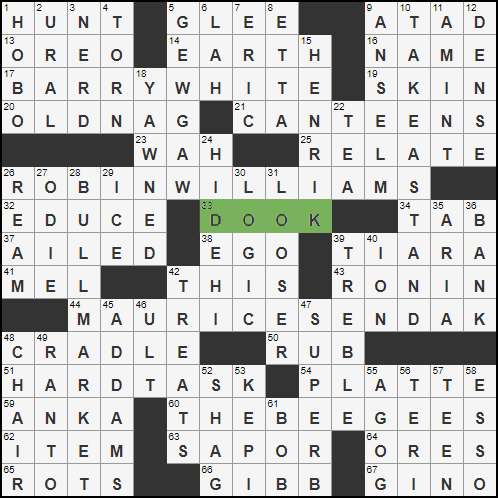
On 16 December 2014, the New York Times puzzle grid carried this answer which led to much bafflement in the solving community:

DOOK in NYT Crossword
Source: © 2014, The New York Times

The clue (33a) was "Scrape by" – but why was its solution DOOK? Solvers checked standard dictionaries and found the word unlisted; they combed through online sources and discovered the word could mean bathe or plunge, a Scottish variant of duck, a misspelling of the University in Durham, a plug, a clucking sound made by a ferret. There was nothing to support "DOOK = Scrape by" as defined in the puzzle.

Comments on NYT crossword blogs were abuzz with conversation around this mysterious word…

…till someone pointed out that DOOK is not "dook", DOOK is "do OK".

No Enumeration, Cause of Confusion

In the New York Times crossword, solution lengths are not stated. The total count of cells to be filled for each clue is evident from the grid, but the clue does not tell you if its answer is a (4) or a (1-3) or a (2,2). This property was used to fantastic effect in the 1996 NYT Election Day crossword; this property also led to the DOOK confusion.

DOOK as Crossword Jargon

Since the time it was first noticed, DOOK has become a blog shorthand for words placed together in the grid (typically parts of a multi-word answer) that can be misinterpreted.

DOOKS do not normally affect British cryptics except in the rare case of enumeration errors: Guardian 24032 – what does doordie mean?

Usage examples:
"I'm nominating DOOORDIE for DOOK of the year." [source]
Comment on puzzle Give Me Some Space, in which one had to insert spaces in themed clues (GOON –> GO ON, NOTABLE –> NOT ABLE, etc.) to arrive at their answers: "IT'S A DOOK PUZZLE!" [source]

Related Posts:

If you wish to keep track of further articles on Crossword Unclued, you can subscribe to it in a reader via RSS Feed. You can also subscribe by email and have articles delivered to your inbox, or follow me on twitter to get notified of new links.

Wednesday, 2 December 2015

Song: Crossword Puzzle (Starting Here, Starting Now)

A crossword solver tells us in song why the words in the Sunday Times puzzle elude her today. The song is "Crossword Puzzle" from the 1977 off-Broadway musical revue Starting Here, Starting Now.

Watch a rendition by Jennie McGuinness:


[RSS/email subscribers – please visit the blog to watch the video]

In true cryptic tradition, this song isn't what it seems at the start – the simple act of filling words into the grid slowly and fitfully reveals a tale of melancholy and anger. The lyrics are also extremely clever in playing upon word meanings when the solver's musings segue into the clues.

But of course. The theatre director/lyricist Richard Maltby Jr. of Starting Here, Starting Now is also a cryptic crossword setter - he has been creating puzzles for Harper's Magazine since 1976 and for New York magazine before that. The Nation has an interesting interview with him, in which he talks of commonalities between cryptic crossword setting and lyric writing.

I think there is a connection between cryptic puzzle and lyrics. Lyric writing involves the technical manipulation of language. You have to say what you want in exactly the right syllables and often with the accents or emphasis predetermined. Lyricists therefore become acutely aware of the intricacies of words, their multiple meanings, their diversity of definitions, pronunciations, spelling.

"Crossword Puzzle" song lyrics:

I am sitting here doing the Sunday Times crossword puzzle, somehow the words won't come.
I am staring at squares, but my eyes never focus and my mind's feeling strangely numb.

What's a five letter word meaning...here's an example...2 Down: "A Peruvian poison dart."
Why, when Hecky and me used to breeze through the puzzle, on Sundays, the answer would leap in my harte....[i]
-beest. That's a GNU. [ii]
G N U. boo-boopy doo.

Where is Hecky now? Ha! He ran off with some floozy on a boat bound for warmer climes.
And he left me here doing the crossword puzzle in the Sunday ...[iii]

All the times we had fun here, when more often than not.
He'd say, "Hon, what's a pustule?" And I'd say "It's a BLOT."
He'd say, "Af-ghan-i nomad". And I'd say, "It's a KURD."
I'd let him hold the pencil, he could write in the word.

And when he was having trouble spelling TRYST... T R Y S T,
I showed him, how I showed him...23 Across: "Lover (archaic)"...AMORIST!
A M O R I S T Blank!"

I am sitting here doing the Sunday Times crossword puzzle, somehow the words won't come.
Can you figure it, me with my splendid vocabulary, maybe I should play dumb

What's a four letter word meaning "Why should it happen to us"? There was never a moment's doubt
All at once Hecky's jumping and screaming and yelling...I tell you the four letter words that came out!
Prefix! That means pro
P R O, poly ole dough

Starts you feeling as if having brains or intelligence was one of the world's worst crimes,
And the sentence is doing the crossword puzzle in the Sunday ...[iv]
All the times Hecky'd tell me , "You shut up, this I'll get -
seven blanks meaning airhole, it's FISTULA I bet"
I'd say, "No." He'd say, "Don't tell me. It's TUBULUS...
TU-BU-LU…"
I'd say, "Hecky, its CHIMNEY."
Hecky'd sit down and cry.

Perhaps that's why I'm left here on the shelf
Perhaps he wanted to get the long ones by himself.
38 Across: "She carries a torch"
Statue of Liberty S T A T U E O F L I B E R T Y
Y, Y , why, why, why, why, why, why?

I am sitting here doing the Sunday Times crossword puzzle, and I know why the words won't come.
'Cause my mind is miles off on a boat to Bermuda with an ignorant lousy crumb
What's a five letter word meaning "Phi Beta Kappa". That's me. I'm as bright as a girl can be. 
So bright someone else who could not tell a fig from a frigate is off with my Hecky at sea… [v]
-bird." That's an AUK.
A U K. Auk!

If I weren't so dumb, I'd be spending this Sunday in a church hearing wedding chimes,
And I'd never remember there was a puzzle in the Sunday Times.


[i] 'harte' is a homophone of 'heart' which matches the sense of the sentence
[ii] However, hartebeest is not a gnu; wildebeest is ...
[iii] 'Times' is the unspoken word, rhyming with 'climes'; 'time' is used in the next line
[iv] 'Times' is the unspoken word, rhyming with 'crimes'; 'time' is used in the next line
[v] 'sea' continues in the next line in a different context

Many versions of the "Crossword Puzzle" song are available online, others I liked: by Loni Ackerman (from the original cast of Starting Here, Starting Now), by Danielle McCully.

Thanks to Kishore for discovering this song, typing out the lyrics and telling me about it.

PS: What's with all the cultural messaging against shared solving with your significant other? In the Crossword Puzzle song, Hecky abandons this solver. In the story Old Love (A Quiver Full of Arrows), the husband commits suicide due to a crossword clue!

Related Posts:

If you wish to keep track of further articles on Crossword Unclued, you can subscribe to it in a reader via RSS Feed. You can also subscribe by email and have articles delivered to your inbox, or follow me on twitter to get notified of new links.

Tuesday, 30 June 2015

Parallels Between Cryptanalysis and Crossword Solving

Fialka Cipher Machine During World War II, recruiters for Bletchley Park had looked for crossword solvers to join them, as it was believed that crossword experts would be good codebreakers. [The story is that in 1942, a challenge was issued to solve a Daily Telegraph crossword in under 12 minutes. Shortlisted candidates were invited for a live crossword test, after which six solvers were recruited.]

Bletchley Park's successes during the war proved that their crossword-inclined hiring policy worked. But have you wondered if this correlation was incidental? Interestingly, NSA's chief cryptologist William Friedman might have wondered so – in the treatise Military Cryptanalysis (originally dated 1938, 4th Edition dated 1952), under the heading "Mental equipment necessary for cryptanalytic work", he made a strong case against correlating cryptanalysis with crossword solving.

The present author deems it advisable to add that the kind of work involved in solving cryptograms is not at all similar to that involved in solving crossword puzzles, for example. The wide vogue the latter have had and continue to have is due to the appeal they make to the quite common interest in mysteries of one sort or another; but in solving a crossword puzzle there is usually no necessity for performing any preliminary labor, and palpable results become evident after the first minute or two of attention.

He went on to elaborate on the points of difference between the two skills (section I, p2).

Now try this: exclude that specific warning and replace 'cryptanalytic' with 'crossword solving', 'cryptogram' with 'puzzle', etc. in the manual's description of the "mental equipment". Do you also see that large excerpts of the text could pass off as a guide for crossword solvers?

I was especially struck with these parallels while reading Simon Singh's The Code Book, a narrative about the evolution of cryptography. In the hunt for structure and hidden meanings in text, in the battle of wits between codemakers and codebreakers, the similarities between cryptanalysis and crossword solving are hard to miss. A few examples of cryptanalytic techniques and their crossword parallels:

Frequency analysis

Every letter of a language has distinct character. The frequency with which the letter appears in text, the way it positions itself with respect to other letters in the alphabet, the types of letter clusters it appears in – all make the letter uniquely identifiable.

The frequency distribution of letters (singly or in sequences), a powerful tool for cracking substitution ciphers, has similar applicability in crossword solving – though we usually process this information instinctively rather than formally.

The appearance of more than one low-frequency letter (J K Q X Z) alerts the solver that the grid could be a pangram.

Longer letter sequence frequencies provide strong hints about possible answers in the crossword grid. Solvers watch for clusters like IN-, RE-, TH-, -ING, -TION in answers since they are occur commonly in English. When tackling a checked answer slot, say one that starts with ?H- or ends with -T?C, one can eliminate many letters from matching the ? because the resulting clusters do not appear in natural English words. 

Wartime cryptanalysts exploited the knowledge that certain words occur more frequently in military communication than in normal conversation. Likewise, experienced crossword solvers are well up on crosswordese and expressions typical of crosswords e.g. phrases normally used with 'your' in the real world tend to appear with ONE'S in crosswords (e.g. PUT ONE'S FOOT IN ONE'S MOUTH).

Cillies

At Bletchley Park, the term cilly was used for predictable message keys that the cryptanalyst could guess based on the radio operator's habits: for example, an operator might have the habit of using consecutive letters such as QWE on the keyboard. Another type of cilly was the repetition of a message key by an operator, presumably the initials of a loved one.

Deciphering messages based on hunches about cillies is similar to cracking crossword clues based the setter's signature style. An Anax puzzle is more penetrable if you are aware that he often disguises verbal indicators as nouns, an AfterDark puzzle might unravel faster if you look out for something special in his grid.

Cribs

Cryptanalysts used the term crib to refer to any known or suspected plaintext in an enciphered message. They would foretell cribs from the time and source of a message (e.g. a 6am message from X station would be a weather report), and this knowledge would give them a way to break the rest of the code.

Guessing a crossword's theme and possible answers based on the date and setter/publication is similar to using a suspected crib in cryptanalysis. We apply such information all the time to figure out a puzzle even before we have read any clues. Factors like an out-of-turn appearance by a setter, a special date of publication or a crossword numbering milestone, give us ideas about what to expect in the grid fills.

Vigenère Cipher with Running Key

The Vigenère Cipher with running key (i.e. key as long as the ciphertext) was considered unbreakable when it was first designed. Codebreakers soon found that this cipher too, like its predecessors, does not guarantee security if the key has structure and consists of recognizable words.

The process of breaking the Vigenère Cipher with running key goes like this: start with a crib (e.g. the), refer to the Vigenère Square to derive the key and check if the derived key looks meaningful. If it does, fill in other gaps and proceed to derive the rest of the message by alternating between the plaintext and the key. If you reach an impasse (i.e. meaningless text in either the plaintext or key), backtrack and resume on another track till you end with meaningful key as well as plaintext.

The snapshot below from The Code Book shows three routes a cryptanalyst might take to decipher a message with this approach. In the first, the plaintext is gibberish and cannot be right. The second looks possible but if we proceed on that route, it soon ends in deadlock. The last, with the plaintext string 'at the', seems the most promising – and it does turn out to be the right one.

Deciphering the Vigenère Cipher 

The cipher's plaintext is analogous to crossword answers in one direction (Across or Down), the key to its intersecting answers in the perpendicular direction. When we use a grid-centric approach to solving, we essentially do the same as cracking the Vigenère Cipher: derive answers based on factors like enumeration (e.g. 4,2,7 might be NEXT TO NOTHING), and validate that they fit into the grid generating workable crossings.

In the grid below, without glancing at the clues, one can tell that something is not right with the filled-in Down answers as this grid will end in deadlock at 14Across. At this point the solver would revise the Down answers, just as a cryptanalyst would discard the key trial if it led to such a pattern in the plaintext.

Partly Solved Grid

While cryptanalysis shares its approach with crossword solving, some forms of encipherment have shades of cryptic clueing. Navajo, for example, which was based on a native American language and formally developed for secret communication by US Marines. This language had a complex structure which made it unintelligible to anyone who did not know the rules for parsing it. The code used creative substitutions for military terms (e.g. platoons = mud clans, mortars = guns that squat), similar to lateral clue definitions. Some words that could not be translated directly to Navajo were split and encoded using a phonetic alphabet or through homophones. Nicknames were added to the Navajo lexicon to refer to nations - Australia became 'Rolled Hat', Spain was 'Sheep Pain' – somewhat like rhyming slang.

Related Posts:

If you wish to keep track of further articles on Crossword Unclued, you can subscribe to it in a reader via RSS Feed. You can also subscribe by email and have articles delivered to your inbox, or follow me on twitter to get notified of new links.

Tuesday, 26 May 2015

5 Works of Art Inspired by Crosswords

The sight of a crossword affects not just people like us who solve or set. The stark geometry of its grid, the passion it inspires in people who engage with it, are subjects of fascination to artists too.

A few crossword-driven works of art for you to savour, with commentary by the artists.

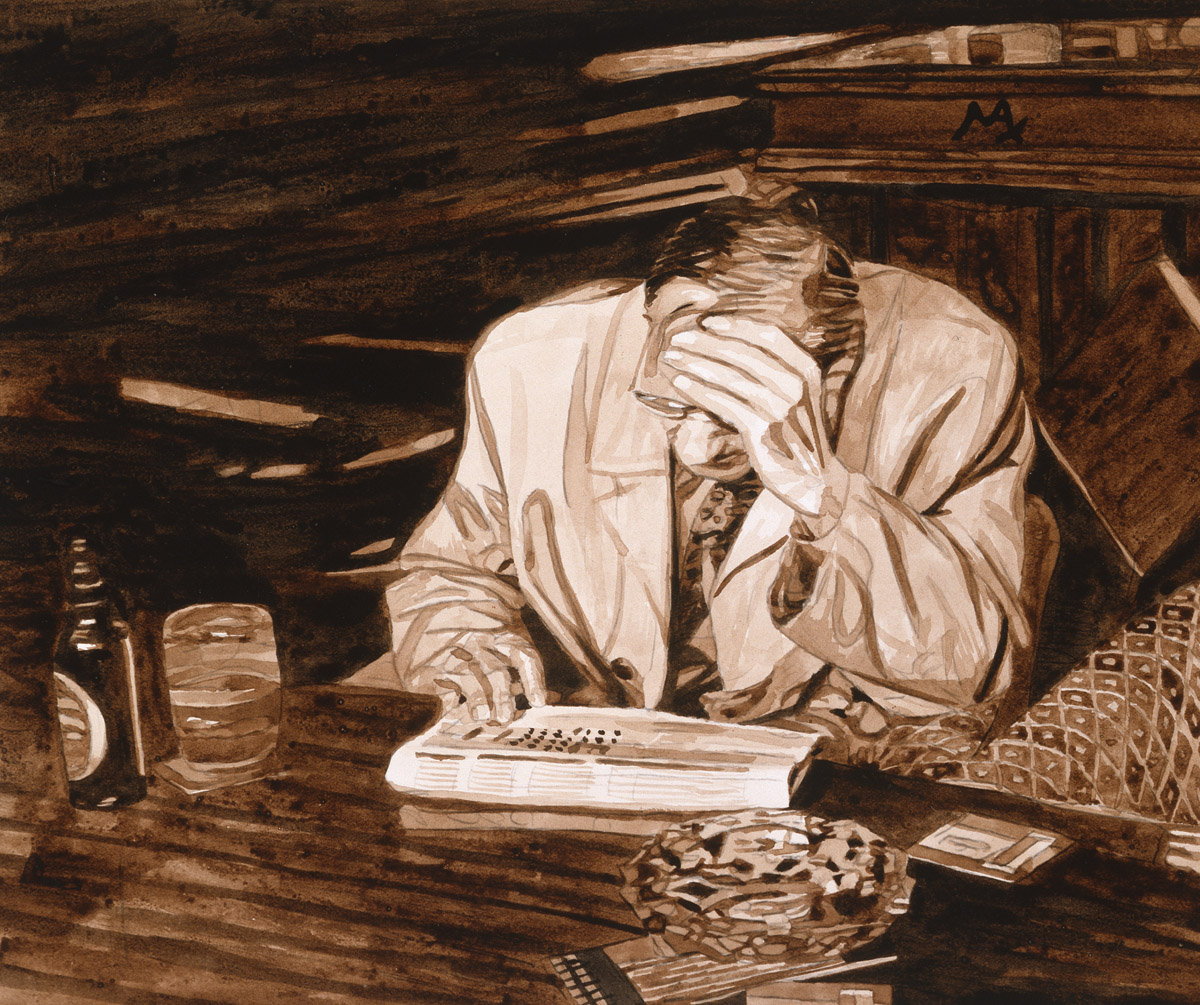
1 Crossword Puzzle [Ink wash drawing by Max Ferguson]

The scene is of a man in a pub in London, whom the artist Max Ferguson chanced upon while traveling through the city in 2004. By the look of it, the solver is battling a particularly fiendish cryptic.

Crossword Puzzle: Max Ferguson

Most of Max Ferguson's paintings are in oil paint and highly polished, with true-to-life colours. It's probably fitting that this one, centered on a crossword, is in monochrome. He says:

This was rather challenging as ink wash has to be done very quickly and is a very unforgiving medium. When I am about to begin a new piece I think about what medium / size would work well for that particular image. In this case I felt a small (10 x 12 inches) ink wash drawing would be well-suited.

This drawing is available at the time of writing this – visit Max Ferguson's site for more.

2 Crossword Puzzle with Lady in Black Coat [Gouache by Paulina Olowska]

Gouache-on-canvas artwork from Paulina Olowska​'s exhibition 'Au Bonheur des Dames' (The Ladies' Delight) at Stedelijk Museum, Amsterdam, in 2009. Photo from another angle here shows the imposing size of this work.

Crossword Puzzle with Lady in Black Coat: Paulina Olowska

A crossword person will no doubt notice the unorthodox checking and clue slot numbering of the grid. Perhaps it represents a puzzle that's not meant to be solved?

3 Dad's Crossword [Oil/linen by Duane Keiser]

Duane Keiser made this painting as part of his popular A Painting A Day project in 2013. The painting is of a Washington Post grid, which his dad solves almost everyday. As Duane puts it:

I don't think he even reads the news anymore in the paper-- he pulls out the crossword and throws the rest away.

Hands up all of you who do the same? [My hand is raised!]

Dad's Crossword: Duane Keiser

This oil on linen artwork is 6 x 7 inches, almost life-sized to the actual crossword. It was sold via auction on Duane's blog. [You can request for a print here if you're interested.]

Describing the thought behind the painting, Duane says:

There are a couple of things that attracted me to this scene: in comparison to the now ubiquitous digital media, newsprint has a kind of warmth and intimacy to it now. I zoomed in close to the subject to give a sense of being lost in concentration while the outside world momentarily disappears. Lastly, I liked the calligraphic aspects of the marks and the geometry of the crossword juxtaposed with the curves of the glasses.

It was a challenge to keep the structure of the crossword but not get bogged down in unnecessary detail. I was mostly interested in the visual rhythm of the words rather than simply copying them. You can almost read the words, but not quite - it is what you'd see if you glanced at it.

4 Crossword Tools [Oil painting by Sarah Lytle]

Coffee, reading glasses, and a pen – 'crossword tools' as the artist calls them. Sarah Lytle is not a coffee drinker or a crossword person (she prefers the Sudoku!) – this painting was prompted by her mother's tools of choice. Sarah describes her mother as a crossword fan who can solve the hardest of puzzles.

She must have her glasses, her morning coffee and her pen. I can see her sitting at the breakfast table or curled up in the chair, glasses perched on her nose, newspaper folded in half to the puzzle, working away. It makes me smile thinking about it.

Crossword Tools: Sarah Lytle

This 8 x 8 inch painting was made wet-on-wet (alla prima, meaning 'at first attempt' in Italian). 'Crossword Tools' is sold already, but you can reach out to Sarah for commissioned work.

5 Red Tomatoes on Crossword Puzzle [Watercolour by Carolyn Watson]

At artist Carolyin Watson's home, garden tomatoes were laid out on newspaper on the floor to ripen, when she was struck by the contrast of the red over black-and-white.

I loved the way the red of the tomatoes was reflected into the shadows and how the black of the newsprint was darker in the shadow.

This led to a series of watercolors of vegetables placed over crosswords.

Tomatoes on Crossword: Carolyn Watson 

These tomatoes eclipse the clues too, in making the grid fills: VINE, RIPE, HOME, GROWN, TOMATO - and the US-style grid gives neat placeholders for the words on the left hand side.

Another interesting painting from the series is Red Peppers on Crossword, which looks as if someone abandoned solving midway and started doodling on the grid instead.

The originals are sold, but you can buy prints and request for commissioned originals of the peppers on crossword with customized grid fills.

Related Posts:

If you wish to keep track of further articles on Crossword Unclued, you can subscribe to it in a reader via RSS Feed. You can also subscribe by email and have articles delivered to your inbox, or follow me on twitter to get notified of new links.

Friday, 27 March 2015

A Puzzling Difference Between Crossword Solvers and Non-Solvers

Why don't we do a crossword puzzle. It'll only take us five minutes. Or, in your case, six.

– says Joan Clarke to Alan Turing in the 2014 film The Imitation Game.The Imitation Game

Something about the dialogue between these wonderful solvers seemed off to me.

People who solve crosswords call it 'crossword' or 'puzzle' in conversation.
People who call it 'crossword puzzle' are usually those who don't solve crosswords.

Is this an Indian thing? Would seasoned solvers elsewhere, when they get together, talk of 'crossword puzzles' instead of 'crosswords'?

Or has the lingo changed with time, just as 'crossword' gets shortened to 'crossie' among the younger Indian solvers nowadays?

An online search shows interesting evidence.

On Alan Connor's Guardian Crossword blog, the term 'crossword puzzle' appears either when emphasizing a difference from other types of puzzles, or when quoting from non-crossword sources: e.g. an announcement on The Imitation Game publicity puzzle, an excerpt from the script of The American President, a crossword story in Orlando Sentinel. Elsewhere it is 'crossword' or 'puzzle', sometimes 'cryptics' in the plural.

In this Will Shortz interview on Bitter Lawyer (a non-crossword legal humour site), the interviewer uses the term 'crossword puzzle' in a question, but Will Shortz responds with 'crossword' or 'puzzle'. In another interview with him, this one on Wordplay (NYT crossword blog), neither interviewer nor interviewee says 'crossword puzzle' except when referring to ACPT.

In a crossword-focused Q&A with David Kwong (crossword consultant for The Imitation Game), the only time he uses the expression 'crossword puzzle' is when he quotes from the film's script - “[Alan,] you just defeated Nazism with a crossword puzzle".

So, do you do 'crosswords' or 'crossword puzzles'? How do you refer to them when you talk to other crossword people?

Related Posts:

If you wish to keep track of further articles on Crossword Unclued, you can subscribe to it in a reader via RSS Feed. You can also subscribe by email and have articles delivered to your inbox, or follow me on twitter to get notified of new links.

Sunday, 30 November 2014

Some Offbeat Crossword-Themed Gift Ideas

When you look for a crossword-themed gift, you probably pick a crossword book. That's a fine choice, one you can't go much wrong with - but if you want to try something unconventional, here are a few interesting options.

[Links to Amazon will give me a 5% referral benefit if you buy through my link. The price for you will remain the same.]

Related Posts:

If you wish to keep track of further articles on Crossword Unclued, you can subscribe to it in a reader via RSS Feed. You can also subscribe by email and have articles delivered to your inbox, or follow me on twitter to get notified of new links.

Monday, 17 November 2014

Crossword Bloggers' Jargon – Decoded!

crossword-bloggers-jargon-decoded New to crossword blogs and forums? Some of the conversation happening there might appear more cryptic than the clues. This post will help you interpret what the regulars are saying. Enjoy participating!

Anagrind, Anagrist

Anagrind stands for anagram indicator. The letters that get jumbled to give the solution in an anagram clue are called anagram fodder, or anagrist.

Usage examples:
"Last in was ANGOSTURA, perhaps the cleverest clue in the crossword; it was ingenious to use 'turns' as anagrist rather than anagrind." [source]
"I never heard of it either, and I'd also have spelt THINGAMABOB differently but for the anagrist." [source]

For further reading: But Which is the Anagrind?

Anno

A term popular among Indian solvers, anno is short for "annotation" i.e. the explanation of wordplay in a cryptic clue. A solver who blogs about a puzzle's solution presents the anno along with each answer.

Usage examples:
"Though I got through this one in a jiffy I'm unable to get some of the annos." [source]
"Anno pending" [source] - typically put next to a clue's solution on the blog, if the clue has been answered but the parsing is unclear. This is an invitation for the commenters to provided the parsing.

For further reading: Clue Annotation Shortcodes

Biff

To biff is to enter a clue's answer from the definition without fully understanding its parsing. The term originated in Jan 2015 as BIFD (acronym of Bunged In From Definition) in a comment on Times for the Times blog. BIFD later morphed into 'biffed'.

Usage examples:
"As soon as I read 1dn I thought of BELLYACHING but I didn't have any checkers and didn't want to biff it that early into the solve." [source]
"...had trouble with 7 because I biffed LARGO, beware biffing!" [source]

Checkers or Crossers

Short for checking letters or crossing letters – those letters that are revealed in a clue's answer because of the filled cells from intersecting clues in the grid.

Usage examples:
"A very pleasant puzzle with two excellent fifteen letter anagrams to give you a lot of checkers!" [source]
"5 and 26 were last in, new to me but gettable with crossers." [source]

For further reading: Crossword Grid: Checking, Cold Solving

COD or COTD

"Clue Of The Day" – what the solver hails as the best clue of a crossword.

Usage examples:
"DISPATCH is my COD for the devious surface that had nothing to do with the final answer." [source]
"I do find that my last-in (or nearly) is so often my COD." [source]

COD can also stand for Concise Oxford Dictionary, as in "rare isn’t apparently given in Chambers or the COD but is no doubt somewhere" [source]

CRS

Clue annotation shortcode for "Cockney Rhyming Slang", usually seen in the solution explanation on British crossword blogs.

Usage examples:
"PRATFALL = TAR rev + F all in PAL (china - CRS) + L" [source]
"We are usually given the CRS and expected to use the literal meaning, rather than the other way around as here." [source]

For further reading: Demystifying Clue Annotation Shortcodes

DBE

"Definition By Example" - a type of wordplay in which the clue contains not a synonym, but an example or sub-type, of the answer.

Usage examples:
"Presumably the question mark is intended to cover the DBE." [source]
"...I considered and rejected early on the possibility that "bowler" might give HAT: I was sure such a clear DBE would have to be indicated in the Times." [source]

In clue wordplay, DBE can also mean Dame of the British Empire.

DNF

The situation of not having completed the crossword. Acronym of "Did Not Finish".

Usage examples:
"Failed on 'neodymium' and 'algonkin', so a DNF for me today. If anyone complains that the puzzle was too easy, I’ll consider taking up knitting." [source]
"Is it still a technical DNF if you resort to aids and the aids don't help and then you get the answer anyway?" [source]

Enu

Another term popular among Indian solvers, enu is short for "enumeration" i.e. the length of a clue's solution. When the solution is a phrase or contains hyphenated words, the enu indicates the word breakup too e.g. (6-4) for ANIMAL-LIKE, (2,3,4,2) for AS YOU LIKE IT.

Usage examples:
"I don’t go with the thinking that giving the enu as (2-7) would be a dead giveaway." [source]
"When it is an acronym such as Nato, pronounceable as a word, the enu might be 4. But when it is say, NDTV, where every letter is pronounced the enu must be 1,1,1,1." [source]

FIB or FITB

"Fill In the Blank(s)", a clue type in which a sentence/phrase - usually a line of poetry or a famous quote - acts as the clue, with word(s) blanked out to indicate the answer. The acronym is mostly used by The Hindu Crossword solvers, perhaps because this clue type is rarely seen in other crosswords nowadays.

Usage examples:
"A FITB clue to complete a quote from Shakespeare or Chaucer might be easy for those into them, but horribly hard for people like me." [source]
"Not a single CD in sight! (Barring the FITB.)" [source]

LOI

"Last One In" - refers to the final answer that a solver entered into the grid. LOI is usually mentioned when there was a special struggle involved in solving that last clue. As you'd guess, the opposite of LOI is FOI (First One In).

Usage examples:
"LOI was 10A - the shortest words can be the hardest, if there isn't too much to work with on the surface!" [source]
"For some reason I needed all the checkers for my LOI…" [source]

Nina

A hidden message within a pattern of cells in the completed crossword grid. Read more at What is a Nina?

Usage examples:
"No theme, but there is a devilishly clever Nina hiding where you wouldn’t expect it." [source]
"I suspected a Nina from the start from the shape of the grid and esp as some answers had less than 50% checking." [source]

For further reading: Possibly the oldest Nina

"n" Magoos, "x" Tonies, etc.

On Times for the Times (T4tT) blog, it is customary for solvers to mention the time they took to finish the crossword. The Times Crossword Club leaderboard lists the stats for each puzzle, which means that any solver can benchmark their play against the fastest solvers.

T4tT bloggers have come up with nifty units to measure relative solving speed: the most popularly used is a Magoo – the time taken by Times crossword champion  Mark Goodliffe to finish the crossword. Instead of quoting absolute time as, say, "26 minutes 55 seconds", a solver could say "2.4 Magoos". Similarly, a tony is the time taken by Tony Sever to finish the crossword, a keriothe the time taken by Keriothe.

Usage examples:
"Five tonies for me (or three keriothes), and in my terms that's very good." [source]
"…clock stopped at 18:17, which was well outside my daily target of 2 Magoos" [source]

PB

Short for "Personal Best" – the fastest time/highest score achieved by a solver.

Usage examples:
"This was perhaps the easiest daily crossword I have ever done…I expect a lot of fast times, several PBs and not a few less than gruntled regulars." [source]
"my time was 11:48. I'm sure this must be a PB if measured in Magoos." [source]

Note: sometimes PB can stand for the initials of another person on the forum e.g. when the Sunday Times blogger says "Many thanks, first of all, to PB for letting me have an advance copy of this puzzle" – the thanks are meant for the Sunday Times crossword editor.

PDM

The beautiful "Penny-Drop Moment" when the workings of an elusive clue or theme suddenly become clear to the solver. Often used in the context of crosswords with interlinked clues, in which the PDM gives the key to the theme.

Usage examples:
"I was struggling to see how it worked, and it was only on coming to write up the blog that I had the pdm" [source]
"I proceeded through the puzzle with increasing incredulity at the seemingly lost opportunity until the huge PDM at my penultimate entry at 14ac." [source]

Samosa

A metaphor for the joy a solver (especially a new solver) experiences in finishing the crossword. Used on The Hindu Crossword Corner (THCC), ever since solver Gayathri Sreekanth celebrated a completed grid by eating samosas.

Also conveys that the crossword was easy - where a blogger on T4tT would say "I expect several PBs today", one on THCC might say "A samosa feast today!".

Usage examples:
"No samosa for me today as I'm stumped for some annos :-(" [source] - technically, DNF = No samosa
"I have lost 3 samosas in the last few days for being careless" [source]

Unch

An unchecked letter in the crossword grid. Read more at Crossword Grid: Checking.

Usage examples:
"Read round the unches from the bottom left in the two ways to the top right to get the Nina." [source]
"I can't see any message in the unches or the diagonal, but I have this nagging feeling that I've missed something." [source]

Xim

Short for Ximenean. The terms comes up in discussions on the accuracy or fairness of a clue.

Usage examples:
"The perception is that Xims and Libs stand in opposite trenches which, to me, is a shame." [source]
"As well as being an Indyist he’s also in the Times, and you can’t get away with too many ‘in-deedisms’ on that pro-Xim panel." [source]

For further reading: in-deedism, Of Ximeneans and Libertarians

Related Posts:

If you wish to keep track of further articles on Crossword Unclued, you can subscribe to it in a reader via RSS Feed. You can also subscribe by email and have articles delivered to your inbox, or follow me on twitter to get notified of new links.

Tuesday, 16 September 2014

Unlikely Movie Characters as Potential Crossword Setters

Unlikely Moviiew Characters as Potential Crossword Setters There are times when, while watching a movie, we find a character say something that prompts us to think – here's someone with the makings of a cryptic crossword setter. This character need not be in the mould of a glib-tongued Bond; s/he may be a person ordinary within the film's framework who lets out an unexpected flash of lexical wizardry.

Some such characters from movies I've seen.

1. Lata Srivastav, Chupke Chupke (1975) 

Lata Srivastav, potential crossword setter

Why her?
Lata asks Vasudha why the man has given her a ring with the letter 'S' on it, when her initial is 'V'. The exchange between them:

Vasudha: Wo mera naam hai na Vasudha, V-A-S-..., wo S hai.
Lata: Wo S nahin, tu ass hai.
Rough translation:
Vasudha: That's from my name Vasudha, V-A-S-..., that's the S (pronounced 'ass').
Lata: That's not the S, you are the ass.

Wordplay type demonstrated: Homophone

2. Gru, Despicable Me 2 (2013)

Gru, potential crossword setter

Why him?
Gru resists being arm-twisted into an undercover job for the Anti-Villain League (AVL), and takes his leave from the head of the league with these words:

Gru: Good day, Mr. Sheepsbutt.
Silas Ramsbottom (AVL head): Ramsbottom.
Gru: Oh, yeah, like that's any better.

Wordplay type demonstrated: Charade

3. Inspector YP Singh, Raja Natwarlal (2014)

YP Singh, potential crossword setters

Why him?
This policeman's mission in life is seemingly not just to nab Raja, but to craft all possible cryptic clues around the word CON. Not a chance for crossword-style wordplay slips by when he's around.

Example 1:

Heroine (answering her phone): Hello? Kaun?
Policeman: Con! Con hi to karne gaye ho wahan tum log.
Rough translation:
Heroine: Hello? Kaun (Who's that)?
Policeman: Yes, you've gone there for a con.

Wordplay type demonstrated: Bilingual homophone

Example 2:

Heroine: Wo ek chhota-mota contractor hai.
Policeman: Contractor! CONTRACTOR mein se TRACTOR uda de. Kya bacha? Con!
Rough translation:
Heroine: He is a small-time contractor.
Policeman: Contractor! Strike out from CONTRACTOR the word TRACTOR and see what you get. Con!

Wordplay type demonstrated: Deletion

4. Meeta Sen, Anubhav (1971)

Meeta Sen, potential crossword setter

Why her?
In the song Mujhe Jaan Na Kaho Meri Jaan, Meeta Sen asks her husband not to call her jaan (beloved), with this rationale:

Jaan na kaho anjaan mujhe, jaan kahan rahti hai sadaa
Anjaane, kya jaanein, jaan ke jaaye kaun bhala
Rough translation:
Don't call me jaan (beloved), anjaan (ignorant one) - jaan (life) does not last forever
Anjaane (naive people) kya jaanein (do not know any better), nobody departs jaan ke (on purpose)

In true cryptic crossword tradition, when the word jaan appears multiple times in the opening line, the hearer does not know that the one of the jaans refers literally to life. The cryptic reading is revealed only a little later. The meaning of jaan keeps switching fluidly from 'life' to 'beloved' to 'know' and the hearer has to keep up with the shifts to make sense of the song.

Wordplay type demonstrated: Multiple Definitions 

5. Danish, Shamitabh (2015)

Shamitabh, Name Wordplay

Why him?
Aspiring actor Danish is speech-impaired, but with the help of "voice transfer" technology, he manages to speak in the voice of another man (Amitabh Sinha) and lands a big role in a Hindi film. He is then asked to choose a screen name. Danish picks the name "Shamitabh", and explains his choice in a way that would do a pro setter proud.

(i) Shamitabh is hidden within 'DaniSH + AMITABH Sinha'
(ii) Shamitabh is a charade of SH (silent) + Amitabh, which implies that behind the mute front stands the voice-lender

Wordplay type(s) demonstrated: Hidden Word, Charade with Cryptic Abbreviation

---
Over to you. Can you add to the list?

PS: In case you missed the memo - an Open Magazine feature about cryptic crossword solvers in India: The High of Hidden Words.

Related Posts:

If you wish to keep track of further articles on Crossword Unclued, you can subscribe to it in a reader via RSS Feed. You can also subscribe by email and have articles delivered to your inbox, or follow me on twitter to get notified of new links.

Thursday, 7 November 2013

The 2500 Clue Challenge

2500_clue_challenge How many crossword clues have you solved this year?

At least one among us can answer that question straight off the bat. Daniel Peake, a 27-year old meteorologist in UK, pledged that he would solve 2500 clues of the Guardian weekday cryptic crossword in 2013, a target that he has been tracking meticulously throughout the year. His progress report is available online in a spreadsheet with detailed statistics of solves and misses, along with aggregated information such as graphs by setter and day of week. His flickr stream shows his hand-written attempt at each weekday Guardian cryptic.

Why this challenge, and why 2500 and not any other number? Daniel says the figure of 2500 was worked out after a couple of test weeks back in 2012. He calculated that his average was about 8 or 9 clues a day, making the target of 2500 clues over 261 weekday crosswords, something he could aim for if he performed at the upper end of his solving ability.

Dan is following a set of rules in the process, such as a clue split over multiple entries in the grid is counted as one, no solving aids are allowed except Bradford's Crossword Dictionary, and the clues have to be solved within the date of publication.

The purpose of the 2500 Clue Challenge is to raise money for Rethink, a mental health charity that provides support for people who suffer from mental health issues, and helps research into the underlying causes and new therapies to deal with them. Dan says:

I want to promote awareness of depression as it's something I suffer with and has quite a taboo marked against it. I want to tell people it's ok to feel sad, and there are things that you can do to help yourself (even if you don't know what they are). The more we can understand depression and mental illnesses, the better we can deal with them.

Dan finds that his ability to think and solve is related to how happy he is - if he is feeling low he finds it harder to think and ends up with fewer clues solved. On better days, he solves more even though he spends roughly a similar amount of time everyday trying to solve clues. The variations are visible in his progress report – there's a 1/28 score at one end of the spectrum, a whopping 32/33 on another. He finds Puck and Enigmatist the hardest setters to tackle, and Brendan the 'easiest' (although still not easy, he adds!) He enjoys themed crosswords the most, specially those in which a word is repeated across many clues.

At the time of writing this post, Dan is about two days behind schedule and trying to make the ground back up. Cheer him on, and if you would like to contribute to Rethink, head over to http://www.justgiving.com/danielpeake2500.

DanielPeake_600
Daniel Peake with his gallery of Guardian crossword clippings.

Solve These

Dan's favourite clues from October 2013:

Guardian 26073 (Picaroon): Time, an hour after midnight, to get music and liqueur (3,5) T__ _____
Guardian 26076 (Arachne): Put new gloss on a Pinter play? (7) R______
Guardian 26084 (Brendan): Fashionable judgment shown by doctor on a lot of points (5,5) _____ S____

Related Posts:

If you wish to keep track of further articles on Crossword Unclued, you can subscribe to it in a reader via RSS Feed. You can also subscribe by email and have articles delivered to your inbox, or follow me on twitter to get notified of new links.

Friday, 19 October 2012

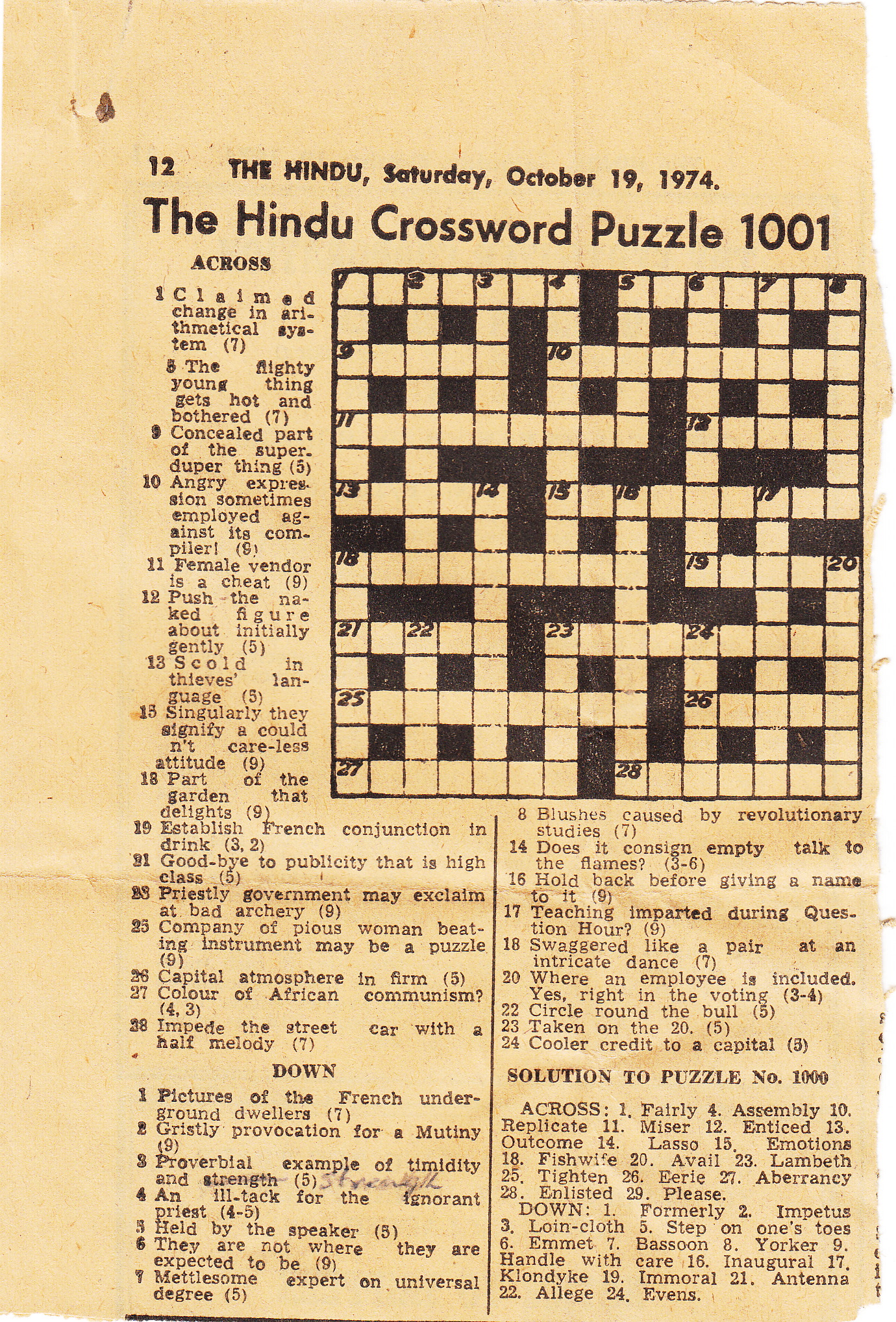
The Hindu Crossword 1001 [October 19, 1974]

I hope you enjoyed battling with The Hindu Crossword 1000 set by Admiral Katari, the first crossword compiler of The Hindu. Admiral Katari's family has kindly shared two of his crosswords with us, here is the second of the lot – The Hindu Crossword 1001. This crossword was originally published in The Hindu on the same date as today, exactly 38 years ago.

Interactive Across Lite version created by Chaturvasi, available here: THC 1001 Interactive.

Have fun solving. I found this slightly easier than the previous crossword. Perhaps solving one built some familiarity with the setter's style? What do you think?

[click to enlarge]

The same rules apply: enter your answers with annotations in the comments section. Max 3 answers per person.

I'll update this post with the solutions on October 22, 2012 (Monday).

Update [October 22, 2012]:

Related Posts:

If you wish to keep track of further articles on Crossword Unclued, you can subscribe to it in a reader via RSS Feed. You can also subscribe by email and have articles delivered to your inbox, or follow me on twitter to get notified of new links.

Sunday, 14 October 2012

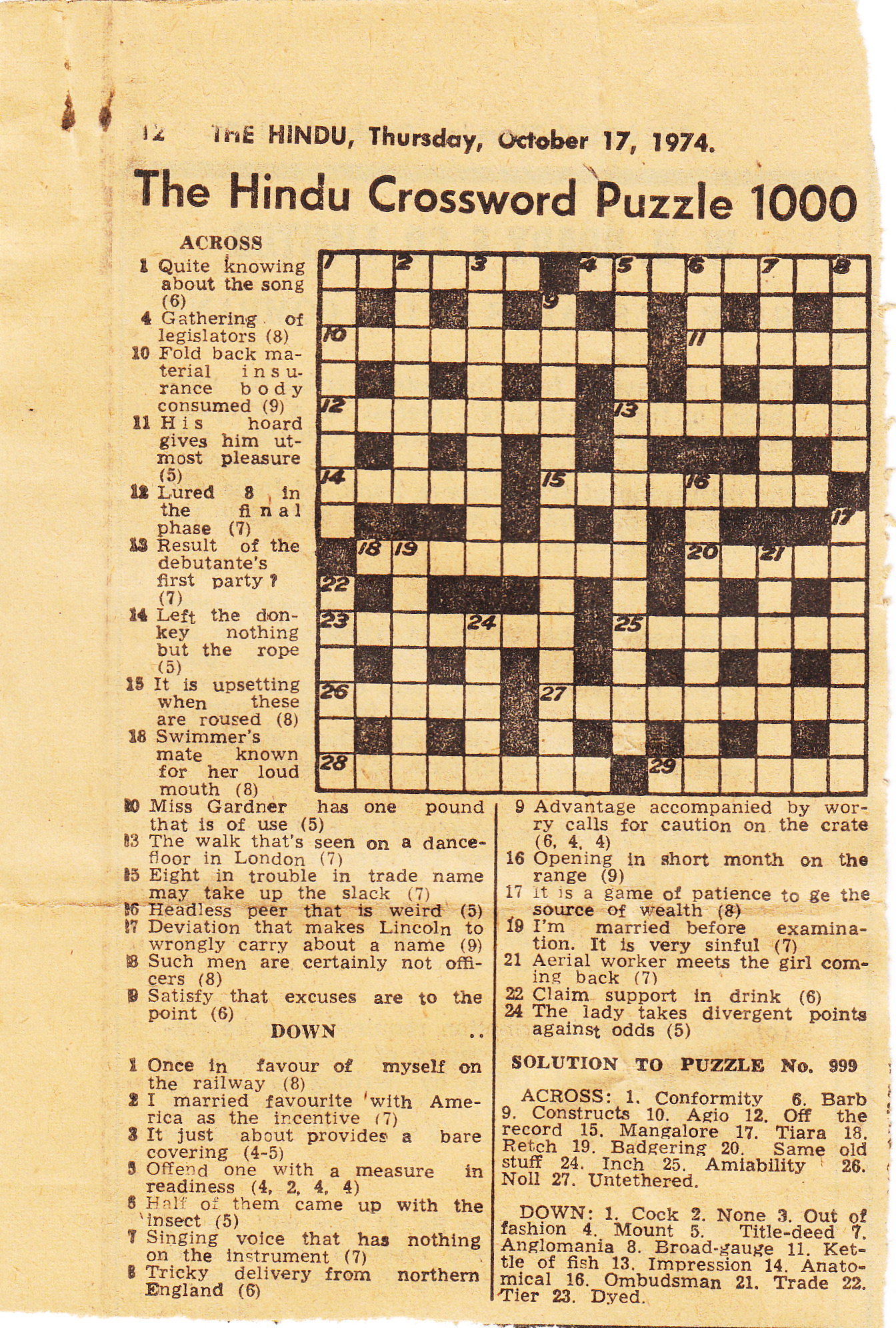
The Hindu Crossword 1000 [October 17, 1974]

As promised in my post on Admiral Katari, here is The Hindu Crossword no. 1000 set by him. This puzzle was originally published in The Hindu on October 17, 1974. Enjoy solving.

Interactive Across Lite version created by Chaturvasi, available here: THC 1000 Interactive.

Instructions: Post answers with annotations in the comments section. Max 3 answers per person.

I'll update this post with the solution grid, handwritten by Admiral Katari, on October 15, 2012 (Monday).

[click to enlarge]

Update [October 15, 2012]:

Related Posts:

If you wish to keep track of further articles on Crossword Unclued, you can subscribe to it in a reader via RSS Feed. You can also subscribe by email and have articles delivered to your inbox, or follow me on twitter to get notified of new links.

Monday, 8 October 2012

Remembering Admiral Katari, the first crossword setter of The Hindu

Plenty is written and said in the media about Admiral Ram Dass Katari's legacy as the first Indian Navy Chief. Very little is said about his legacy as the first Indian cryptic crossword setter.

On Admiral Katari's 101st birth anniversary, I dedicate this post to him for his invaluable contribution to the world of cryptic crosswords in India.

Here are some rare photographs and facts about Admiral Ram Dass Katari (1911–1983) the cruciverbalist.

[Many thanks to Admiral Katari's family Ravi Katari, Ramu & Lalita Ramdas, Tehzeeb, and friend Cmde (Rtd) Ranjit Rai for their inputs.]

1 In 1971, the then Hindu editor Gopalan Kasturi who knew Admiral Katari and his skill with crosswords suggested that he set the crossword for the paper. Admiral Katari agreed, and then discovered that setting a crossword was not as easy as it seemed. He bought some books of blanks and spent a long time practising grid creation and filling. He made his own grids by hand and was very particular that the same words and similar clues did not repeat themselves.

The Hindu Crossword grids by Admiral Katari 
Handmade grids by Admiral Katari on the left, print versions of crosswords on the right.

Print and handwritten versions of The Hindu Crossword no. 1000 
Print and handwritten versions of The Hindu Crossword no. 1000. The family recalls that Admiral Katari was inordinately tickled with this - he told them that he had managed to get hold of this crossword from the then Chief of Bureau for the Hindu, Shri GK Reddy, while on one of his visits to Delhi from Hyderabad.

2 Admiral Katari set The Hindu Crossword single-handedly and anonymously for several years after its inception. [The Hindu began to carry setters' by-lines only in 2008.] In a time when informal channels of communication were next to non-existent, very few solvers were aware of the real identity of the paper's crossword setter.

3 Since he was the only crossword setter at the time, when going away on leave for longish spells he would work fervently in the weeks before to leave a stock of puzzles with the paper and some reserve.

4 As the family rummaged through trunks and cupboards containing Admiral Katari's possessions, they discovered a battered cardboard box containing fourteen bundles of paper tied with string - each bundle containing 100 crosswords similar to the one in the picture above. This adds up to 1400 crosswords compiled and written by hand.

Admiral Katari's crossword bundle 
Discovered in a battered cardboard box: crossword bundle tied with string.

5 As a solver, his crossword of choice was the Times of India crossword, a UK-syndicated cryptic in those days. Records of his solving time are not available but his family recollects seeing the completed crossword on his desk at home in Delhi frequently.

6 An expert Scrabble player, he was clever with fitting words into connecting spots and had a huge vocabulary to draw from. When his children played against him as a twosome, a score less than 700 was hopeless.

7 Admiral Katari only used lead pencils for solving crosswords, and got very angry if anyone used a pen. He hated to see a newspaper folded over down to the crossword size!

8 When he realised in the late 1970s that he was not going to be able to continue setting crosswords, he trained a successor in Commodore Warner, also from Hyderabad, who picked up his setting style as well as his standards. Commodore Warner set the crosswords for Hindu for about three years, and in turn trained his successor in Hyderabad.

9 Crossword memorabilia, including The Hindu Crosswords 1000 and 1001, are on display at Katari Memorial Hall, A/21, Sainikpuri near Secunderabad. Some pictures from the site:

Katari Heritage Hall 
Name board at the entrance to the Katari Heritage Hall, which was inaugurated a year ago on 8th Oct 2011.

Katari Heritage Hall 
Admiral Katari's daughter Mrs. Lalita Ramdas with her son-in-law Carl Jenkins Jr. at the Katari Heritage Hall.

Admiral Katari in Burma
Admiral in Burma: closer look at the framed photo in the image above.

Crossword memorabilia on display at Katari Heritage Hall
Crossword memorabilia on display at the Katari Heritage Hall. The label reads:
The Second Retirement: 1969-83 Gold And Bridge; Crosswords For The Hindu; Mazagon Dock And Sundry Boards; Lions Club, Rotary, Sports Bodies, And Social Work

10 This anecdote isn't exactly about crosswords but I'm sure you'll enjoy it. Cmde (Rtd) Ranjit Rai, who was a cadet when Admiral Katari was the Navy Chief, recounts this incident:

Admiral Katari came to INS TIR and on inspection in his anglicised accent asked Cadet Gill, a thait Sardar, "Do you sail?"

Gill replied, "Sir, sometimes"

Gill did not sail so we said, "Why did you lie to the Chief?"

Gill said, "I thought he asked me if I shave. He is smart; he saw I trim my beard."

In closing, a closer shot of The Hindu Crossword 1000 and 1001.

The Hindu Crossword 1000 and 1001 

Coming up next: crossword set by Admiral Katari, for you to solve.

Related Posts:

If you wish to keep track of further articles on Crossword Unclued, you can subscribe to it in a reader via RSS Feed. You can also subscribe by email and have articles delivered to your inbox, or follow me on twitter to get notified of new links.