Showing posts with label advanced puzzles. Show all posts
Wednesday, 24 April 2019

Crossword Software To Make Puzzles With Multiple Letters Per Cell

In the article Crossword Grids That Hold More Than One Letter Per Cell, cryptic setter eXternal (Steve Bartlett) gave us a detailed tour of “rebus” crosswords, with tips for setting and solving such puzzles. In this article, he walks us through software that can be used to create crosswords with the many-letters-per-square gimmick.

Steve is the editor of Enigmatic Variations crossword in The Telegraph. He also sets advanced puzzles in the series of The Listener and Inquisitor, and standard cryptic puzzles for The Daily Telegraph (as proXimal), The Independent (as eXternal), Financial Times (as ARTEXLEN), The Herald (as Boz) and The National (as Claymore).

Handing over the reins to Steve for this article…thank you!

- Shuchi

It is quite simple to create a puzzle with more than one character per cell by using crossword-creating software. I will describe how to do this using Qxw, which can be downloaded for free from Quinapalus. I use this tool for all my barred puzzles and thoroughly recommend it, as it enables the setter to produce complex puzzles relatively easily.

I'll demonstrate how to use Qxw to produce puzzles with multiple letters per cell with reference to a couple of puzzles I created: one called Odd One Out in collaboration with Serpent for The Inquisitor series in The i; and one called Disappearances, which appeared in the Enigmatic Variations series in The Sunday Telegraph in 2017.

Odd One Out by eXtent

Serpent and I decided to theme a barred puzzle on Brexit. We wanted a grid which would include IVR codes of members of the EU in single cells. The number of letters in IVR codes for these members ranges between 1 and 3 — for example, Portugal is P, Czech Republic is CZ and Ireland is IRL.

Below is an outline of the grid we prepared:

Odd One Out by eXtent - The Inquisitor - Grid Outline

In order to get the three letters IRL in one cell, we needed to do the following:

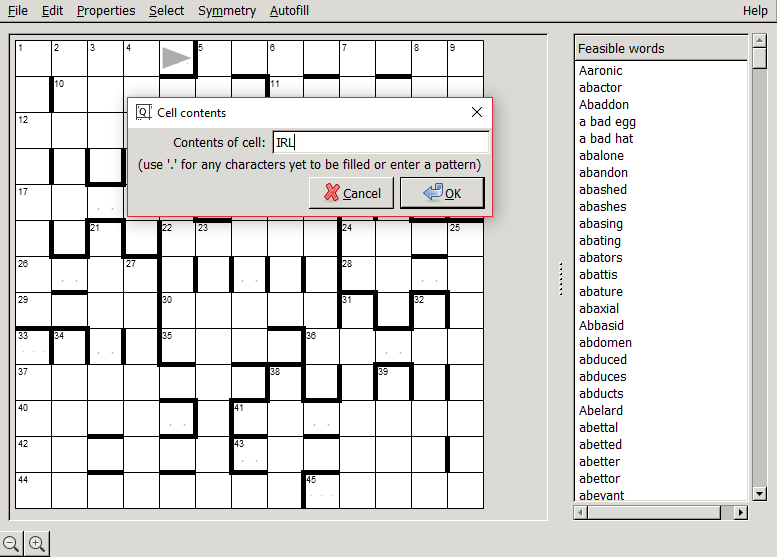
Click on Edit — Cell contents. Then just enter IRL in the dialog box.

Qxw - Edit - Cell Contents

Qxw - Edit - Cell Contents - IRL

Qxw then suggests a number of feasible entries (show in the panel on the right) for insertion.

We simply repeated this procedure for other cells around the grid for each of the two- and three-letter IVR codes. The final grid appeared as follows:

Odd One Out by eXtent - Filled Grid

A blog of the puzzle by HolyGhost at Fifteensquared can be found using this link: Inquisitor 1588: Odd One Out by eXtent.

Disappearances by proXimal

I had decided to base a puzzle on a theme of the decline or disappearance of stores from High Streets. The phrase THE HIGH STREET lends itself really well to being used in a barred crossword, as it has 13 letters and such grids are often 12x12 or 13x13. I decided to have THE HIGH STREET as a thematic unclued entry running down the central column of a 13x13, with names of shops which have disappeared produced by clashes on both sides of THE HIGH STREET. The clashes could be nicely thematically represented just by leaving the clashing cell blank, thus the stores are disappearing.

So, I started with a grid as follows:
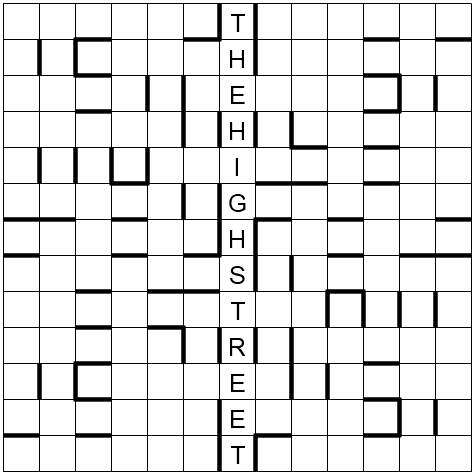
Disappearances by proXimal - THE HIGH STREET

I decided to have five shops either side of THE HIGH STREET to produce a nice range and an interesting challenge for the solver. Firstly, I searched for shops which would lend themselves easily to being divided, to be produced from clashing words using Across and Down entries, but also ones that were relatively well-known. One of the most famous which I decided to use is WOOLWORTHS, which could be split as WOOL and WORTHS.

There is a useful pattern-matching tool on the internet called Qat, designed by Quinapalus, who also developed Qxw; I used Qat to check which words could end in WORTHS and which could start with WOOL. The picture below shows the search for words ending in WORTHS (using search term *worths):
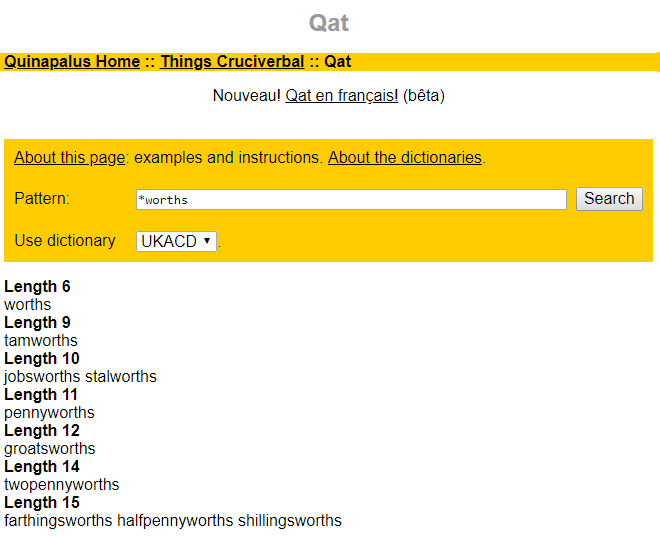
Qat - Word Pattern Search

I liked the look of JOBSWORTHS and decided to have this entry in the grid to provide a clash in the last cell of a five-cell entry; the number of words starting with WOOL, to provide the Across clash, was much higher.

Back to Qxw, I put JOBS in the entry at 27 Down with the last cell blank to accommodate WORTHS in one cell. To enable Qxw to work with clashing entries, one does the following:

1. Select the cell which you want to use (shown in yellow below), by clicking Select and then Current cell, when the cursor is in the cell.

2. Click on Properties — Selected cell properties. Then tick the box which says Override default cell properties and further down, change 'Lights intersecting here' to 'need not agree'.
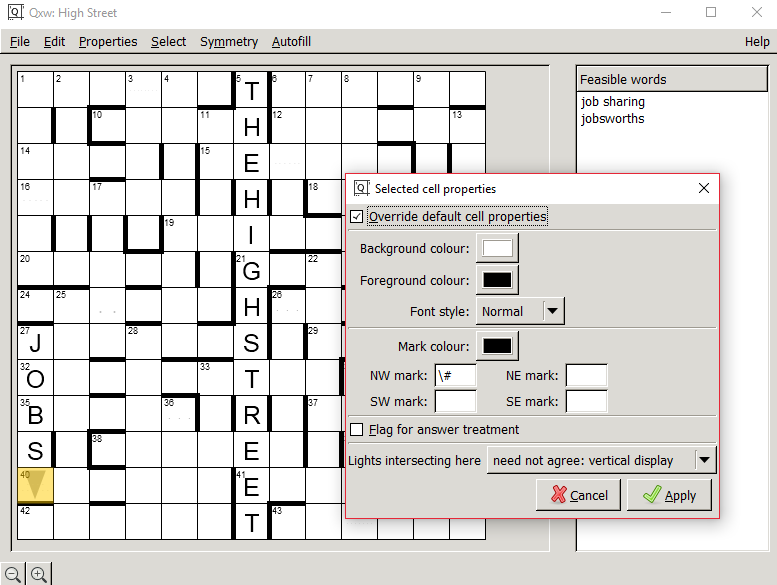
Disappearances by proXimal - Qxw - Intersecting Cells Need Not Agree

This now meant that I could specify an entry beginning with WOOL at 40 Across, with the four letters of WOOL being accommodated in the first cell, to clash with WORTHS provided by the down entry. In order to do this, the following is required:

Click on Edit — Cell contents. Because I have previously specified that the cell can accommodate clashes, a box appears which allows us to enter multiple letters for the Across and Down entries meeting in this cell.

Disappearances by proXimal - Cell Contents

Hence, once I had specified that the contents of the cell for the Across entry should be WOOL, Qxw provides me with a number of feasible entries: WOOLDINGS, WOOLFELLS, WOOLIEST, WOOLPACKS, WOOLSHEDS, WOOLWORTH.

I then repeated the same process in various cells around the grid to accommodate the nine other shops. The completed grid appeared as follows:
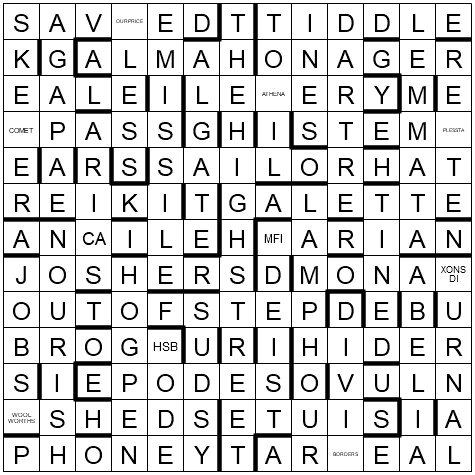
Disappearances by proXimal - Filled Grid

So, for example, SKEETER at 1 Down clashes with COMPASS at 16 Across to create COMET. In this puzzle I also wanted to have real words left when the clashing cells were deleted, so the deletion of the COMET clash would leave words SKEER and PASS in the final grid.

A blog of the puzzle by Dave Hennings at Fifteensquared can be found using this link: Enigmatic Variations No. 1296: Disappearances by proXimal.

Related Posts:

If you wish to keep track of further articles on Crossword Unclued, you can subscribe to it in a reader via RSS Feed. You can also subscribe by email and have articles delivered to your inbox, or follow me on twitter to get notified of new links.

Monday, 12 November 2018

Crossword Grids That Hold More Than One Letter Per Cell

This NYT Wordplay article Yes, You Can Write More Than One Letter in a Square and an ensuing twitter discussion got me to discover some fascinating grid-fill gimmicks used in advanced cryptics. One such is to set aside the one-letter-per-cell norm that we take as a given in blocked grid puzzles.

The word or group of letters that goes inside a single cell is called a "rebus". [Long ago, rebuses were probably "squashwords" – more on that later in the article.]

If the idea of many-letters-per-cell is new to you, then you're probably brimming with questions at this point. When did this trick originate? How does the setter go about crafting a puzzle with rebuses? What should the solver do to crack such a puzzle?

Cryptic setter eXternal (Steve Bartlett) offers us insights into these questions. In this article, he looks at the history and development of puzzles in which individual cells contain more than one letter, and supplements his research with rare images of decades-old puzzles.

Steve sets advanced puzzles in the series of The Listener, Inquisitor and Enigmatic Variations. In addition, he sets standard cryptic puzzles for The Daily Telegraph (as proXimal), The Independent (as eXternal), Financial Times (as ARTEXLEN), The Herald (as Boz) and The National (as Claymore).

Note: The article primarily uses Listener examples, for consistency and because it has the longest history of the barred series.

Over to you, Steve.

- Shuchi

Many Letters in a Square: Dive into History

1. Listener (1950): #1047 Space Saver by Babs
    Compressed repetitions; LILO = LI/O

Here is a Listener crossword and solution from 1950, one of the oldest-known crosswords to employ the many-letters-per-square trick.

Listener 1047 Space Saver by Babs
[click #1047 to enlarge]

The preamble of the puzzle states that only half the number of squares is to be used for each answer, hence an answer of four letters has a light containing only two squares.

For example, the answer to 1 Across:
Refuse the odd bits (8)
is RIFF-RAFF. This to be entered in four cells as R,I/A,F,F, with the I and A sharing the same cell, divided with a slash.

This crosses with 2 Down:
Disinfectant used to make Eliza ladylike (4)
in which the answer IZAL is hidden in 'Eliza ladylike' and entered as I/A,Z/L, using just two cells for the entry.

Listener 1047 Space Saver Solution

The preamble gives several examples of how the answers should be entered, to help the solver understand this unusual entry method.

Grid Fill Examples in Preamble

2. Listener (1951): #1118 One or Two. by Stephanus  
    Random distribution: one letter in a cell or two

A Listener crossword from the following year, 1951, uses a simpler concept. A short preamble merely states that a 'space' contains either one or two letters.

Listener 1118 One or Two Stephanus
[click #1118 to enlarge]

For example, the answer to 5 Across:
Post of Prometheus' hope - and fateful pain? (8)
DELIVERY is entered as DE/LI/V/E/R/Y, in six squares.

This crosses with 6 Down:
What's put the L in AIR? A tree, at least (6)
in which the answer LINDEN (L in DEN) is entered as LI/N/DE/N in four squares.

Interestingly, the solution notes allow an alternative, as the V of DELIVERY and N of LINDEN are unchecked, meaning that DE/L/IV/E/R/Y and L/IN/D/E/N would be equally valid. We seldom see such ambiguities in today's barred crosswords.

Listener 1118 Solution

3. Listener (1961): #1640 Three-in-hand by ffancy
    Alphabetical sum

This example hails from a decade later, 1961. The puzzle has a complicated preamble to explain that each square accommodates three letters. This puzzle uses a gimmick commonly seen in modern barred puzzles, where Across and Down answers clash. Cell entries are derived from the letters of clashing Across and Down answers and the alphabetical sum of these two letters.

Listener 1640 Three-in-Hand
[click #1640 to enlarge]

For example, 1 Across CRACKER clashes with 1 Down KILDERKIN in the first cell. K and C are written in corners of this cell, with the sum C(3)+K(11)=N(14) in the centre.

1640-Solution

A further point to note is that, unlike the previous examples, the 1961 puzzle is thematic. The solution leads to a quote on diagonals from cell 11 — PLEASE TO REMEMBER THE FIFTH OF NOVEMBER etc., using the central cell entries derived from the clashing letters.

So far, the examples have not attempted to coin a term for this particular genre. They merely describe in the preamble what needs to be done to solve and fill the grid.

4. The (Almost) Impossible Crossword Book (1984)
    The name’s Squashword

The next example is from Gyles Brandreth's The (Almost) Impossible Crossword Book (1984), with the actual puzzle probably dating much earlier.

Shared Squares by Convar - Squashwords

Beside the title, appears the line, 'Shared Squares is a squashword'. This might lead us to believe that there was once such a term in usage for puzzles where squares contain more than one letter.

5. Listener (1998): #3479 Belt Up by MynoT
    Symbols for Clashes

The next example is from 1998, after The Listener crossword had moved to its current home in The Times.

3479 Listener Belt Up by MynoT
[click #3479 to enlarge]

Here the clashes are generated using more than one letter contributed from crossing answers. This is typical of modern barred thematics, with the clashes resulting in a thematic word.

For example, the clue to 9 Across is:
Car's before them to perform — by the grace of god (4) DODGEM
DO + DG(Dei gratia) + 'EM

The clue to 4 Down is:
Note's small money (3) MINIM
MINI + M

Both answers are too long for the available space (6 letters for 4 cells; 5 letters for 3 cells) and clash in the crossing cell, with the clash of GEM from DOD/GEM and INI from M/INI/M to give GEMINI, entered as the sign of the zodiac.

Aside from the entry lengths (rather than answer lengths) being given, we can also note that there is no reference to clashes in the very short preamble. The solver must deduce the fact that some answer are overlong and therefore clash.

Listener 1998-10-03 #3482 Belt Up Solution

6. Listener (2002): #3673 Journey by Gioconda
    Abbreviations for Clashes

The final example comes from 2002 and has four entries sometimes clashing in one cell. As opposed to the previous example, answer lengths rather than entry lengths are provided.

Listener 3673 Journey by Giconda
[click #3673 to enlarge]

In this puzzle, 2 Across has four clues but only two lights. The solver can thus deduce that the first two clues will clash somewhere in the first light and the second pair will clash somewhere in the second light.

The first light of 2 Across is made up of 6 cells, but the answers to the first two clues have lengths of 5 and 7 = 12. Therefore, there will be a clash of 7 letters in one cell along that light.

The first two clues of 2 Across are:
Endless joke about half clad women (5) JADES
JES{t} around AD

Amount of water in pool crushed a dog-pen (7) PONDAGE
A DOGPEN*

Therefore, we have JADESPONDAGE to enter in the first light of 2 Across. We can see that DESPOND is a likely 7-letter candidate to be the clash in the third cell.

Then, we look at the Down clues on the column where the large clash from 2 Across occurs, ie column E. The first two clues in column E have answer lengths of 3 and 8 = 11, but a light length of only 4. Therefore, a clash of 8 letters will occur. The first two clues of column E are:

Court Henry with soft centre (3) HOF
H+{s}OF{t}

Cast off sledge bearing frightened Hugo (8) SLOUGHED
SL(HUGO*)ED

Therefore, we have HOFSLOUGHED to enter in the first down light in column E. The clash occurs in the second cell down, the same location as the clash in the across light, providing OFSLOUGH as the contribution to the clash. This is how the solver arrives at SLOUGH OF DESPOND, to be abbreviated as SOD as instructed by the preamble.

Listener 2002-06-29 #3673 Solution

Clashes from multiple entries form places visited by Christian in The Pilgrim's Progress.

This is only a tiny overview of the multitude of ways in which setters have used this gimmick over the past 70 or more years. The puzzles where clashes of more than one letter spell out thematic words or names are particularly common and are often used to set the theme in advance of a further endgame which needs resolving.

Tips for many-letters-per-cell setters

In addition to the generic dos and don'ts of cryptic setting, be mindful of the following points when creating a crossword with more than one letter per cell.

1. Keep an eye on checking

Remember that overlong entry clashes reduce the amount of checking in the puzzle. It is more helpful to the solver if you minimise the proportion of the answer which clashes, or apply some technique to offset the effects of reduced checking.

As an example, take a theme of Santa's reindeer to be produced by clashing answers. When deciding how to generate DANCER, a nice 50/50 split of DAN/CER could be achieved with DAN/GEROUSLY and NECROMAN/CER (~27% clashing). The solver will have more help with checking from cells already populated than using, say, DAN/DY and UL/CER (~60% clashing).

You can also offset the effects of reduced checking by offering easier clues for those answers that might otherwise be troublesome for the solver – for example, through whole anagrams or hidden words.

2. Decide: Answer lengths or number of squares?

When setting many-letters-per-cell puzzle, you have a decision to make about clue enumeration: should you give the lengths of answers or the number of squares available for each entry?

If answer lengths are given, the solver has more guidance as to which answers are likely to clash. For example, in the clashing entries for DANCER to appear (see above), the number of cells needed to enter NECROMAN/CER will be 9, but the answer length is 11. Hence if the setter decides to give the answer length (11), the solver knows this is a clashing entry, as the number of available cells is fewer than the answer length.

It is a lot more common to provide entry lengths (ie number of available cells), so that the solver has to work out which are the gimmick clues.

3. Represent the clashes elegantly

Finally, you also need to decide how the clashes are to be represented in the grid. It is a little inelegant and fiddly to expect the solver to enter a seven-letter word, say, in a single cell.

Solutions to the problem could be for the solver to insert a symbol, abbreviation, first letter of answer or to leave the cell blank.

The method should ideally fit with the theme of the puzzle.

Tips for many-letters-per-cell solvers

From the solver's point of view, the more quickly the theme is uncovered, the easier the solve becomes. So you should be on the lookout for:

  • answers which obviously extend for longer than the given number of cells
  • likely crossing clues which could create a clash

Sometimes only a couple of clashes are needed to get an idea of what the theme might be. Once you have zeroed in on the theme, you can consider the identities of the other thematic items which might be hidden in clashes.

eXternal Steve Bartlett
My thanks to Dave Hennings, Roger Phillips and John Tozer for their help in the research for this article.

– Steve Bartlett


A follow up article will talk about using crossword software to make puzzles with multiple letters per cell. Stay tuned!

Update (25-Apr-2019): The follow-up article: Crossword Software to Make Puzzles with Many Letters per Cell.

- Shuchi

Related Posts:

If you wish to keep track of further articles on Crossword Unclued, you can subscribe to it in a reader via RSS Feed. You can also subscribe by email and have articles delivered to your inbox, or follow me on twitter to get notified of new links.

Friday, 17 July 2015

Playfair

Playfair is an encoding device used to add solving complexity to advanced cryptic crosswords.

How Playfair encoding works

Playfair encoding is based on

  • A codeword or phrase, in which no letter recurs [1]
  • A 5x5 arrangement of letters (called word square or key table)

Before encoding, the letters of the alphabet are written in the word square, starting with the codeword, combining I and J into a single unit. This arrangement accommodates 26 letters of the alphabet in a 25-character square.

For example, if the codeword is ORANGESTICK (that's the word Azed uses with instructions in his Playfair puzzles), the Playfair word square would look like this:

Playfair Word Square 

The word to be encoded in Playfair is split into letter pairs (also called digraphs). So, the word BREAKING is split as {BR, EA, KI, NG}. To each letter pair after this split, an encoding rule is applied according to its position in the word square:

  Letter Pair Position Encoding Rule
(1) Both letters are in the same row Replace them with letters one place to the right of each. If one of the letters is at the extreme right, replace it with the letter at the beginning of the row.
(2) Both letters are in the same column Replace them with letters one place below each. If one of the letters is at the bottom, replace it with the letter at the top of the column.
(3) Neither of the above Replace them with letters at diagonally opposite corners of the rectangle formed by the letter pair. [To encode the first letter, look along its row till you reach the column of the second letter; pick this letter. To encode the second letter, look along its row till you reach the column of the first letter; pick this letter.]

Example: Applying Playfair encoding on the word BREAKING, with ORANGESTICK as the codeword, we get MSTOFEGO as below. (The number in brackets stands for the letter pair position.)

Playfair Encoding  

Playfair in cryptic crosswords

Barred grid cryptics like the Azed and Listener carry Playfair puzzles occasionally – in these, a few answers are Playfair-encoded before being placed in the grid.

To finish the puzzle, the solver needs to work out the Playfair codeword. This can be done by matching the plaintext answers (found by cold-solving the clues) with the encoded answer portions (found by solving the crossing clues). With the letter pairs before and after encoding, the solver can construct the word square, which would reveal the codeword.

Azed usually invites solvers to send in a cryptic clue to the codeword, along with the prize puzzle solution.

To make things more accessible for the solver, Playfair crosswords provide a few cues:

  • Clues with encoded answers are marked in some way. They may be italicized and/or have a common theme linking them.

  • The codeword may be related to the theme of the encoded answers and/or to the title of the puzzle. For example, in Listener 3993 titled Argentum, the encoded entries were HINT, TALK, NEWS, SIGN. Note that all the encoded entries can be defined as 'word', and the puzzle title is an anagram of ARGUMENT. The codeword turned out to be MINCE WORDS.

  • Playfair-encoded entries in the grid contain no repeating letters as a pair, and have an even letter count. Since Playfair crossword rules do not mention how to resolve repeating letter pairs or a single final letter, one can safely infer that these scenarios will not arise in the crossword. (To know how this is handled in actual Playfair messages, see note [2] at the end of the post.)

  • The encoded answers are designed to be relatively easy to solve without checkers.

This blog post about Azed 2164 has helpful tips on the approach for solving a Playfair puzzle.

Why only barred grids? Can't Playfair be used with blocked grid crosswords?

The main hurdle with applying Playfair to blocked grid puzzles is low grid checking. With only about 50% interlocked cells, it would be hard for the solver to construct the word square from before/after letter pairs, since after letter pairs (i.e. those obtained from checking) would be scanty.

What if the setter gives a strong alternate route to the codeword? Say, a subset of the answers when jumbled give the codeword, or a theme derived from the clues leads to the codeword. With less reliance on checking, blocked grid Playfair puzzles might be workable – though I have not seen this done in practice so far. Perhaps there isn't enough interest in this device among blocked grid solvers, or perhaps newspapers would not be willing to allocate extra space for the long preamble necessary to explain Playfair!

History of the Playfair cipher

Playfair was invented by English scientist Charles Wheatstone (1802-1875) and named after Scottish scientist/politician Lyon Playfair (1818-1898) who popularised its use. According to Simon Singh's The Code Book, the two men were neighbours and often met to share their ideas on cryptography.

The cipher was adopted by the British War Office and used first probably in the Boer War.

In its time, Playfair was a deft, dependable way of enciphering messages. It had no elaborate key mapping to memorize or reference, no special equipment needs; the recipient could simply draw the word square based on the codeword and decrypt the message.

Playfair is not vulnerable to obvious letter frequency analysis as every letter is not encoded the same way every time in a message. The code can be broken with digraph frequency analysis, of course - a task made simpler with Playfair Breaker applications which do that for you within seconds.

Notes:

[1] In general Playfair encoding, a codeword with recurring letters *could* be chosen with some patching: by omitting repetitions before entering the codeword in the word square. So, COMMUNICATE would become COMUNIATE. I haven't come across an example of this in Playfair crosswords, though – setters seem to pick lengthy codewords with unique letters. Warning: don't rely completely on this trend – as Azed points out here: "Ximenes once, rather wickedly, used CAB, resulting in only one letter in the word square being misplaced!"

[2] The two letters in each digraph must be different for Playfair encoding to work. If a letter is repeated in a digraph, an extra X is inserted between them to resolve the repetition. So, SUNNY gets split as {SU, NX, NY} before encoding. Similarly an X is tagged to the end of a word to pair up a single final letter. So, SHADY gets split as {SH, AD, YX}.

[Many thanks to setter Alberich for his inputs for this article.]

Related Posts:

If you wish to keep track of further articles on Crossword Unclued, you can subscribe to it in a reader via RSS Feed. You can also subscribe by email and have articles delivered to your inbox, or follow me on twitter to get notified of new links.

Friday, 20 April 2012

Alphabet Jigsaw Puzzles

As promised in the post on cold-solving, here’s a closer look at a special type of cryptic crossword in which cold-solving plays a significant role - the Alphabet Jigsaw puzzle.

Buzzer This article has been written by Bhavan, also known as the setter Buzzer in The Hindu Crossword. Bhavan lives on the Gold Coast and duels daily with a variety of crosswords from the world over. From his experience of solving and recent foray into creating Alphabet Jigsaws, Bhavan shares with us tips to crack these seemingly unconquerable puzzles and gives us a view of challenges a setter might face while creating AJs, with suggestions to get around them.

What are AJs?AJ-puzzle

Alphabetic Jigsaw puzzles or AJs are typically made up of 26 clues. Each clue is labelled with a letter of the alphabet instead of a numbered slot in the grid. The answer to each clue begins with that same letter.

In a standard cryptic crossword, the solver knows from the beginning where each answer needs to be entered in the grid. In an AJ puzzle, that step also needs to be resolved by the solver, fitting the answers into the grid like in a jigsaw.

Therefore, for a solver, tackling an AJ puzzle is a double challenge and consequently a two-step process:

  1. Solving the clues like in a regular cryptic.
  2. Fitting the answers into the grid without the advantage of knowing where each answers goes.

Background

There seems to be some uncertainty about the origin of this puzzle.

AraucariaCrosswords.com says:

John Graham (Araucaria) is credited with creating this new format of crossword, the 'alphabetical jigsaw' in which the clues are labelled not with numbers but with letters which are the first letters of the solutions; when solved, the answers are to be placed "jigsaw-wise, however they may fit," though of course only one arrangement will work.

Puzzler.com says:

The AJ puzzle appeared for the first time in magazine format in the August 1973 issue of Puzzler. A version of this puzzle, created by John Galbraith Graham (Araucaria) may have appeared in The Guardian at an earlier date, but this has not been verified.

AJ puzzles are a recurring feature nowadays in many publications like The Guardian, The Financial Times, The Daily Telegraph, The Independent. A recent example is the Financial Times 2011 Christmas special by Gozo - a double AJ, in which every letter of the alphabet had two clues. CrOZworld, the magazine published by Australian Crossword Club, carries an AJ puzzle every month.

Puzzles To Try

This AJ puzzle from Puzzler is a good introduction for new solvers. The answers are in the same sheet:
Puzzler Alphabet Jigsaw

These AJ puzzles are from the Guardian, set by Araucaria:

Guardian Prize Crossword No. 25125
Guardian Prize Crossword No. 25262
Guardian Prize Crossword No. 25580

Solving Tips

As a solver encountering an AJ puzzle for the first time, some of these questions will run through your mind:

  • Is it possible that I will be able to cold-solve all the clues because there are no crossings for help?
  • Assuming I somehow accomplish that step where do I start with fitting the answers in?
  • If I can't get all the answers before I start with the jigsaw what are my options?

It looks impossible at first glance but there are few things in your favour:

  1. You have starting letters for all the clues. This is a bigger plus than you realize initially.

  2. A fair setter will ensure that the grid design allows you to try and fit some of your answers – especially the long ones. This means you will not need to cold-solve all the clues before beginning to fit them in.

  3. The minimum number of answers you need to cold-solve depends to a large extent on the shape of the grid and the number of unique length answers. It is not unusual to begin with the longest answers first.

  4. Using the letters available as a result of entering your first answer(s), you can tackle the next set of clues. As you repeat this step, your options narrow down enough to attempt any unsolved answers as well as fit them into the grid.

  5. Sometimes the puzzle will have more than 26 clues with one or more letters giving you two answers. Comparing the answer lengths for such clues with the grid, you can easily identify where they go without even having to solve them.

    As an example, if you look at the Guardian Crossword No. 25262 linked above, you will see that the letters B and J are repeated.

    Take the J clues. The answer to one is 12 letters and the other is 7. The only place in the grid where this can happen is at the very top (row 1, column 3).

    alphabet-jigsaw-1

    Similarly for the B clues with answer lengths of 7 and 5, the only slot in the grid is row 9, column 11.

    alphabet-jigsaw-2

Setter’s View

[As a budding setter, my own experience with AJ puzzles is limited, but penning down the problems I faced and the way I overcame some of them.]

As a setter creating an AJ puzzle, you’ll need to bear a few more things in mind beyond what you would with a regular cryptic.

  1. First and foremost is the grid. While the way you frame the clues themselves is only limited by your imagination, it is your job to ensure that answers have a fair distribution in terms of lengths to help the solvers with fitting them into the grid.

    Look at the first grid. No matter how fair and unambiguous your clues are, chances are your solvers will quickly abandon the puzzle after cold-solving a few clues.

    setting-alphabet-jigsaw-crossword-1

    This second grid on the other hand has a much better distribution of word lengths. The 11 letter answers give a good starting point for your solvers.

    setting-alphabet-jigsaw-crossword-2

  2. Be prepared to spend more time than your average grid fills. It is not going to be easy to find relatively non-obscure words especially with Q, X, Y, Z.

  3. Even when you finalise the words it is going to be a manual trial and error process to fit them into the grid. Software like Crossword Compiler will help you to a certain extent in terms of suggesting possible words.

  4. You can use a grid that contains more than 26 clues and still make an AJ puzzle. The excess clues give you the option to repeat some of the starting letters in your answers. That gives you some leeway in terms of trying to fit the unique answers and also allows your solvers to fix positions for some of the letters in the grid easily.

Useful Links

This article on fifteensquared discusses how to solve an AJ puzzle using Guardian 25484 (Araucaria) as an example.

Update (23rd April 2012): The Stickler (David Stickley), a setter for the Australian Crossword Club, has shared with us an AJ puzzle set by him. Solve it here. More AJ setting tips by him here.

Related Posts:

If you wish to keep track of further articles on Crossword Unclued, you can subscribe to it in a reader via RSS Feed. You can also subscribe by email and have articles delivered to your inbox, or follow me on twitter to get notified of new links.

Friday, 28 January 2011

Composite Anagrams

composite-anagram A rare clue type for blocked grid puzzles, the composite anagram (aka compound anagram) is an advanced variant of the anagram clue. In a composite anagram, you need to find the answer to the question: what can I mix with a given word or phrase, to get another given word or phrase?

Take this example:

Azed 1997: Seen this Indian tourist destination? For 'Indus a rupee, that's fantastic (7)

Read the clue in this way to solve the composite anagram:
SEEN + [a word for "this Indian tourist destination"] = (INDUS A RUPEE)*

What Indian tourist destination can you mix with SEEN, to get an anagram of INDUS A RUPEE? The solution is obviously an anagram of (INDUSARUPEE – SEEN) i.e. (IDUARUP)*, which gives you UDAIPUR.

Composite anagrams are not often seen in daily puzzles – some papers like the Times do not allow them as they are considered too complex. They are staple fare for barred grid crosswords like the Azed.

Let's try another one:

Azed 1860: Soup polished off with relish? Oh, i.e., --! (6)

Read this as:
(SOUP + RELISH)* = OH IE + [a word to fill in "—"]

What word can you mix with OHIE, to get an anagram of SOUP RELISH? (SOUPRELISH – OHIE)* i.e. (SUPRLS)*, leads you to the answer - SLURPS. An &lit clue.

How to solve a composite anagram?

Some tips:

  • Find its weakest spot – the anagram indicator.
  • Follow exactly what the clue says. Advanced cryptics balance complexity with strict rules of fairness – there won't be any superfluous words or loose wordplay.
  • Count the letters, make sure the two sides add up to equal length.
  • The definition may appear in the middle of the clue. Look for definition placeholders like "this".
  • Composite anagrams are often of &lit type – check if it works to read the whole clue as the definition.
  • Practise!

Solve These

Put the last tip into action - solve these two composite anagram clues:

Azed 1962: Live through a tough winter? This thing's unsettling (7)
Azed 1987: Yes and no? Refuse thus as on forms (4)

Related Posts:

If you wish to keep track of further articles on Crossword Unclued, you can subscribe to it in a reader via RSS Feed. You can also subscribe by email and have articles delivered to your inbox, or follow me on twitter to get notified of new links.

Monday, 16 March 2009

Barred Grid Crosswords

I have not dipped my toes into barred grid puzzles so far, but reading Peter's detailed write-up on the Azed puzzle aimed at beginners, I'm motivated to try. The post explains the clues of Azed 1919, describes barred grid puzzle conventions and gives useful tips for engaging with this advanced cryptic puzzle.

A little background for those unfamiliar with crossword grid terminology.

blocked-grid-guardian-24828 Daily newspaper crosswords like The Hindu have grids with black-and-white squares. A square that contains a letter is white, one that does not is black. Such a grid is a blocked grid.

Letters in the grid that interlock with more than one word are called checked letters. These help the solver by providing letters for crossing clues. Letters of a word that are sandwiched between black squares and do not link with other words are called unchecked letters or unches. e.g. In clue 1A in this blocked grid, every even letter is checked and odd letter unchecked.


barred-grid-azed-1919 A barred grid has white squares only; each square contains a letter. Word divisions are indicated by thick lines.

There are more checked letters in a barred grid than in a blocked grid. A consequence of this high level of checking is that it is potentially easier to work out unusual/obscure words in the solution. Advanced cryptics with complex wordplay and tough vocabulary, such as Azed and Mephisto, use the barred grid.

Azed 1919

If you have never tried Azed before, 1919 may be a good start point: it is supposed to be easier than a regular Azed, and you have Peter’s post as reference for how the clues work. You can download and print the PDF, or solve it interactively if your computer is Java-enabled.

azed-1919-pdf azed-1919-interactive

  Azed 1919: PDF Version

 Azed 1919: Interactive Version

I've taken the print and will attempt it tonight, with the Chambers dictionary by my side.

Related Posts:

If you wish to keep track of further articles on Crossword Unclued, you can subscribe to it in a reader via RSS Feed. You can also subscribe by email and have articles delivered to your inbox, or follow me on twitter to get notified of new links.