Showing posts with label wordplay. Show all posts
Thursday, 28 April 2016

Definition/Wordplay Etymology Crossover

Definition Wordplay Etymology CrossoverTake a close look at this clue:

Away from home, in the open, dies in battle (7) OUTSIDE
OUT (in the open) (DIES)*; Definition: away from home

The etymology of OUTSIDE is OUT + SIDE, so the clue partly recycles the definition of OUTSIDE in its wordplay OUT (DIES)*.

Try another:

What's used as a religious setting on a piece of furniture (7) RETABLE
RE (on) TABLE (piece of furniture); definition: what's used as a religious setting

The word RETABLE originates from medieval Latin retrotabulum which stands for 'rear table'. In this clue's wordplay, RETABLE splits along its natural etymological join (RE+TABLE), with TABLE retaining its furniture meaning.

Both of those clues show signs of definition/wordplay etymology crossover.

Understanding "definition/wordplay etymology crossover"

When the wordplay of a cryptic clue is etymologically related to its answer, it is a case of definition/wordplay etymology crossover.

You have a definition/wordplay etymology crossover on hand if:

  • The answer is SPACESHIP, the wordplay is SPACE + SHIP
  • The answer is LULLABY, the wordplay is LULL + [b]ABY
  • The answer is MECHANIC, the wordplay is (MACHINE)* + C
  • The answer is ENCLOSES, the wordplay is mEN CLOSE Something [T]

Is this wrong?

In double definition clues, it is widely accepted as good clueing practice to avoid etymology crossover between the two definitions. The same isn't universally followed with other clue types.

In his CU interview, David Stickley mentioned the "no definition/wordplay etymology crossover" rule as applicable to US cryptics, while being acceptable as a setter's tool in UK and Australia. I notice though that some setters of UK cryptics too avoid this device.

In his blog, Australian setter David Astle calls out such clues as "hookworms" in round-ups of weakly constructed clues.

Definition/wordplay etyomology crossover often results in wordplay that is not very cryptic. Crafting a smooth surface exacts less imagination from the setter when the wordplay echoes the definition.

What do you think?

Fine or flawed – what's your take?

Solve These

Three words, two clues for each word: one with definition/wordplay etymology crossover, the other without. Enjoy solving and spotting which one.

Rampant war arising always without peacekeepers (7)
One's taken flight to travel across the Channel (7)

Gangster abandoning accepted rule (4)
Turned on by jolly type (4)

Lost hour of sleep's restored (8)
To expect little is being negative (8)

[Thanks to setter Aakash Sridhar (Axe/Exa) for contributing all the clues for this post.]

Related Posts:

If you wish to keep track of further articles on Crossword Unclued, you can subscribe to it in a reader via RSS Feed. You can also subscribe by email and have articles delivered to your inbox, or follow me on twitter to get notified of new links.

Monday, 25 April 2016

&Lit Clues That Do Not Deceive

andLit Clues That Do Not DeceiveOne of the hallmarks of a strong cryptic clue is a misleading definition. Some definitions are so creatively done that they stick long after one has solved the puzzle.

Guardian 26720 (Arachne): Part of autumn operation employs army swimmers (9) OCTOPUSES
OCT (part of autumn) OP (operation) USES (employs); definition: army swimmers

An important component that helps with disguising the definition is the alternate route to the answer. In the OCTOPUSES clue, "...autumn operation employs..." primes the solver to think of "army" of the military kind, steering the mind away from the "arm-y" interpretation.

Camouflage of this sort can be very challenging to execute in an &lit / semi-&lit clue. No alternate route exists in this clue type to contribute to surface misdirection. Additional constraints are at play: besides being accurate, the definition must also coincide with the wordplay without coming across as forced.

As a result, often, the &lit definition ends up being so direct it can be solved as a straight clue.

Independent 9103 (Klingsor): This country abuts Russia's borders in east (7) UKRAINE   
UK (this country) R[ussi]A IN E

THC 11583 (Vulcan): That which manages dirty clothes at home (7,7) WASHING MACHINE
(WHICH MANAGES)* around IN (at home); semi-&lit

The clues above are solvable from the surface meaning alone. As self-contained definitions, they are absolutely brilliant. But as cryptic clues, they do not venture to deceive.

Solvers: Do you notice a lack of misdirection in &lit clues?
Setters: When you write an &lit clue, do you keep an eye on the obviousness of the definition?

If, for the sake of a good &lit, the setter has to sacrifice one element out of accuracy / surface sense / deception – I guess it is wisest to let go of deception!

I leave you with a couple of &lit-type clues that work beautifully without giving away the answer:

FT 14737 (Alberich): A tall tree tumbles, trapping one? That will do (10) ALLITERATE
(A TALL TREE)* around I; D-by-E semi-&lit

Sunday Times 4650 (Dean Mayer): One trusted to get "creative" with books? (3,7) ART STUDENT
A (one) (TRUSTED)* NT (books)

Solve These

Enjoy solving these lovely &lit clues notwithstanding the straightish definitions.

Indy 8031 (Dac): In this, one may be flung out of car hitting tree (5)
FT14828 (Alberich): Lad regularly plunging into water, after small round object? (5,5)
Clue by Rufus: Make hale? (4)

Related Posts:

If you wish to keep track of further articles on Crossword Unclued, you can subscribe to it in a reader via RSS Feed. You can also subscribe by email and have articles delivered to your inbox, or follow me on twitter to get notified of new links.

Friday, 17 April 2015

Elementary Deceptions

As chemistry taught us, every chemical element has a unique symbol, a short character representation usually derived from the element's name. Fe = Iron (from Latin ferrum), O = oxygen, K = potassium (from Latin kalium) are a few popular examples.

Elements Periodic Table

Element name <-> symbol substitution forms the basis of some ingenious wordplay in crosswords.

Chemical elements whose names coincide with other meaningful words fit beautifully into cryptic clues. For example, 'lead' isn't just a metal - it can, among other things, stand for 'leash' or 'precedence' or a verb meaning 'guide'. Similarly, 'tin' can be can, 'copper' a policeman, 'iron' a verb about the pressing of clothes. The non-element meaning can misdirect the solver on the clue's surface while the element symbol contributes to the answer.

Sunday Indy 1292 (eXternal): Female's accepting lead on family film, new actress (7) HEPBURN
HER (female's) around Pb (lead) on U (family film, from the U certificate) N (new)

FT14789 (Io): Take 7Up out of tin at all? (4) EVER
R (recipe, take) + SEVEN 'out of tin' i.e. without Sn, with 'Up' implying reversal.

Further jugglery can happen with the element name <-> symbol substitution:

Sunday Times 4486 (Tim Moorey): Restrain dog with the small part of lead (4) CURB
CUR (dog) b (the small part of 'lead' i.e. the lowercase letter of 'Pb')

Sometimes, in place of the element name, a broader definition can get used.

FT14642 (Mudd): Precious thing, wind, in summer (6) AUGUST
Au (precious thing – the symbol for gold) GUST (wind)

Times 25065: Most curious split appearing back on shiny metal (4) AGOG
GO (split) reversed, after Ag (shiny metal – the symbol for silver)

Uppercase Illusions

What's more devilish is the use of the element symbol on the clue's surface when it happens to match another unrelated English word.

Guardian 25872 (Arachne): I have supper after ten (6) IODINE
DINE (have supper) after 10 (ten). The personal pronoun is also the chemical symbol for iodine.

Guardian 25818 (Paul): At sea, Titan at sea (8) ASTATINE
(SEA TITAN)*. 'At' is also the chemical symbol for astatine.

The initial capital of the chemical symbol poses a hurdle in clue-writing: since false lowercasing is not OK, the clue cannot say "at" when it means "At" for Astatine. The workaround is to make the initcap of the chemical symbol look like an inconspicuous punctuation-driven uppercase.

A D-by-E that uses this trick with two such symbols:

Guardian 24730 (Arachne): They're essential. Am I? (8) ELEMENTS
Am and I are examples of elements: Am is americium, and I iodine.

Other such words to watch out for: As = arsenic, He = helium. But don't rule out yet element symbols that by themselves mean nothing, as the setter can do this:

FT 13938 (Crux): Pub's empty – could indicate some kind of poisoning (4) LEAD
Empty 'Pub' = Pb, the symbol for lead. And then there's lead poisoning.

Solve These

Enjoy solving these cryptic crossword clues that play on element names and symbols.

Times 24143: Lead put into gold (two billion) in only a bit of a lather! (4,6)
Times 25767: He, I, and then you, we hear, occupying leadership position (6)
Guardian 26234 (Arachne): White copper put black boy in cell without clothes (3,4)
Indy 8817 (Monk): Tough guy possibly viewed as female? (4,3)
Indy 8847 (Anax): As is one kind bearing malice, running after the man (8,7)

Also try this Guardian puzzle by Brendan, themed on chemical elements. And see the blog on FT14457 by Loroso (the crossword is no longer available on the FT site), in which all the Across clues have an element symbol omitted from the wordplay.

Related Posts:

If you wish to keep track of further articles on Crossword Unclued, you can subscribe to it in a reader via RSS Feed. You can also subscribe by email and have articles delivered to your inbox, or follow me on twitter to get notified of new links.

Tuesday, 30 December 2014

My Top Ten Clues 2014

Top Ten Crossword Clues 2014 My pick of ten outstanding clues from 2014. Which clues were your favourites this year?

Guardian 26373 (Nutmeg): Like Mum and Dad, I complain vigorously about doctor (11) P__________

FT 14737 (Alberich): A tall tree tumbles, trapping one? That will do (10) A_________

Times 25800: Bodywork with bumper off finally exposed (8) W______T

Guardian 26295 (Pasquale): Embarrassed about sexes sitting next to each other, ensconced on sofa? (5) C____

Sun Times 4605 (Dean Mayer): Put too much money into space travel, do I? I must be mad (15) O______________

Clue by Mohsin @ 1ACross: (twelfth of seventy-eight) + (fourth of five) + (eighth of eighteen) (3) 

Azed CWC 2170 (T.C.Borland): Utter it leaving terminal in Tokyo Narita? (8) S_______

Times 25906: Flying Gulf Air, one goes into Economy? (6)

FT 14778 (Redshank): Somehow deflecting praise, suppressing ego (4-11)

Guardian 26182 (Paul): Intercepting express, criminal is armed, one holding up a train (10) B_________

Best wishes to you for 2015 – have a fantastic new year!

[Answers next week.]

Related Posts:

If you wish to keep track of further articles on Crossword Unclued, you can subscribe to it in a reader via RSS Feed. You can also subscribe by email and have articles delivered to your inbox, or follow me on twitter to get notified of new links.

Friday, 19 December 2014

Fill In The Blanks

Fill In The Blank Clues In a good cryptic clue, the surface is a standalone piece of prose with a real-world/relatable meaning. But you will occasionally come across this exception: a surface containing blank(s), which need to be filled based on the clue's answer to become meaningful.

A fill-in-the-blanks (FITB) clue prompts the solver to supply the missing chunk that, when inserted into the blank(s), makes its surface sense complete. The missing chunk is generally indicated with a series of underscores.

Example 1:
FT 13284 (Viking): Solemn? Yes, if rendered ____ (9) MONEYLESS
The clue works on the anagram (rendering) of (SOLEMN YES)*.
One would understandably be solemn if rendered moneyless, as the surface says when the answer is plugged into the blank.

Sometimes it isn't directly the clue's answer that completes the surface, but wordplay associated with it.

Example 2:
Guardian 24043 (Paul): Successful author's ____ in it, you might say! (7) ROWLING
The answer is the successful author Rowling, but the word that goes into the blank is its homophone (indicated by 'you might say') 'rolling'.

Solve These

A few fill-in-the-blank clues for you to relish.

THC 11176 (xChequer): Seek charity at home because that's where it should _____? (5)

[From Tim Moorey's book] If one cold toe is numb, two must be ____ (4,6)

TIB16 (Diogenes): Naughtily ogle at her when model's caught in the ____ ? (10)

Guardian 25488 (Araucaria): "Bedtime: that's all ____" — no love this time (9) F________

Guardian 26051 (Paul):  Though analogue isn't a poisoner ___ ? (9) D________

Related Posts:

If you wish to keep track of further articles on Crossword Unclued, you can subscribe to it in a reader via RSS Feed. You can also subscribe by email and have articles delivered to your inbox, or follow me on twitter to get notified of new links.

Friday, 31 October 2014

Spooner Camouflage

Spooner TwistedFor a crossword setter, spoonerisms are extremely hard to hide – the telltale indicator "Spooner" gives the game away. A direct reference to Reverend Spooner, to whom this wordplay device owes its name, cannot be avoided in this clue type.

And so the wily setter uses a different ruse to confuse the solver. Since the word "Spooner" in a clue primes the solver to think of the spoonerism clue type,  the setter turns that expectation on its head by placing the word in clues that do not contain spoonerisms.

Enjoy a few examples of "Spooner" used in deceptive ways.

Times 24992: Spooner's helping in hospital circles, to make us well (3,6) ___ __R___

Times 24894: Spooner’s confused about one term for an insidious killer (8) _O______

Guardian 25962 (Boatman): Spooner's starting to say joints are a problem with cold (6) _N____

A puzzle by Radler on Alberich's site, in which Across clues employ the word "Spooner" in a variety of devices.

Related Posts:

If you wish to keep track of further articles on Crossword Unclued, you can subscribe to it in a reader via RSS Feed. You can also subscribe by email and have articles delivered to your inbox, or follow me on twitter to get notified of new links.

Thursday, 25 September 2014

Really Well Hidden Long Answers

telescopic-clue-type-long-answers Cryptic clues with hidden answers are perhaps the trickiest for the crossword setter to disguise. Since all the letters of the answer have to be given out to the solver, in the sequence expected, the clue can end up being too easy. And so, most often, setters reserve the use of this clue type for short words as they are more convenient to conceal in the clue.

Embedding long answers in a clue is quite a feat – the fodder tends to cut across multiple words but it has to be inconspicuous, the clue surface has to be meaningful, the hidden word indicator has to be fair without letting out instantly that the solution is stashed inside the clue.

Sharing some exceptional clues using the hidden clue type, in which long answers span across multiple words of the fodder.

Times 25538: Academic rose, condemning boxing in an instant (11)

THC 11161 (Buzzer): Burst and tore as one keeping fit (5,2,6)

Times 25900: Henceforth, ATM at terminal — at the centre, indeed  (3,4,6)

Guardian 25260 (Boatman): Railhead activity leads to accident — rain mention­ed in covering letters (11)

Guardian 26158 (Paul): Nevadan died in Montana, dog buried there (6,7)

Tim Moorey's How To Master The Times Crossword quotes this as possibly the longest hidden clue ever:

Times: As seen in jab, reach of pro miserably failing to meet expectations (6,2,7)

Related Posts:

If you wish to keep track of further articles on Crossword Unclued, you can subscribe to it in a reader via RSS Feed. You can also subscribe by email and have articles delivered to your inbox, or follow me on twitter to get notified of new links.

Thursday, 4 September 2014

Alphabetic Letter Names in Crosswords

letter-names Every letter of the English alphabet has a "letter name". Vowel names are the same as the letters they represent, consonant names are usually <consonant>EE (e.g. B = BEE, C = CEE) or E<consonant> (e.g. F = EF, M = EM).

Though a letter naming standard exists, its practical usage in the real world is limited to scenarios like saying the alphabet aloud, answering queries of the form "how do you spell PHNOM PENH", or creating rhymes/songs. In the cryptic world, on the other hand, the possibilities of letter name usage are rich.

Clue Examples

Letter names like BEE (B) and GEE (G) are also dictionary words with other independent meanings, and can be used on a clue's surface with interesting results.

Guardian 24893 (Pasquale): Alert old maid, possibly as bee-keeper (9) OBSERVANT
O (old) SERVANT (maid), keeping i.e. containing B (bee)

Letter names can provide wordplay options that the simple letter would not.

Guardian 25704 (Puck): Leading lady's letter to the papers (7) EMPRESS
EM (letter M) PRESS (the papers)

Guardian 26076 (Arachne): Wrongly use double ef in "defiled" (8) BEFOULED
(DOUBLE EF)*

The longer ones can be used for grid fill.

Times Cryptic 4524 (Dean Mayer): Start to write the letter (3) WYE
W[rite] YE (the)

Sometimes, an unusual clue comes along with the letter on the surface and its name in the answer.

Guardian 26240 (Qaos): Writer who claims S, perhaps, equals T? (8) ESSAYIST
ES (letter S) + SAY (perhaps) + IS T

The Letter Name Reference Table

A reference list of names for all the letters of the English alphabet, from the Chambers dictionary

Letter Code Word
A a
B bee
C cee, see
D dee
E e
F ef
G gee
H aitch
I i
J jay
K kay
L el
M em
Letter Code Word
N en
O o
P pee
Q cue
R ar
S es, ess
T tee
U u
V vee
W double-u, double-you
X ex
Y wye
Z zee, zed, izzard

A closely matching list from the OED is on Wikipedia.

Notes:

1. A wise crossword setter would use letter name substitution sparingly, as this device can easily slip into charade overdose territory.

2. If you've wondered why there isn't consistency in the naming of consonants (why should D = DEE and not ED, or M = EM and not MEE?), the reason can be traced back to Latin letter naming system, in which stop consonants were named <consonant>EE, sonorants and fricatives took the form E<consonant>. This link offers more insights.

Solve These

Guardian 25900 (Philistine): A desire or aspiration (5)
Times 23937: Disney character after rest moved casually (7)
Times Club Monthly 20145: Innocent follower of ex (X) in action? (4-4)

Related Posts:

If you wish to keep track of further articles on Crossword Unclued, you can subscribe to it in a reader via RSS Feed. You can also subscribe by email and have articles delivered to your inbox, or follow me on twitter to get notified of new links.

Monday, 14 July 2014

Writing Easy Clues is not Easy: A Behind-The-Scenes Report

easy-crossword-clues [Last week, Anax posted this delightful clue on twitter:

    It should ensure dental health in the future (also in the past) (10)

The answer, as you've probably worked out, is TOOTHPASTE: TOO (also) + TH(PAST)E. With its explanatory definition and undisguised wordplay, the clue is the kind that'd get solved at sight by a seasoned solver.

So the clue is easy, but it is no less elegant for that. Look at the way the cryptic elements come together in an expressive surface, how the phrases "in the future" and "in the past" balance each other.

It is not easy to write an easy clue, says Anax. Read on for more from him on the topic. – Shuchi]

Much has been written (or at least I've banged on about it myself often enough) about the common novice setter mistake of equating 'hard' to 'good' when it comes to clue-writing, but it's rather hard to explain how a good easy clue should be written.

Anagrams and hidden answers are usually a logical place to start, but most commercial outlets set limits on the number of each which is permitted in a single puzzle and, in any case, clever use of wordplay indicators can make even the most obvious clue deceptively tricky. For me there are two elements/approaches to easy clue-writing:

  1. When breaking the answer down into components – charade, container etc – going with the first idea that jumps out.
  2. Not disguising everything. A part of the answer may be AND, OR, IN, HAS etc; there's no harm in presenting these elements exactly as they are.

We might also consider brevity and/or using only the simplest of wordplay indicators, but these have their own pitfalls. A brief clue isn't necessarily easy and, while simple wordplay indicators are fine, the results can be rather crosswordy.

The TOOTHPASTE clue, I admit, didn't have anything to do with the first approach. After thinking of less obvious things that could be applied with a brush, I'd honed in on TOOTHPASTE and spotted THE SOAP, wondering if it might form the basis of a nice anagram clue. It didn't, so I started looking at other ways to break it down, and at that point TOO + TH(PAST)E was the first candidate. I hadn't imagined keeping both THE and PAST exactly as they appear in the answer, but 'in the past' is such a stock phrase it felt daft to attempt any disguise. The result is an almost shockingly easy clue, but it feels right. You could probably come up with a far better definition, but the wordplay is about as natural as you can get. And, of course, 3 wordplay elements plus container indicator totalling only 3 more letters than the answer is a bonus for fans of concision.

Over the past couple of years, many solvers who used to feel let down by easy puzzles have come to appreciate how much skill is involved in writing them. In terms of what devices you can use and how intricate your clue-writing can be, it's a bit like a cricketer going to the crease with a half-size bat. When I mentioned to Shuchi the idea of an article about easy clues she asked if I could get a few together; after a full day of trying to match the simplicity of the TOOTHPASTE clue I came up with nothing.

Setters such as Roger Squires, Don Manley and, to an extent, John Halpern, employ this skill day in day out, and I envy them.

As I've mentioned at the end I completely failed to write any clues as simple as the TOOTHPASTE one, which shows just how hard it is!

[Thanks for the write-up, Anax. A few good easy clues for you all to savour:

By Rufus: Found bliss intermingled with hate (9)
By Sankalak: An extremely small measure — not grams, silly! (8)
By Afrit: This can be read just as it is, so you needn't do so! (8)

- Shuchi]

Related Posts:

If you wish to keep track of further articles on Crossword Unclued, you can subscribe to it in a reader via RSS Feed. You can also subscribe by email and have articles delivered to your inbox, or follow me on twitter to get notified of new links.

Saturday, 5 July 2014

Counting the Ways of Using COUNTER

counter "Counter" is one of those gifted words that map to multiple lexical categories and, like other words of its kind ("about" comes to mind), it lays open a world of wordplay opportunities for the setter. In a typical example, on the clue's surface "counter" would be a noun, in the cryptic reading a verb, an adjective or an adverb acting as wordplay indicator.

Here are some popular ways in which COUNTER gets used in clues.

1. As reversal indicator

Counter implies "in the opposite direction", a meaning used to form reversal clues.

Indy 8510 (Klingsor): Counter-revolutionary avoids opening in Leicester Square (4) NINE
LENIN (revolutionary) reversed, minus L[eicester]. NINE is a square number.

Independent 8191 (Donk): Appropriate stuff when one's expected to burst on the counter (6) PIRATE
ETA (when one's expected i.e. Expected Time of Arrival) RIP (burst), "on the counter" i.e. all reversed

2. In its nounal forms

"counter" has several meanings when it's a noun, and what's more, the word can be swapped in the answer with other crossword-friendly words – bar, chip, fish, table, etc.

Independent 8425 (Radian): Counter counter (6) ABACUS
cd; A frame used for counting with beads (counters) sliding on wires.

Times 24825: Chip against the bar (7) COUNTER
Triple definition: chip, against, bar.

Independent 8396 (Dac): Who might be unearthing rubbish on counter? (7-6) BARGAIN-HUNTER
(UNEARTHING)* on BAR (counter), &lit

3. As anagram fodder

The letters in "counter" can be sorted/combined with more letters, to produce other words/phrases for the answer.

Guardian 25964 (Rufus): Counter-productive defeat (7) TROUNCE
(COUNTER)*

Independent 8245 (Hob): Name given to counter-revolutionary piece (8) NOCTURNE
N (name) (COUNTER)*

4. As part of the definition

FT 14498 (Jason): Possibly Selma saw no person on the counter? (10) SALESWOMAN
(SELMA SAW NO)*

FT 14577 (Rosa Klebb): Counter-agent has Sunday off, stationed abroad (8) ANTIDOTE
(STATIONED – S)*

Solve These

Times 25232: Original chicken counter in popular Indian (5) N____
Times 24338: Scene showing gold under the counter (7) T______ 
FT 14471 (Wanderer): Counter with winning counter, an asset in trading (10, 4) B_________ ____

Related Posts:

If you wish to keep track of further articles on Crossword Unclued, you can subscribe to it in a reader via RSS Feed. You can also subscribe by email and have articles delivered to your inbox, or follow me on twitter to get notified of new links.

Thursday, 22 May 2014

Questioning Many

Do you know why crosswords use "many" to clue "M"? I couldn't find any sound justification for it, but I'm pretty sure I've seen it done in
published grids.

- reader Martin DeMello wrote in to ask.

manyM

"many = M" is indeed a controversial abbreviation. Chambers Crossword Manual by Don Manley marks "many = M" with a †, the dagger to indicate "unsound/not liked by all Ximeneans". The equation comes from the Roman numeral M for 1000, which one could call a large number. As there are two levels of indirection going on here: "many" to "thousand", and "thousand" to "M", purists do not approve.

This is a handy shorthand for the setter though - the word "many" can fit into variety of clue surfaces. Examples of use abound in published grids.

Guardian 25036 (Rufus): Many a shipwreck could be bad luck (6) MISHAP
M (many) (A SHIP)*

Indy 8306 (Alchemi): Moves very quickly, leaving many animal homes (4) ZOOS
ZOOMS (moves very quickly) - M (many)

You may well ask, if "many" is "M" because thousand is a large number, why not any other large number such as C (hundred) or D (five hundred)? You have your answer below.

Guardian 24852 (Rufus): Many have soft features (6) DOWN
D (many) OWN (have)

FT 14298 (Cinephile): Many persist to smarten sports facility (8,4) CHANGING ROOM
C (many) HANG IN (persist) GROOM (smarten)

I can't recall the use of "many" to clue a Roman numeral in the Times crossword, though.

What do you think of this cryptic abbreviation?

Solve These

Clues in which "many" leads to a large number. Enjoy solving.

Guardian 24722 (Shed): Writer securing many books in end of administration (12)
FT 14559 (Cincinnus): China provides many a garden feature (8)
Guardian 25505 (Arachne): Many large moons oddly observed in the universe (6)
Guardian 25736 (Araucaria): Spell Shah Jahan's city with many a starry figure (8)
Guardian 25976 (Rufus): Gong brings many in to dinner, for example (5)

Related Posts:

If you wish to keep track of further articles on Crossword Unclued, you can subscribe to it in a reader via RSS Feed. You can also subscribe by email and have articles delivered to your inbox, or follow me on twitter to get notified of new links.

Monday, 30 December 2013

My Top Ten Clues 2013

top-ten-crossword-clues Best wishes to you for a very happy and successful 2014. At the close of 2013, sharing a selection of ten outstanding clues that were my personal favourites of this year. Enjoy solving!

Times 25372: Storing most of new mobile phone numbers? (9) R____O___

Guardian 26056 (Philistine): Coldplay's latest hit (newer compilation) (3,7,4) ___ W______ ___E

FT14219 (Redshank): Question: is romance ruined when sex intrudes? (5-7) C___-_______

Guardian 26093 (Arachne): Toast Schubert, Brahms and Liszt — cheers! (10) B_______T_

Guardian 26110 (Picaroon): With onset of nineties, memories not working could result in one (6,6) S_____ _____T

Sunday Times 4527 (Dean Mayer): Mister Bob Hope (7) __R___R

Independent 8406 (Quixote): Pound lost — keen person in no danger of looking fat! (8) ___L____

Times 25574: Van Gogh, in famous self-portrait, wouldn't have this approach (4,4) D___ ____

Times 25463: Cautious, taking dangerous bends (2,4,5) __ ____ ____D

FT 14314 (Alberich): Bill Gates fires partners (6) _____R

Which clues did you enjoy the most in 2013?

Related Posts:

If you wish to keep track of further articles on Crossword Unclued, you can subscribe to it in a reader via RSS Feed. You can also subscribe by email and have articles delivered to your inbox, or follow me on twitter to get notified of new links.

Wednesday, 25 September 2013

I am not OK but I must be OK

letter-I-cryptic-crosswords Consider this clue:

Implied I am bound by discretion (5) I inside TACT (discretion); definition: implied

Do you think it works?

Ximenes wouldn't have been happy with it. Here's why.

The Personal Pronoun vs. The Letter

On the surface, the clue uses "I" as in the first person pronoun. In the wordplay however, "I" is not a reference to self - it is simply a letter of the alphabet. Grammar demands that we say "I is" in the wordplay, since the letter "I" is (not am) in TACT.

For the clue to be accurate, the surface reading as well as the cryptic reading needs to be grammatical. The clue above does not pass muster on the second count.

Is There A Way Out?

Ximenes on the Art of the Crossword suggests an easy solution:

In nearly every case the trouble can be got over by saying "I must be", "I can be", etc., or by using "one".

Which is what Everyman used in puzzle no. 3484, clue 13A. The published clue is:

Everyman 3484: Implied I must be bound by discretion (5)

A related discussion you might find interesting – the comments section of an old blog post of mine at fifteensquared, on puzzle FT13137 by the excellent setter Viking. The point of discussion was the use of "I follow" in clue 9D.

FT13137 (Viking): I follow victor in continually backing rally (6) REVIVE
I after V (victor), in EVER (continually) reversed

Solve These

Enjoy these clues that successfully counter the "I" dilemma.

Azed 2412: I'll be enthralled by underwear colours (6) ____T_
FT 14212 (Io): I'll get caught by rabid pet on tiptoe (6) P_____
Everyman 3437: As a member of the clergy, I must be found in cathedral (8) M_______

Related Posts:

If you wish to keep track of further articles on Crossword Unclued, you can subscribe to it in a reader via RSS Feed. You can also subscribe by email and have articles delivered to your inbox, or follow me on twitter to get notified of new links.

Thursday, 29 August 2013

The Dicey A = I Equation

A-to-I-crossword-wordplay Is the use of 'A' to mean 'I' in cryptic clues kosher?

Going by the drift of a recent discussion on the Facebook group Cryptic Crossword Society, this device seems to be a universal hackle-raiser. Most crossworders object to A = I on grounds of indirection. A = one = I is not a straight substitution: A = I needs to be translated via 'one' for the equation to hold. We would not accept 'book' substituted with 'coolness' in a clue with the logic that book = reserve and reserve = coolness. Why then would we accept A = I because A = one and one = I?

Actually, there is another dictionary definition that links A to I without any intermediate translation. Chambers lists 'A' as a dialect form of the pronoun 'I'.

Chambers dictionary A = I

This meaning of 'A' may be obscure but if other arcane stuff like SA = IT is considered fair game in crosswords, why the problem with A = I?

Well, that's my take on it but it does not fly with Peter Biddlecombe, editor of the Sunday Times crossword. He says:

A is a "dialect form of I" in Chambers - that would allow something like ("a locally" = I) in puzzles using Chambers as a reference (barred grid ones, mainly). But this meaning of A is not shown in Collins English Dictionary or the Oxford Dictionary of English. That would disallow it for Sunday Times puzzles, and most other broadsheet cryptics.

As you say, A and I both mean "one". However, it's hard to think of an example where you could replace one with the other and still have a natural-sounding sentence - that's my version of the indirection point. On that basis, I don't think I would allow it.

That explains why I don't recall seeing A = I in the Times or Sunday Times, though examples abound in the Guardian crossword.

What do you think?

Solve These

Solve these clues in which 'A' means 'I'.

Guardian 25404 (Boatman): Give a wide berth, taking a berth with a fish (9) S______N
Guardian 25796 (Araucaria): Piece of chalk for a pupil, a destroyer (6) A__A__
Wordview Mint (Vinod Raman): A criminal nursed and offered protection! (7)

Related Posts:

If you wish to keep track of further articles on Crossword Unclued, you can subscribe to it in a reader via RSS Feed. You can also subscribe by email and have articles delivered to your inbox, or follow me on twitter to get notified of new links.

Tuesday, 9 April 2013

Clueing really long solutions in a crossword

In his guest post on 2 November 2012, Gordon Holt discussed the technique of using anagrams to clue long words or phrases in a cryptic crossword. Here, he looks at how other clueing devices may come into play with long solutions that span 15 letters or more.

Gordon Holt aka Otterden is a crossword setter for the British weekly New Statesman.

long crossword solutions The construction of a clue for a lengthy solution is often problematic for a compiler because clueing for several letters together can tend to be awkward and tortuous. In the absence of an overall anagram that works, an amalgam of various other devices may be necessary, and it is not often possible to string these together fluently in a strict item-by-item charade format. However, if a charade is possible, it gives the clue some sort of structure giving a solver a reasonable chance to unravel it.

A simple example:

Excitable reviewer friend acted over censoriously (15)
The answer is HYPERCRITICALLY: HYPER (excitable) CRITIC (reviewer) ALLY (friend)

A more complex example containing five different elements:

Bad temper display after a party member on phone goes on and on  (9,6) 
This leads to PERPETUUM MOBILE: PER (a) PET (bad temper display) UU (party: Ulster Unionists) M (member) MOBILE (phone)

Multi-word long answers also give the compiler a chance to devise wordplay in which the building blocks of the charade cross the word-breaks in the solution.

Clues for long entries which use a mixture of other clueing devices are quite possible of course, but require considerable ingenuity to set, especially if a smooth face reading is striven for. A splendid recent example, using three insertions and a deletion, by the great Araucaria of The Guardian:

School friends' payment kept by head female in a church garment shortened, one with a tin with nothing in it (6-7,11)
The answer is PARENT-TEACHER ASSOCIATION: RENT (payment) in i.e. kept by PATE (head) + HER (female) in A CASSOC[k] (church garment shortened) I (one) A TIN round O (nothing).

Dealing with of a long quotation is another problem area for setters, but sometimes the task of breaking one down into separately clued bits and pieces can be avoided. For instance, the famous Shakespearean 30-letter line from Hamlet TO BE OR NOT TO BE, THAT IS THE QUESTION could be dealt with in a fun way by saying:

Familiar quote might have been heard when casting for Spiderman
Here the homophonic reference is to Tobey (Maguire), the actor selected for the role in the Spiderman films.

Another example is the 51-letter solution string from Shakespeare's As You Like It: ALL THE WORLD'S A STAGE AND ALL THE MEN AND WOMEN MERELY PLAYERS. This could be clued as:

'Global' declaration heard in London this summer providing planetary overview
This clue may need some explanation for non-UK solvers: in 2009 when the puzzle was published in UK's New Statesman, the seasonal presentation at the famous Globe theatre was As You Like It.

As I mentioned in my previous post, one problem with solutions which run into multiple words, particularly where some are of one, two or three letter length, is that with a bit of thought and only a few checking letters it may be possible for a solver to get to the answer without needing help from the actual clue wordplay...and all of a compiler's hard work is sidestepped!

It may be possible to clue a long solution word by double definition and a fun example which readers might like to solve is:

Sensible quality of Frankenstein's monster (5-10)

Related Posts:

If you wish to keep track of further articles on Crossword Unclued, you can subscribe to it in a reader via RSS Feed. You can also subscribe by email and have articles delivered to your inbox, or follow me on twitter to get notified of new links.

Tuesday, 19 March 2013

Talking pointlessly

points-of-compass A cryptic clue can use 'pointless' or 'pointlessly' to indicate the removal of compass points N E W or S from the fodder.

Independent 7316 (Morph): Pointless to get up, at the end of the day, if so (5) TIRED
STIR (get up) with point S removed + [th]E + D (day), semi-&lit.

The above is a straightforward case of fodder [STIR] with only one point S, which gets deleted unambiguously.

What happens when the fodder has more than one compass point?

In this case I take 'pointless' to mean 'without any point' – that is, all occurrences of N E W S should get removed from the fodder. As in these clues:

THC 9863 (Sankalak): Courage in pain is a strong point, accepting reversal of duties pointlessly (9) FORTITUDE
FORTE (a strong point) around DUTIES reversed, with points E S removed.

Times 25331: Crazy man's wed pointlessly (3) MAD
MANS WED with points N S W E removed.

FT 13862 (Crux): Many pointless clues need editing – that's insulting! (7) CALUMNY
Anagram of (MANY + (CLUES with points E S removed))

All setters don't seem to agree on this. Some use 'pointless' or 'pointlessly' to indicate the removal of any compass point.

THC 10626 (Lightning): Pointlessly long for a tale (4) YARN
YEARN (long) with point E removed, point N not removed.

Telegraph (Kolkata): Way with pointlessly shrewd law (7) STATUTE
ST (way) + ASTUTE (shrewd) with point S removed, point E not removed.

Guardian 25775 (Gordius): Rule where to abdicate is pointless (5) REIGN
RESIGN (abdicate) with point S removed, points E N not removed.

Which point gets removed and which remains in the answer seems to be at the setter's discretion in such clues, and no indication is given to the solver about it.

Solve These

More clues that use 'pointless' or 'pointlessly', either to remove one point or to remove all points.

Guardian 24174 (Araucaria): Rejected or retained, Adelaide is displaying pointlessly (4,5) L___ ____E
Sunday Telegraph 4509: Curved structure was nice but pointless and obsolete (7) A_____C
FT 13249 (Satori): Pointlessly safe attack's timid (6) __R__D
Daily Telegraph 26034: They're useless, pointless (7) N______

[Edited: I realised soon after hitting Publish that in the fourth clue, 'pointless' can indicate the removal of an end-point rather than a compass point. In which case, I have no issue with it and think it's brilliant! Clues used as examples updated accordingly.]

What do you think?

When a clue uses 'pointless' or 'pointlessly' on fodder with more than one compass point, should it remove a single compass point from the fodder, any number of compass points, or all compass points?

Related Posts:

If you wish to keep track of further articles on Crossword Unclued, you can subscribe to it in a reader via RSS Feed. You can also subscribe by email and have articles delivered to your inbox, or follow me on twitter to get notified of new links.

Monday, 24 December 2012

My Top Ten Clues 2012

top-ten-crossword-clues It is that time when I post my personal favourite cryptic crossword clues of the year. I found it hard to whittle down the list to ten, what with the variety of gems from debuting setters with fresh styles - notably Picaroon of the Guardian, Rorschach of the Independent and Lightning of The Hindu. Eventually I gravitated towards my usual soft spots - the crackling &lit, innovative wordplay and sly surfaces.

Here are my top ten clues of 2012. Take a stab at solving them. Enjoy!

Sunday Times 4474 (Tim Moorey): Reconstructing roughly? (7,7) C______ ______S

Guardian 25823 (Arachne): It might drop me, if uninitiated in its use (9) T_______E

Times 25169: Taking betrothal with zeal, I failed to get a grip on matrimony, ultimately? (9,6) E________ _____R

Guardian 25638 (Picaroon): He has left the property (7) T_____E

Sunday Times 4467 (Dean Mayer): Heavy weight is breaking wooden floor (8) A______H

THC 10505 (Textrous): So this may be a 'dots' animal? (9) D_______N

Independent 8130 (Klingsor): As one's awfully mean, small tips for waiters ensue (2,5) __ M____

Sunday Times 4506 (Dean Mayer): Danger - albeit rum - at sea (7,8) B______ _______E

FT13968 (Dante): When models that have lost their shape are employed? (6) S_____

Guardian 25697 (Orlando): Mafia-style base? (6,4) F_____ ___T

Which cryptic clues will you pick for your Best Of 2012 list?

Wish you a happy Christmas and lots of joy for the New Year.

[Update: See comments for answers.]

Related Posts:

If you wish to keep track of further articles on Crossword Unclued, you can subscribe to it in a reader via RSS Feed. You can also subscribe by email and have articles delivered to your inbox, or follow me on twitter to get notified of new links.

Monday, 19 November 2012

3-Segment Container Clues: {A in (B+C)}

container-clue-indicator-plural In a simple container clue, you are given two components: the container and the content, and the indicator tells you to put the container around the content. For example, the word EARTHEN can be clued as EARN around THE.

Things get more complex when the wordplay splits the answer into more than two components. If EARTHEN is treated as "EAR and TEN around H", then it can be clued in any of these ways:

    Case 1: EAR + (TEN around H)
    Case 2: (EAR+TEN) around H

A majority of 3-segment container clues are written in the more intuitive style of Case 1. Case 2 is harder to reconcile with for most solvers, and that's the one this post is about.

In generic terms, a word can be clued in the form {A in (B+C)} where A goes anywhere inside (B+C): within B, within C, or within the gap between B and C.

Indicator Grammar: Singular or Plural?

If a verbal indicator, say "surround", is used in the clue for {(B+C) around A}, then should it be written as {(B+C) surrounds A} or {(B+C) surround A}?

The answer depends on whether (B+C) is treated as one item or two. Both styles are seen in published clues, as in these two examples from the Times:

Singular Indicator
Times 25321: A high street store, defaulting on rent, holds firm no matter what (2,3,5) AT ALL COSTS
(A + TALL + ST + S[tore]) holds CO

Plural Indicator
Times 24448: Man books house round the corner - probably not for this! (3,5) HEN NIGHT
(HE + NT) house NIGH

Another interesting example of the use of a plural indicator:

THC 10294 (Arden): They could be cast because people have one (10) ASPERSIONS

At first glance you might read the wordplay as "AS + (PERSONS around I)" and think that the cryptic grammar is off. The indicator needs to be in the singular form – "has" instead of "have" - to justify this parsing. But the setter intends you to read the wordplay as "(AS+PERSONS) around I": AS and PERSONS together have I inside them.

When the wordplay extends beyond two components, the setter has the flexibility to place invisible "brackets" in the cryptic logic. The solver needs to work out where those brackets are and apply the first rule of BODMAS: process whatever is inside the brackets first. In the ASPERSIONS clue, the position of the brackets makes all the difference to the cryptic grammar.

As With Containers, So With Deletions

3-segment wordplay works with deletion clues as well: {(B+C) – A} could mean that A is deleted from within B or within C.

Times 23516: Watered animal died – that’s not right (5) HOSED
(HORSE + D) minus R

FT 14152 (Dogberry): Basic source of mould removed from the Spanish cheese (9) ELEMENTAL
M deleted from (EL + EMMENTAL)

Is {A in (B+C)} wordplay Ximenean?

As far as I know, Ximenes had no explicit rule about this type for wordplay. Ximenean setters/publications like Azed and the Times use it in their crosswords. It looks fine to me but some solvers don't like it – if you have the patience, you might want to go through a lengthy debate from 2010 about Anax's clue in this CWC thread. The clue was:

A juke box versus a more modern version? (7) ADVANCE
A + DANCE (juke) box i.e. contain V (versus)

What do you say to {A in (B+C)}? Fair or not?

Solve These 

Pit your wits against these clues with {A in (B+C)} wordplay.

Times 25078: Boorish Conservative impulse solely to conceal bad name (12) _U_________Y
Times 25311: I have got in a state, giving up being very active (5,3,7) _____ ___ K______
Times 25305: Toiling hard in Brazilian location, American breathes in powdery stuff (11) __D______O__

Related Posts:

If you wish to keep track of further articles on Crossword Unclued, you can subscribe to it in a reader via RSS Feed. You can also subscribe by email and have articles delivered to your inbox, or follow me on twitter to get notified of new links.

Friday, 2 November 2012

Clueing long solutions with anagrams

A guest post by Otterden aka Gordon Holt, who has been a crossword setter for the British weekly New Statesman magazine since 2004. The name 'Otterden' came from the fact that otters live in 'holts'! Before he turned to setting puzzles, Gordon Holt had a career in town planning and was the founder/editor of the profession's weekly newspaper.

abbreviations The inclusion of long solutions in cryptic crosswords, often titles, sayings, phrases, quotes etc. (let us say of 15 or more characters in length) can be quite compelling for puzzle setters. The main reason is that the use of lengthy composites can help to add interest and diversity to a puzzle, making solving more fun. Indeed, in compiling a themed crossword the use of longer entries may sometimes prove to be essential. Another positive is that long composites facilitate connectivity within the whole of a grid making it less likely that a solver will get stuck in one particular sector of a puzzle. There are downsides to be cautious of, though. If the clue is too easy much may be given away too early in terms of copious checking letters for other solutions in far-flung parts of a puzzle. Another danger is that if the solution is composed of a number of shortish words the pattern of enumeration alone can provide the key to solving, and a setter's elaborately worked out wordplay completely by-passed.
In deciding to include a long solution in a given puzzle a compiler is making a rod for his own back as clueing problems are far more likely to occur. It is possible that at the end of the day he or she will be forced to indulge in a complex series of wordplay devices in order to construct a satisfactory wordplay. In many cases succinct definitions of long solutions prove elusive. All of this may make the achievement of a clue with a fluent face reading difficult and may result in a clue that is awkward, tortuous and difficult to solve.

So, if there is an anagram available for the totality of the words in the solution all well and good. Unlikely maybe, but like most setters I always have a look for one at a very early stage in the clueing process. From my own experience by far the best result came when clueing one of my New Statesman puzzles. Here I had set myself the task of theming fictional characters who wore masks. Clearly, apart from Zorro, Batman etc., one of the solutions just had to be the 19 letter composite THE MAN IN THE IRON MASK.  The chance of there being a total anagram for nineteen letters was slim but after I had a quick look at the multitudinous jumbles of words provided by electronic anagram finders, it dawned on me that buried here were the words I am the throne man’s kin which, joy oh joy, was also exactly the situation of the title character.  So all I had to do was to add the ubiquitous 'perhaps' and I had an &Lit.

A particularly amazing cognate anagram of 23 letters is to be found in Michael Curl's Anagram Dictionary (this publication is unfortunately now out of print): A NOVEL BY A SCOTTISH WRITER leading to Ivanhoe by Sir Walter Scott.

No account is complete without mention of the celebrated 26-letter clue by Araucaria of The Guardian:

Poetical scene has surprisingly chaste Lord Archer vegetating (3, 3, 8, 12) THE OLD VICARAGE GRANTCHESTER

This may need some explaining to non-British solvers. The Old Vicarage, Grantchester is a poem by Rupert Brooke but later the home of Jeffery Archer, the British politician and author who at the time was keeping a low profile there after a sex scandal.

Of course, lengthy cognate anagrams of this sort are only going to be achievable once in a blue moon, but occasionally more conventional total anagrams are possible.

Some examples for readers to solve from past puzzles of mine:

Bones (knees and hips) are dislocated quite often on racehorses (9,8)
Was relieved to be off seeking image to change (5,2,8)
Brothers were aggrandising hero, perhaps (6,3,3,8)

---
In a further posting Otterden will discuss how, and how not to, clue long words with clueing devices other than anagrams. [Update (10th November 2013): Otterden's follow-up post – Clueing really long solutions in a crossword]

Related Posts:

If you wish to keep track of further articles on Crossword Unclued, you can subscribe to it in a reader via RSS Feed. You can also subscribe by email and have articles delivered to your inbox, or follow me on twitter to get notified of new links.

Wednesday, 22 August 2012

Kannada crosswords

Kishore Rao chanced upon a Kannada crossword during his lunch break at work. His curiosity piqued, he solved the crossword, discovered other Kannada crosswords in mainstream publications, analysed them over a couple of weeks and soon this article took shape. I'm happy to share Kishore's insightful article with Crossword Unclued readers.

Kishore lives in Bangalore and is well-known on the Indian crossword circuit. He is an ace puzzle solver, math whiz, pun-crafter and polyglot – his repertoire includes familiarity with languages as diverse as Tamil, English, Swahili, Konkani and Sanskrit (he once gave a speech in Sanskrit in the Bangalore Town Hall!).

Over to you, Kishore. – Shuchi

Shuchi had recently brought up the topic of crosswords in Indian languages and even got the ball rolling on Hindi crosswords and clueing. Curiosity got the better of us cats and we started looking more closely at crossword puzzles in Indian languages. I looked for puzzles in Kannada (which is not my native language, or as it is quaintly called, my maternal lingo). My mother tongue, Konkani, is next only to Hindi in terms of the sheer length of the distance it is spoken across India. Konkani sadly lacks a script and makes do with a plethora of others systems of writing, from Roman and Devanagri to Kannada and Malayalam scripts, thus dividing the flock on a script basis (as if other bases were not enough).

Kannada has linguistic attributes similar to Hindi, and so brings with it the same difficulties of crossword setting as in Hindi.

[First, a confession: My Kannada is pretty bad. I left Bangalore in my first standard (Kannada medium) and came back for my tenth standard (English medium with Kannada as a compulsory language). When I came back, I did not know a word of Kannada or the script and had to come up to speed in about eight months. Even now, though my spoken Kannada passes muster, I do grope for words when I try a crossword.]

I came across Kannada crosswords being published in mainstream publications:

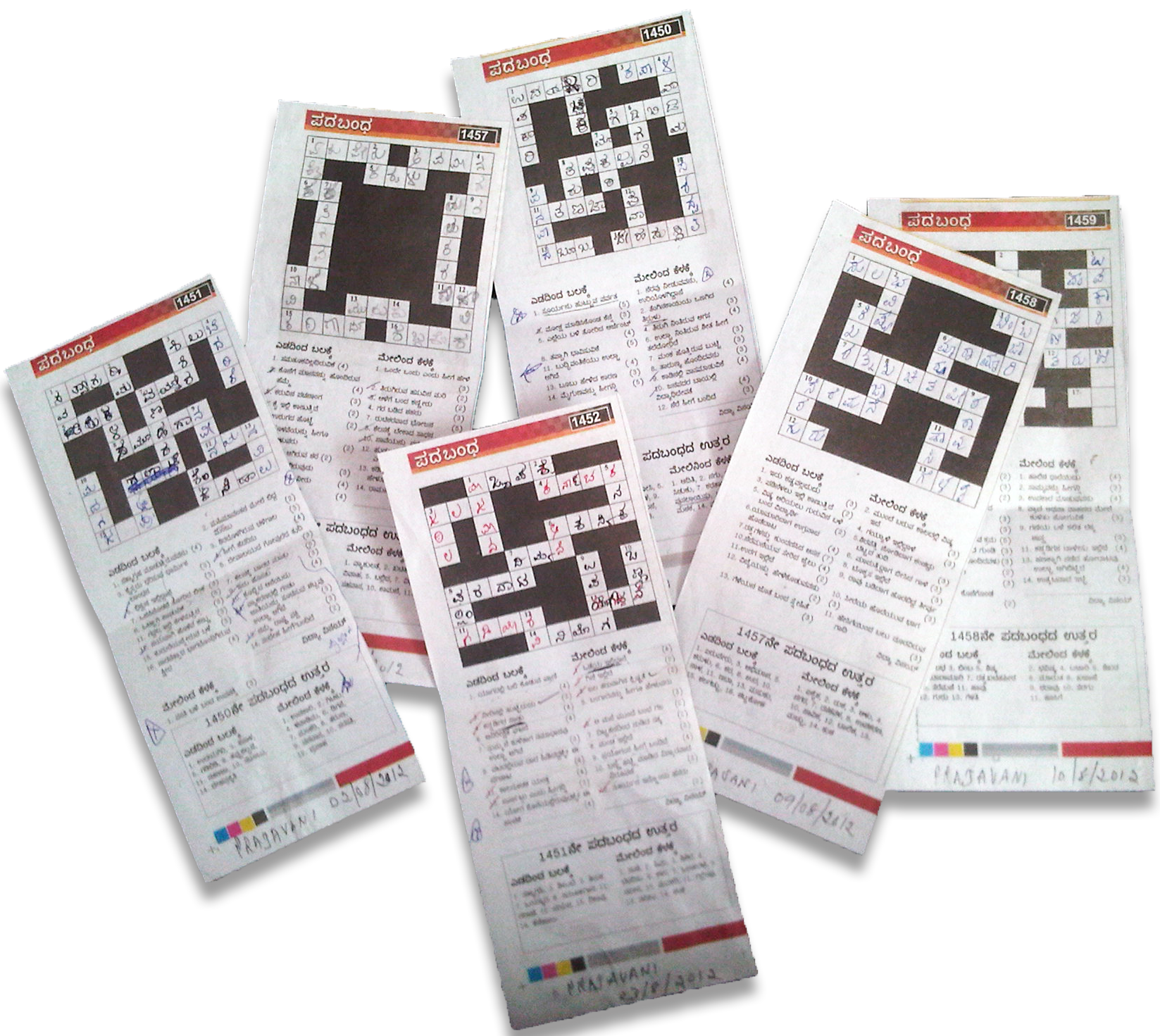
a 9x9 in PrajavaaNi (from the Deccan Herald group) presently running numbered over 1450,

kannada-crosswords-5prajavani 
(click the image above to enlarge)

a 9x9 KannaDa Prabha (from the New Indian Express Group), presently running numbered over 6250,

kannada-prabha-crossword

a 7x7 in UdayavaaNi (from Manipal based UdayavaaNi group) presently running numbered over 4150.

udayavani

All the three have symmetric grids, more than half blackspace in many cases, triple unches, and sometimes, whitespace islands not linked to other parts of the crossword. I tried all three but found PrajavaaNi, a daily puzzle set by Ms.Vidya Vinay, the most intriguing since the other two did not seem to have any cryptic side to their wordplay[1].

prajavani-crossword-grids

The clue sheet headings are a little more elaborate compared to English: Across is Left to right, Down is Up to down for Down. All three Kannada publications use this wording.

I observed a rummy thing in Kannada crosswords which is not kosher in English crosswords: in an English crossword DEER being reversed as REED is ok, but DEAR cannot be reversed as RAED. But the Kannada crosswords I solved had such instances of grid fills with no meaning, such as #7 below.

The most delightful surprises were some clues that displayed shades of wordplay similar to what we see in English ones:

  1. ಯೋಗ ಕೊನೆಯಲ್ಲಿರುವ ಈ ಹಂಚಿಕೆ (4) (Yoga koneyalliruva ee hanchike)= This distribution has yoga at the end of it
  2. ಪಟದಲ್ಲಿರುವ ದಾರ ಹಿಡಿದಕ್ಕೆ ಈ ಪೇಚಾಟ (4) (PaTadalli daara hiDidakke ee pechaaTa)= This disturbance/dislocation/embarrassment is due to the chart holding the string
  3. ವಸತಿ ಬಳಿ ಬಂದ ಉಪಪತ್ನಿ (3) (vasati baLi banda upa-patni)= The minor wife who came to the house
  4. ಮಹಿಮವಂತನ ಮೇಲೆ ಬಿದ್ದ ಮಂಜು (2) (mahimavantan mele bidda manju) Dew/frost that fell on the famous person
  5. ಸೂರ್ಯನು ಹುಟ್ಟುವ ಪರ್ವತ (4)(suryanu huTTuva parvata)= The mountain where the sun is born(rises)
  6. ನೆರವು ನೀಡುವವನು, ಉರಿಯೋಳಗಿದ್ದಾನೆ (4) (neravu neeDuvavanu, uriyoLagiddane)= Person who helps, is in fire
  7. ತಿರುಗಿ ನಿಂತಿರುವ ಅಗಸ (4) (tirugi nintiruva agasa)= A washerman who is standing, turned/ a washerman who is facing away
  8. ದೊಡ್ಡ ಹಾರೆಯಿದು (3) (doDDa haareyidu) = This is a big garland
  9. ಮಾರುತಿದ್ದಾಗ ಬೀಸಿದ ಗಾಳಿ (3) (maarutiddaga beesida gaaLi) = The wind that blew when selling

No.3 was sheer magic, though the anagram indicator was missing. This is not a rare omission - many a times, anagram and container/contained indicators are not given with clues in Kannada crosswords.

The answers:

  1. ವಿನಿಯೋಗ viniyoga (as in the Sanskrit/Hindi विनियोग) means distribution, investment or putting into, and has yoga as its ending.
  2. ಪರದಾಟ  pardaat means travel (=dislocation), and consists of the word play of insertion of anagram (without indicator) ದಾರ (daara=thread) as ರದಾ inside ಪಟ (paTa=chart)
  3. ಸವತಿ savati=minor (junior/second) wife (as in Hindi सौतन) which is an anagram of ವಸತಿ (vasati=house).
  4. ಹಿಮ hima=dew/frost (as in Sanskrit/Hindi हिम), which is a synonym of ಮಂಜು and is hidden in ಮಹಿಮವಂತನ, a famous person
  5. ಉದಯಗಿರಿ udayagiri (उदयगिरि) there are several places called Udayagiri in South India, which roughly translates to the sun-rise mountain.
  6. ಉಪಕಾರಿ upakaari (उपकारी), person who helps, the outer two characters of this word spell out ಉರಿ (fire) as mentioned in the clue.
  7. ಳವಾಡಿಮ does not mean anything, to my knowledge and subject to correction, but is a reverse of ಮಡಿವಾಳ (Madivala= washerman), also the name of a lake and locality in Bangalore, which probably like the Washermanpet (ண்ணாரபேட்டை/ Vannaarappettai ) in Chennai or Dhobi Talao (धोबी तलाव / धोबी तालाब) in Mumbai was where all the laundering took place in days of yore, and probably continues.
  8. ಗಜರಿ gajari (a type of flower garland equivalent to गजरा, in Hindi), the reference to big may be an allusion to the ಗಜ (गज) which is an elephant (=mammoth/large)
  9. ಮಾರುತ maaruta (मारूत = wind) hidden in the Kannada word ಮಾರುತಿದ್ದಾಗ (maarutiddaga) = when selling

Solve These

Kannada clues set by Kishore:

1. ಭೈರವಿ ರಾಗದಲ್ಲಿ ಹೀಗೆಕೂಡ  ಕರೆಯಬಹುದು ಸೂರ್ಯನನ್ನು (2)
(Bhairavi raagadalli heegekooDa kariyabahudu Suryannu - You can also call Surya thus in the Bhairavi raaga)


2. ಯಾವ ದಿಕ್ಕಿನಲ್ಲಿ ಹೋದರು ಈ ಜಿಲ್ಲೆಯ್ ಹೆಸರು ಓದಬಹುದು (3)
(Yaava dikkhinalli hodaru ee zilleya hesaru odabahudu -Whichever direction you go, you can read this district name)


3. ಈ ಊರಿನ ವಡೆ ಬಹಳ ಹೆಸರಾಗಿದೆ (3)
(Ee oorina vaDe bahaLa hesaraagide - The vaDa (an eatable) from this town is very well known)

Notes:

[1] Except one clue in UdayavaaNi (ಹೇಗಾದರೂ ಬಂಗಾರ – hegaadaru bangaara = gold anyway, with an answer ಕನಕ=kanaka=gold), the answer being a palindrome as indicated by the 'anyway' in the clue.

[2] Another thing that made my day with the PrajavaaNi crossword is the fact that it is adjacent to the Henry cartoon strip, called ಗುಂಡಣ್ಣ, GundaNNa= round elder brother (euphemism for a bald chap) in the Kannada paper. The Henry cartoon was created in 1932 by Carl Anderson and used to appear on the 'filler portions' of Mandrake and Phantom comics published by Indrajal Comics, a rage with kids in India in the seventies and eighties.

Related Posts:

If you wish to keep track of further articles on Crossword Unclued, you can subscribe to it in a reader via RSS Feed. You can also subscribe by email and have articles delivered to your inbox, or follow me on twitter to get notified of new links.