Showing posts with label us crosswords. Show all posts
Monday, 2 September 2019

What is a DOOK?

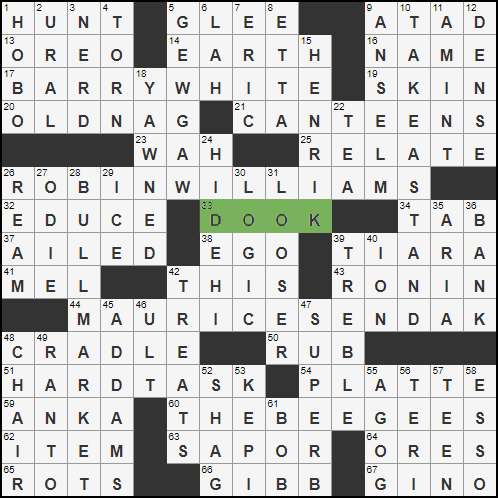
On 16 December 2014, the New York Times puzzle grid carried this answer which led to much bafflement in the solving community:

DOOK in NYT Crossword
Source: © 2014, The New York Times

The clue (33a) was "Scrape by" – but why was its solution DOOK? Solvers checked standard dictionaries and found the word unlisted; they combed through online sources and discovered the word could mean bathe or plunge, a Scottish variant of duck, a misspelling of the University in Durham, a plug, a clucking sound made by a ferret. There was nothing to support "DOOK = Scrape by" as defined in the puzzle.

Comments on NYT crossword blogs were abuzz with conversation around this mysterious word…

…till someone pointed out that DOOK is not "dook", DOOK is "do OK".

No Enumeration, Cause of Confusion

In the New York Times crossword, solution lengths are not stated. The total count of cells to be filled for each clue is evident from the grid, but the clue does not tell you if its answer is a (4) or a (1-3) or a (2,2). This property was used to fantastic effect in the 1996 NYT Election Day crossword; this property also led to the DOOK confusion.

DOOK as Crossword Jargon

Since the time it was first noticed, DOOK has become a blog shorthand for words placed together in the grid (typically parts of a multi-word answer) that can be misinterpreted.

DOOKS do not normally affect British cryptics except in the rare case of enumeration errors: Guardian 24032 – what does doordie mean?

Usage examples:
"I'm nominating DOOORDIE for DOOK of the year." [source]
Comment on puzzle Give Me Some Space, in which one had to insert spaces in themed clues (GOON –> GO ON, NOTABLE –> NOT ABLE, etc.) to arrive at their answers: "IT'S A DOOK PUZZLE!" [source]

Related Posts:

If you wish to keep track of further articles on Crossword Unclued, you can subscribe to it in a reader via RSS Feed. You can also subscribe by email and have articles delivered to your inbox, or follow me on twitter to get notified of new links.

Wednesday, 9 March 2016

Coincidence or Plagiarism: How do we tell?

Plagiarism or Coincidence in Crossword PuzzlesThe crossword world has been abuzz with this FiveThirtyEight report for the past few days. The investigation and its aftermath have spawned several threads of conversations about plagiarism in puzzles.

In this case, the data is so overwhelming that it leaves no doubt - but often the difference between plagiarism and coincidence is not so marked. A few clues with shades of similarity, a brilliant clue that was done before, an identical theme, even a full puzzle almost like another – any of it can happen by sheer chance.

In 2015, two consecutive Guardian prize puzzles by different setters carried the same theme of US Presidents – the grid fills naturally shared common entries, and what was arguably the cleverest clue in both employed the same wordplay device.

In 2009, two American crossword setters produced crosswords with a theme that, on the face of it, doesn't look like it could get repeated: phrases with the word RAVEN embedded inside. Both puzzles had near-identical theme entries in the exact same places in the grid. Matt Gaffney, the setter of one of those puzzles, wrote about how such a thing could happen independently and coincidentally.

Earlier when I spotted similar clues across crosswords, I used to blog about it (Déjà Vu, The Times Squires). I discontinued doing so as finding such commonality turned out to be too frequent to be post-worthy. Talented wordsmiths can surely see without external prompting that a TARANTULA is "natural at spinning" or a RHINO is a "one-horn animal" – it surprises me no more to find these words clued by different setters in the same style.

Arden Anax Clue Similarity

Some words (extra risotto, anyone?) are grid-friendly and will show up often in crosswords. Some words can be treated for clueing in only so many ways. Sometimes the ways of word breakup are many but two setters pick the same idea since it produces a great surface.

In clue-writing contests such as CCCWC, which do not make the entries public till after the deadline, participants cannot possibly copy/get inspiration from other participants' clues. And yet, declare the clue word CLEMENTINE and three entrants turn in "Papal cross? (10)".

So how do we identify a case of wilful copying?

If a setter does actually lift/tweak another setter's work, it is hard to tell when the instances of resemblance are few and the clues in question aren't markedly different from the setter's usual style. Only the setter knows!

I believe that we should be careful in using the P-word unless the evidence is very strong, such as:

  • Repetitions over a large volume of puzzles
  • Wide variation in quality of puzzles/clues by the setter
  • A pattern of resemblance to others' work especially in the long grid fills, where the potential for copying is the highest

The recent case reveals another tell-tale sign: expressing a disregard for the puzzle that your own work closely resembles. Not a fan, never have been a fan? If these repetitions were by chance, the setter/editor would like the crosswords that happen to be uncannily similar to his own!

Sometimes even a single clue can raise suspicions of copying. Say an amateur setter whose clues are generally unremarkable writes a brilliant clue on social media. There will be those who notice this anomaly and search for the clue online. If they find that this clue resembles a winner on another CWC, they will suspect. If this happens over and over, they will be sure. There may not be charges of theft made openly, but people watch, people know!

With publicly available puzzle databases and advanced search tools online, plagiarising puzzles/clues is easy. What is also easy is getting caught. The same puzzle databases and advanced search tools are available to consumers of puzzles. Puzzle solvers are smart and curious and driven to unraveling mysteries. Plagiarism in puzzles, if attempted, is bound to come out sooner or later.

Related Posts:

If you wish to keep track of further articles on Crossword Unclued, you can subscribe to it in a reader via RSS Feed. You can also subscribe by email and have articles delivered to your inbox, or follow me on twitter to get notified of new links.

Wednesday, 25 November 2015

Crossworld by Marc Romano

Crossworld by Marc RomanoI might not have read Marc Romano's Crossworld had I not received it as a gift. The subtitle tells us that the book is about "one man's journey into America's crossword obsession". An unfamiliar author writing about the kind of crosswords I don't solve would not interest me terribly – or so I thought.

The idiom "don't judge a book by its cover" just got a literal endorsement: I opened this book's cover and I found in it much to enjoy.

Crossworld begins with the line:

This is a book about my yearlong journey into the world of competitive crossword solving – although saying that is a little like saying "Lucy in the Sky with Diamonds" is a song about a girl or The Scream is a painting of a guy standing on a bridge.

This style of drawing extra-crossword parallels continues throughout the narrative: if that's your thing, you will find Crossworld an entertaining ride.

As a first-person account of the 2004 American Crossword Puzzle Tournament (ACPT), the book captures the feel of the tournament well and has many elements a competitive solver of other puzzles too will identify with. The rules of the Indian Crossword League or UK's Times Crossword Championship may vary, but the factors that make or break one's performance in these contests are universal: the trade-off between time and accuracy, the difference between solving online vs solving on paper / solving alone vs solving alongside others, the enormous cost of tiny errors. Most of all the shared thrill of being surrounded by crossword lovers at the championship venue.

The goings-on at 2004 ACPT are narrated with expansive detail, but there were times when I wished for a little less detail. I would not have missed them if the passages on point totals during the puzzle rounds ["Brendan finished the sixth puzzle correctly in nineteen minutes to earn 1,825 points; I finished in twenty-one, with one mistake, to earn 1,580. At 7,895 to 7,665, he was safely and irretrievably ahead of me overall." (p129)] or what the author ate after the tournament ["I ate some walnuts" (p164)] had been dropped, and the fascinating sub-chapter on the crossword mystery novel had been extended. This portion describes rare and out-of-print crossword whodunuts written a few decades ago and made me add a few to my book wishlist, notably John Garland's Crime of the Crossword (1940), for which Crossworld includes a complimentary précis by Will Shortz.

As in the film Wordplay, Will Shortz is a towering presence in Marc Romano's story. Crossworld presents him with great warmth and admiration, quoting and referencing him every few pages: his opinion on other setters' work, his influence that prompted Marc Romano to modify his coinage "cryptic creep" (the growing influx of cryptic wordplay in American crosswords) to "cryptic drift". A full chapter The Puzzlemaster in his Labyrinth gives us a tour of Will Shortz's library containing thousands of puzzle books and memorabilia.

One thing that pulls the book down is its overall structure. There are many tangential notes and back-references, mostly fun reading on their own, but they disrupt the flow of the outer story. The other is the narrator's focus on himself when turning the spotlight on others around would have made the book more appealing. 

Crossworld is perhaps best read as a view to the puzzling landscape through the author's prism - what he sees might not always coincide with what we would see independently. For one, things are seldom "good" or "bad" in Marc Romano's world, they are "best ever" or "worst ever".

You'd think that a crossword competition would be a quiet and understated sort of affair, given that it features the largest collection of loners this side of the last Kafka family reunion, ...

This is like hearing a friend given to dramatized opinions – I would listen attentively, but I would not take everything he says at face value. I felt this strongest when he touched upon cryptic crosswords. If we consider quick crosswords and cryptics as two camps, Marc Romano is clearly in the former and I believe gets carried away when contrasting the two. Sample these:

…American-style puzzles require that every letter appearing in them has to be conected to at least two others, while British-style puzzles allow – in fact they prefer – there to be as many unchecked letters as possible.

Since cryptics are easier to construct than American puzzles, you don't need legions of freelance contributors, overseen by one all-powerful editor, to make sure one appears in your newspaper every day of the year. All you need is one guy reliably cranking them out for you (who might be the editor himself), …

The statement about cryptic checking is not true, which puzzles are easier to construct and how many contributors you need for them (one vs legions!) is not so simplistic to determine. He goes on to make a case that Americans struggle with cryptics because of less checking and "unfamiliarity with the minutiae of British life and society". I am astonished to read such reasoning from someone who "can usually complete the Times of London cryptic" (p47).

But there were other conclusions I agreed with totally. When talking of puzzles in different languages, Marc Romano says the ability to solve puzzles in a language is no measure of proficiency in that language. That made me think about the many solvers who complete Hindi crosswords based on cryptic technique and knowledge of the script alone, without having native fluency in Hindi. 

Related Posts:

If you wish to keep track of further articles on Crossword Unclued, you can subscribe to it in a reader via RSS Feed. You can also subscribe by email and have articles delivered to your inbox, or follow me on twitter to get notified of new links.

Thursday, 8 November 2012

Puzzazz: Puzzle e-bookstore for iPhone, iPad

Puzzazz If you use an iPad, iPhone or iPod Touch, try out this app called Puzzazz, a collection of puzzle e-books that allow you to solve puzzles directly on the pages of the e-books.

The Puzzazz app has been developed by a Seattle-based puzzle technology startup, founded by crossword setter and software architect Roy Leban.

For cryptic crossword solvers, Puzzazz has four e-books in the bookstore at present including one by Brian Greer, popularly known as Brendan in The Guardian. His e-book Across and Down the Guardian Path with Brendan contains 20 handpicked puzzles originally published in The Guardian, including one that was discussed in 2009 on Crossword Unclued: Sample a Themed Guardian Crossword. The other three cryptic crossword books are by Mike Selinker, Todd Rew and Wayne Robert Williams, setters of repute on the American cryptic circuit - visit the author profiles page for details.

"TouchWrite" for handwriting recognition

The app lets you enter crossword answers in an interactive grid using either the keyboard, or a unique feature developed by the Puzzazz team called "TouchWrite" - a way to hand-write answers on the screen with your finger. TouchWrite recognizes a variety of different writing styles: for example, you can draw an E in one stroke like a backwards 3, or in four strokes. The technology seems pretty intuitive and it doesn't require much practice to get it to work accurately. If you do need help, the app provides a TouchWrite guidelines section.

The ability to write directly on the puzzle is very useful on smaller devices like an iPhone because the keyboard takes up a lot of screen space. Check out the video at the end of the post to see TouchWrite in action.

How much does it cost?

The price per e-book ranges from $0.99 to $4.99. The app itself is free, and every e-book in the store is "try before you buy" - at least the first puzzle in every e-book is fully solvable without cost. To view the free puzzle, tap on its number/title. If you view the other non-free puzzles, they will be greyed out and the option to buy will be shown above the puzzle.

Screenshots from Brian Greer's e-book:

Puzzazz-BrianGreerPuzzle

At this time, the Puzzazz store contains 29 puzzle e-books by 17 constructors. Puzzles available so far include crosswords (cryptic and quick) and other word/logic puzzles such as rebuses.

Demo: Watch Puzzazz in action

Here's a 1:38 min video of Puzzazz (version 2.0) in action. The video shows an overview of the e-bookstore, the cryptic crossword page with a sample crossword by Mike Selinker, and the use of keyboard + TouchWrite to enter answers. I guess it is obvious from the demo that I am not accustomed to a touchscreen! Thanks to my friend Paul Schloss for lending his iPhone to try out Puzzazz. [RSS/email subscribers: In case you can't see the video embedded below, please visit the blog.]

Have a look at this Geekwire video as well, which includes a voiceover by Puzzazz founder Roy Leban.

You can get the Puzzazz app here. If you're a crossword setter interested in publishing on Puzzazz, you might want to visit Puzzazz - Call for Constructors.

Related Posts:

If you wish to keep track of further articles on Crossword Unclued, you can subscribe to it in a reader via RSS Feed. You can also subscribe by email and have articles delivered to your inbox, or follow me on twitter to get notified of new links.

Thursday, 8 March 2012

Dr. Fill, Crossword Solving Software to Compete with Human Solvers

dr-fill-crossword-solver Dr. Fill, a new software than can solve American-style crosswords, is poised to make a keenly-watched debut in the upcoming American Crossword Puzzle Tournament. Dr. Fill has been built by Matt Ginsberg, a former artificial intelligence researcher and now a regular crossword constructor for the New York Times. Matt Ginsberg is also the creator of GIB, the first bridge software to beat several top-ranked human bridge players in 1998.

The crossword solving program has been put through simulations of several past tournament crosswords and has shown consistently high scores. Based on the performance tests conducted so far, Dr. Fill's might place 20th in this year's tournament, The Economist reports.

Dr. Fill will be a "non-ranked participant" in the American Crossword Puzzle Tournament - that is, it won't be competing officially but will solve the puzzles alongside human participants and will submit the solutions to the judges for scoring. According to the banner on the tournament's official site, an "I Beat Dr. Fill" button will be awarded to any contestant who scores higher than Dr. Fill.

What is the secret of Dr. Fill's solving ability?

The abstract for Ginsberg's research paper on JAIR provides this daunting explanation:

Dr.Fill works by converting crosswords to weighted CSPs, and then using a variety of novel techniques to find a solution. These techniques include generally applicable heuristics for variable and value selection, a variant of limited discrepancy search, and postprocessing and partitioning ideas. Branch and bound is not used, as it was incompatible with postprocessing.

Gizmodo makes Dr.Fill's approach sound far more accessible. It is the same one Indians know as ratta.

What makes Dr. Fill so smart, so worthy of competition with those speedy word nerds? Memory. He's basically memorized the entire cannon of crossword puzzles to plug-and-play as needed. Unlike Watson, Dr. Fill wasn't programmed to understand the language of the clues, but rather to play the game.

Dr. Fill's database contains clues and answers for all major American crosswords created since 1900, plus references to online sources like Wikipedia and the movie site IMDb. The program does not try to make sense of the words and clues, instead it sifts through a long list of potential answers for a slot in the grid and fills in the most likely one, then works through the crossing clues.

Will Shortz, crossword editor of the New York Times, sounds skeptical about Dr. Fills ability to beat human crossword solvers but doesn't rule out the possibility [San Francisco Chronicle]:

Because of the complexity of the English language, the breadth of subjects covered in puzzles and the playfulness of crossword themes, I've always thought that a human brain would be better than a computer at solving crosswords. Maybe I'll be proved wrong.

We’ll know soon. The American Crossword Puzzle Tournament begins on 16th March 2012.

Update: Check out this video report about Dr.Fill with shots of the software in action (there's a 30 second ad before the 2:22 min video):

Related Posts:

If you wish to keep track of further articles on Crossword Unclued, you can subscribe to it in a reader via RSS Feed. You can also subscribe by email and have articles delivered to your inbox, or follow me on twitter to get notified of new links.

Thursday, 3 February 2011

Who says documentaries are boring? Watch Wordplay

Wordplay (Movie) NYT Crossword "Well, it's not like insulin. I mean, I can live without it for a day." says Jon Stewart, American standup comedian and crossword fan, when asked if he can do without the daily crossword puzzle. [Wordplay, 2006]

Whoever can identify with that sentiment – and I bet that's most of you reading the blog – is going to love this smart film on the world of crosswords. Wordplay is full of nuggets about grid-smitten folk – one champion solver cannot understand why people spend hours on a puzzle that takes her ten minutes ["I guess I've just accumulated a lot of useless knowledge that often is in the puzzles", she adds bemusedly], another when passing by a place with the word "Intercoastal" in it, remarks that the word is an anagram of ALTERCATIONS.

The pivotal figure in Wordplay is Will Shortz, New York Times (NYT) crossword editor, possibly the most powerful figure in the American puzzle world. He talks of the changes he has brought about in the NYT crossword since he took on the role of editor in 1993, and good-humouredly reads out some sharp letters written to him. "Dear Sir or Madam…you have taken all the fun out of crosswords." complains one writer. "You are sick, sick, sick." declares another. It comes with the territory, doesn't it, puzzle makers?

The film also visits celebrity solvers like Bill Clinton and Bob Dole who share their reactions to the diabolical New York Times Election Day Puzzle of 1996. The puzzle is displayed ingeniously in the film with the lights fading in and out of the grid cells and the clues inset.

Wordplay is about a non-cryptic crossword yet the film is no less interesting for solvers of cryptics. In a broad sense there is a lot in common between the two styles of puzzles: the same consideration for difficulty and symmetry, the approach to adding words to the grid – crossword setter Merl Reagle takes us through the process starting with the long entries, paying attention to crossing words till he reaches a stage where he needs to check the dictionary for a grid fill. As a musician in the film puts it, comparing crossword construction to writing a song - "all those things you play with - obscurity, clarity, generalization, specificity". You could say the same for cryptic crosswords.

Both styles of puzzles inspire a common drive in their fans to find answers, and a lot of Wordplay is about such devoted solvers. The film is built around the 2005 American Crossword Puzzle Tournament where crossword titans battle it out for the top spot. The film is visually excellent: it lets us watch the clues – and play along at places - as the competitors fill the grid on huge whiteboards. The final has all the thrill and suspense of a high-energy sport. A race against time by the three finalists, a heartbreaking faux pas, a close fight to the finish and ultimately the winner's classic victory statement: "Words are failing me. I am just glad they waited until now to do so."

---
PS: I think America is such a great place for encouraging enterprise. Through Indiana University's Individualized Major Program, Will Shortz studied Enigmatology in college, a course he designed himself – apparently Indiana University has an Individualized Major Program that lets you create your own personalized course of study. Will Shortz is the only person known to hold a college degree in the subject. Can we imagine doing something like that in India? For that matter, can we imagine a special grid of The Hindu Crossword being a topic of TV news, being commented on by the PM and leader of Opposition? OK, it might happen if The Hindu Crossword publishes a grid as sensational as the NYT Election Day Puzzle, but I doubt it :)

PPS: Straight crossword clues with difficult vocabulary are harder than cryptics for sure. I wouldn't get 1 Across of the championship final - "Stark and richly detailed, as writing (9)" without subsidiary indication. Can you? Hint: The answer has a Z and a Q in it.

Related Posts:

If you wish to keep track of further articles on Crossword Unclued, you can subscribe to it in a reader via RSS Feed. You can also subscribe by email and have articles delivered to your inbox, or follow me on twitter to get notified of new links.

Monday, 15 March 2010

Attention film-makers: Crossworders are not oddballs!

cruciverbalists-oddballs Have you seen the film No Reservations (2007)? A by-the-book rom com, except for a significant fact.

The leading lady is a crossword solver.

Each day she sits with her colleagues at the lunch table, armed with a pen and crossword grid. While the others laugh and chat, she is immersed in the crossword with a glum expression. She is also unkempt, unfriendly, has no "life" and no boyfriend. She is in therapy.

Along comes the hero. As it happens in such films, they spar then become friends. The lady grows cheerful and beautiful. After predictable twists, the movie moves towards the inevitable happy end.

Once Love enters the lady's life, she is never again to be seen solving the crossword.

In All About Steve (2009), the heroine is a crossword compiler for the (fictional) paper Sacramento Herald. She is also socially inept, clingy and spouts random facts to anyone within hearing range.

She gets so besotted with a man Steve (whom she has barely met) that she writes her next crossword themed entirely on him, titled "All About Steve". The crossword when printed frustrates the readers. (The paper obviously follows The Hindu's model of allowing anything by the setter to get published without checks.) She is fired from her job for this crossword.

Now unemployed, the lady stalks the man all across the country and gives him the creeps.

----
Any cruciverbalists up for a dharna against such unflattering stereotyping?

Related Posts:

If you wish to keep track of further articles on Crossword Unclued, you can subscribe to it in a reader via RSS Feed. You can also subscribe by email and have articles delivered to your inbox, or follow me on twitter to get notified of new links.

Monday, 7 September 2009

ABC Of The Crossword Grid

crossword-grid In my initial years of solving cryptic crosswords, I concentrated entirely on the clues and did not even notice the grid. I vaguely figured that the quick crossword grid in the evening paper had a higher white:black ratio than the cryptic grid, but thought no more about it.

One day I chanced upon a freeform crossword in a magazine. The grid was awkward, unsightly. It struck me then that the crosswords I solve look way better than that.

As a "wiser" solver today, I respect the grid much more. Coming up is a series of posts, starting with this one, about different properties of the cryptic crossword grid, good and bad attributes, and ways in which setters do clever stuff with the grid.

The most visible grid property first – its appearance. If you're unfamiliar with grid terminology (checking? unches? blocked grid?) read through this to start with: Link.

Shape And Size

A typical cryptic crossword grid is square, and 15 x 15 in size. Grids used by The Hindu, Economic Times and most daily publications from UK fit that description. There could be different-sized grids too - the New Indian Express crossword is a smaller 13 x 13, while the Times Jumbo as large as 23 x 23. Smaller grids tend to be used for easier puzzles (I'm not sure why!).

The standard cryptic grid is a blocked grid – that is, within the grid there is a pattern of black-and-white squares. Each square is called a cell. Series of white squares into which answers are entered are called lights; the black squares are called darks, blacks, or blocks.

Rotational Symmetry

All mainstream crossword grids have 180° rotational symmetry, also called two-way symmetry or half-turn symmetry. This means that when the grid is turned upside down, the black squares and white squares are in the same locations. Some grids also have 90° symmetry, which is four-way symmetry or quarter-turn symmetry.

The rotational symmetry doesn't affect the solving in any way, just adds to visual appeal (except if you have a Poirot-esque obsession with order then it will help by not distracting you from the solving). It does help the setter in keeping other aspects of the grid consistent across the puzzle.

Black Space Distribution

Good cryptic crossword grids have balanced spread of dark vs lights. There will be no huge black shapes or clusters of white within the grid.

This does impact solving in a way. More on this in the coming posts.

See It For Yourself!

freeform-crossword-grid Freeform Grid

        - No internal symmetry
        - Big black shapes
american-crossword-grid American (Quick) Crossword Grid

        - Square, 15 x 15 
        - Half-turn rotational symmetry 
        - Higher white:black ratio
        - Clusters of white
guardian-24648-rufus-grid Cryptic Crossword Grid

        - Square, 15 x 15
        - Half-turn rotational symmetry 
        - Lower white:black ratio 
        - No clusters of white or black

Related Posts:

If you wish to keep track of further articles on Crossword Unclued, you can subscribe to it in a reader via RSS Feed. You can also subscribe by email and have articles delivered to your inbox.

Friday, 9 January 2009

New York Times Election Day Crossword

I recently read a book called Pretty Girl In Crimson Rose (8)[1], an autobiography interweaved with interesting stories about crosswords. One such anecdote is about a remarkable crossword puzzle published in the New York Times in 1996. I looked it up on the net and (bless Google) found the puzzle online.

Here is a screenshot of the grid and clues:

new-york-times-election-day-crossword

Crossword Copyright 1996 New York Times

The NYT puzzle is not a cryptic one; it has straight clues with the occasional pun or cryptic definition. You'll notice another dissimilarity with regular cryptic crosswords: the NYT clues do not mention solution lengths. This feature was put to ingenious use in the 1996 Election Day Crossword.

The special clue is the one cutting across the centre of the grid - 39A(+43A):

Lead story in tomorrow's newspaper (!)

The answer to the central clue corresponds with two 7-letter spaces.

This puzzle was published on 5th November 1996, the day of the Presidential Election in US in which Bill Clinton and Bob Dole were the prime candidates. The lead story in the next day's newspaper would naturally be about the result of the election.

The checking letters for 39A worked out as:

39D  Black Halloween animal             CAT
40D  French 101 word                       LUI
41D  Provider of support, for short    IRA
23D  Sewing shop purchase               YARN
27D  Short writings                          BITS
35D  Trumpet                                  BOAST
42D  Much-debated political inits.     NRA    

The solution stood like this, then: 
nyt-solution-clinton-elected 

Lead story in tomorrow's newspaper (!): CLINTON ELECTED

BUT at the time the crossword was published, the election result had not been declared. There were loud protests from solvers – was NYT being so presumptuous as to predict the result?

What they did not realize was that another group of solvers were sniggering over NYT's massive faux pas, for they had answered the same clue as BOB DOLE ELECTED.

The beauty of this puzzle is that there are two possible solutions. The clues for the crossing words are deliberately ambiguous and allow a completely different set of valid answers. So, if you answered the crossing clues like this:

39D  Black Halloween animal             BAT
40D  French 101 word                       OUI
41D  Provider of support, for short    BRA
23D  Sewing shop purchase               YARD
27D  Short writings                          BIOS
35D  Trumpet                                  BLAST
42D  Much-debated political inits.     ERA    

You would get this solution:
nyt-solution-bob-dole-elected

Lead story in tomorrow's newspaper (!): BOB DOLE ELECTED

Very few solvers at the time realized that a solution different from theirs was possible.

The exclamation mark in clue 39A works like it does with cryptic clues – signalling that something other than the obvious is going on. Of course, the same device couldn't have been used in a standard cryptic crossword as word length breakup of solutions - (7, 7) vs (3, 4, 7) - would have given the game away.

This crossword was designed by Jeremiah Farrell. The New York Times crossword editor, Will Shortz, calls it his favourite puzzle of all time.

[1]: As you can guess, the title of the book Pretty Girl In Crimson Rose (8) is a cryptic clue. Can you tell what the answer is?

You might also enjoy reading:

If you wish to keep track of further articles on Crossword Unclued, you can subscribe to it in a reader via RSS Feed. You can also subscribe by email and have articles delivered to your inbox, or follow me on twitter to get notified of new links.