Showing posts with label grid. Show all posts
Monday, 2 September 2019

What is a DOOK?

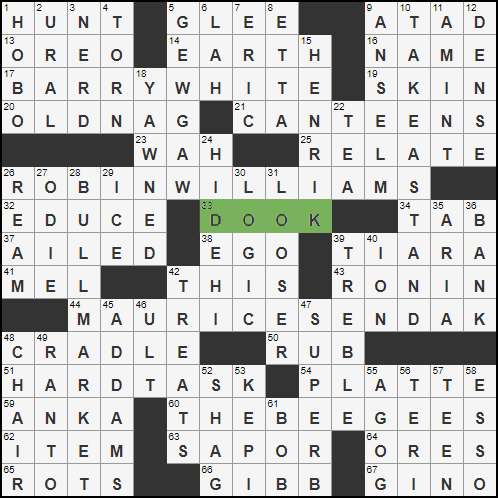
On 16 December 2014, the New York Times puzzle grid carried this answer which led to much bafflement in the solving community:

DOOK in NYT Crossword
Source: © 2014, The New York Times

The clue (33a) was "Scrape by" – but why was its solution DOOK? Solvers checked standard dictionaries and found the word unlisted; they combed through online sources and discovered the word could mean bathe or plunge, a Scottish variant of duck, a misspelling of the University in Durham, a plug, a clucking sound made by a ferret. There was nothing to support "DOOK = Scrape by" as defined in the puzzle.

Comments on NYT crossword blogs were abuzz with conversation around this mysterious word…

…till someone pointed out that DOOK is not "dook", DOOK is "do OK".

No Enumeration, Cause of Confusion

In the New York Times crossword, solution lengths are not stated. The total count of cells to be filled for each clue is evident from the grid, but the clue does not tell you if its answer is a (4) or a (1-3) or a (2,2). This property was used to fantastic effect in the 1996 NYT Election Day crossword; this property also led to the DOOK confusion.

DOOK as Crossword Jargon

Since the time it was first noticed, DOOK has become a blog shorthand for words placed together in the grid (typically parts of a multi-word answer) that can be misinterpreted.

DOOKS do not normally affect British cryptics except in the rare case of enumeration errors: Guardian 24032 – what does doordie mean?

Usage examples:
"I'm nominating DOOORDIE for DOOK of the year." [source]
Comment on puzzle Give Me Some Space, in which one had to insert spaces in themed clues (GOON –> GO ON, NOTABLE –> NOT ABLE, etc.) to arrive at their answers: "IT'S A DOOK PUZZLE!" [source]

Related Posts:

If you wish to keep track of further articles on Crossword Unclued, you can subscribe to it in a reader via RSS Feed. You can also subscribe by email and have articles delivered to your inbox, or follow me on twitter to get notified of new links.

Wednesday, 24 April 2019

Crossword Software To Make Puzzles With Multiple Letters Per Cell

In the article Crossword Grids That Hold More Than One Letter Per Cell, cryptic setter eXternal (Steve Bartlett) gave us a detailed tour of “rebus” crosswords, with tips for setting and solving such puzzles. In this article, he walks us through software that can be used to create crosswords with the many-letters-per-square gimmick.

Steve is the editor of Enigmatic Variations crossword in The Telegraph. He also sets advanced puzzles in the series of The Listener and Inquisitor, and standard cryptic puzzles for The Daily Telegraph (as proXimal), The Independent (as eXternal), Financial Times (as ARTEXLEN), The Herald (as Boz) and The National (as Claymore).

Handing over the reins to Steve for this article…thank you!

- Shuchi

It is quite simple to create a puzzle with more than one character per cell by using crossword-creating software. I will describe how to do this using Qxw, which can be downloaded for free from Quinapalus. I use this tool for all my barred puzzles and thoroughly recommend it, as it enables the setter to produce complex puzzles relatively easily.

I'll demonstrate how to use Qxw to produce puzzles with multiple letters per cell with reference to a couple of puzzles I created: one called Odd One Out in collaboration with Serpent for The Inquisitor series in The i; and one called Disappearances, which appeared in the Enigmatic Variations series in The Sunday Telegraph in 2017.

Odd One Out by eXtent

Serpent and I decided to theme a barred puzzle on Brexit. We wanted a grid which would include IVR codes of members of the EU in single cells. The number of letters in IVR codes for these members ranges between 1 and 3 — for example, Portugal is P, Czech Republic is CZ and Ireland is IRL.

Below is an outline of the grid we prepared:

Odd One Out by eXtent - The Inquisitor - Grid Outline

In order to get the three letters IRL in one cell, we needed to do the following:

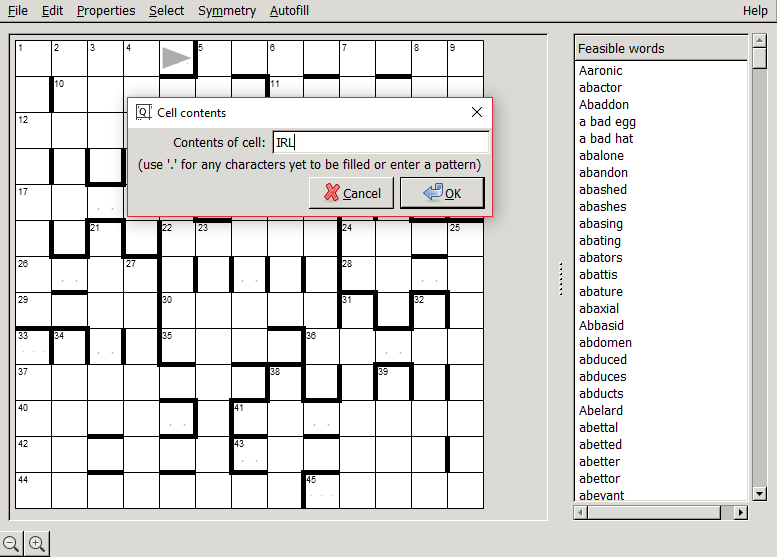
Click on Edit — Cell contents. Then just enter IRL in the dialog box.

Qxw - Edit - Cell Contents

Qxw - Edit - Cell Contents - IRL

Qxw then suggests a number of feasible entries (show in the panel on the right) for insertion.

We simply repeated this procedure for other cells around the grid for each of the two- and three-letter IVR codes. The final grid appeared as follows:

Odd One Out by eXtent - Filled Grid

A blog of the puzzle by HolyGhost at Fifteensquared can be found using this link: Inquisitor 1588: Odd One Out by eXtent.

Disappearances by proXimal

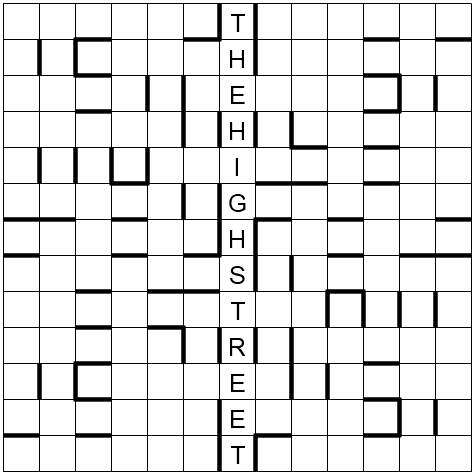
I had decided to base a puzzle on a theme of the decline or disappearance of stores from High Streets. The phrase THE HIGH STREET lends itself really well to being used in a barred crossword, as it has 13 letters and such grids are often 12x12 or 13x13. I decided to have THE HIGH STREET as a thematic unclued entry running down the central column of a 13x13, with names of shops which have disappeared produced by clashes on both sides of THE HIGH STREET. The clashes could be nicely thematically represented just by leaving the clashing cell blank, thus the stores are disappearing.

So, I started with a grid as follows:

Disappearances by proXimal - THE HIGH STREET

I decided to have five shops either side of THE HIGH STREET to produce a nice range and an interesting challenge for the solver. Firstly, I searched for shops which would lend themselves easily to being divided, to be produced from clashing words using Across and Down entries, but also ones that were relatively well-known. One of the most famous which I decided to use is WOOLWORTHS, which could be split as WOOL and WORTHS.

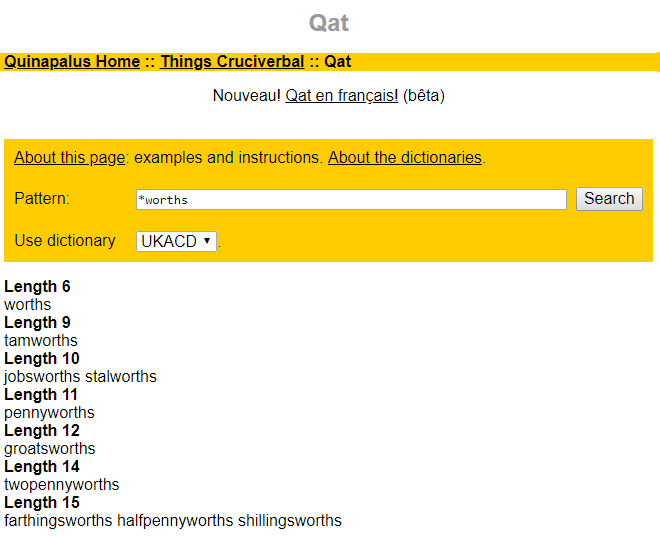
There is a useful pattern-matching tool on the internet called Qat, designed by Quinapalus, who also developed Qxw; I used Qat to check which words could end in WORTHS and which could start with WOOL. The picture below shows the search for words ending in WORTHS (using search term *worths):

Qat - Word Pattern Search

I liked the look of JOBSWORTHS and decided to have this entry in the grid to provide a clash in the last cell of a five-cell entry; the number of words starting with WOOL, to provide the Across clash, was much higher.

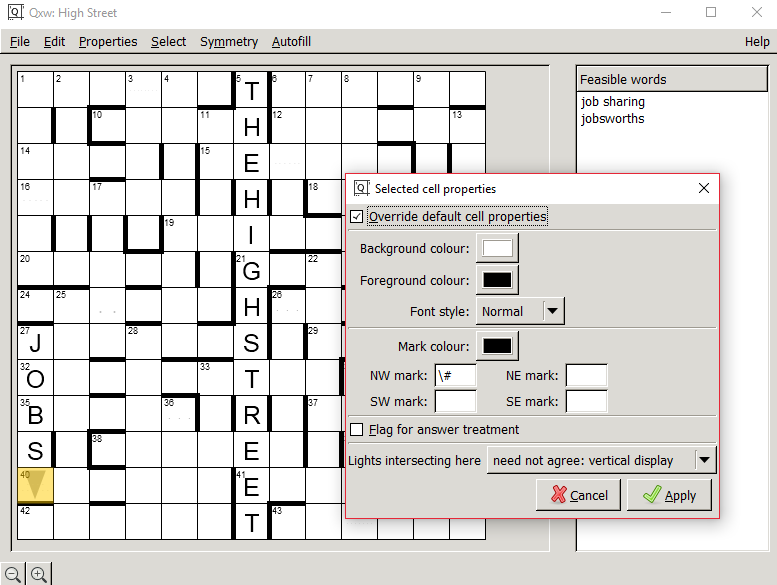
Back to Qxw, I put JOBS in the entry at 27 Down with the last cell blank to accommodate WORTHS in one cell. To enable Qxw to work with clashing entries, one does the following:

1. Select the cell which you want to use (shown in yellow below), by clicking Select and then Current cell, when the cursor is in the cell.

2. Click on Properties — Selected cell properties. Then tick the box which says Override default cell properties and further down, change 'Lights intersecting here' to 'need not agree'.

Disappearances by proXimal - Qxw - Intersecting Cells Need Not Agree

This now meant that I could specify an entry beginning with WOOL at 40 Across, with the four letters of WOOL being accommodated in the first cell, to clash with WORTHS provided by the down entry. In order to do this, the following is required:

Click on Edit — Cell contents. Because I have previously specified that the cell can accommodate clashes, a box appears which allows us to enter multiple letters for the Across and Down entries meeting in this cell.

Disappearances by proXimal - Cell Contents

Hence, once I had specified that the contents of the cell for the Across entry should be WOOL, Qxw provides me with a number of feasible entries: WOOLDINGS, WOOLFELLS, WOOLIEST, WOOLPACKS, WOOLSHEDS, WOOLWORTH.

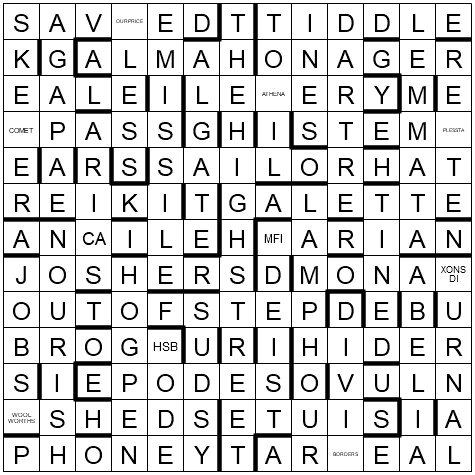
I then repeated the same process in various cells around the grid to accommodate the nine other shops. The completed grid appeared as follows:

Disappearances by proXimal - Filled Grid

So, for example, SKEETER at 1 Down clashes with COMPASS at 16 Across to create COMET. In this puzzle I also wanted to have real words left when the clashing cells were deleted, so the deletion of the COMET clash would leave words SKEER and PASS in the final grid.

A blog of the puzzle by Dave Hennings at Fifteensquared can be found using this link: Enigmatic Variations No. 1296: Disappearances by proXimal.

Related Posts:

If you wish to keep track of further articles on Crossword Unclued, you can subscribe to it in a reader via RSS Feed. You can also subscribe by email and have articles delivered to your inbox, or follow me on twitter to get notified of new links.

Monday, 12 November 2018

Crossword Grids That Hold More Than One Letter Per Cell

This NYT Wordplay article Yes, You Can Write More Than One Letter in a Square and an ensuing twitter discussion got me to discover some fascinating grid-fill gimmicks used in advanced cryptics. One such is to set aside the one-letter-per-cell norm that we take as a given in blocked grid puzzles.

The word or group of letters that goes inside a single cell is called a "rebus". [Long ago, rebuses were probably "squashwords" – more on that later in the article.]

If the idea of many-letters-per-cell is new to you, then you're probably brimming with questions at this point. When did this trick originate? How does the setter go about crafting a puzzle with rebuses? What should the solver do to crack such a puzzle?

Cryptic setter eXternal (Steve Bartlett) offers us insights into these questions. In this article, he looks at the history and development of puzzles in which individual cells contain more than one letter, and supplements his research with rare images of decades-old puzzles.

Steve sets advanced puzzles in the series of The Listener, Inquisitor and Enigmatic Variations. In addition, he sets standard cryptic puzzles for The Daily Telegraph (as proXimal), The Independent (as eXternal), Financial Times (as ARTEXLEN), The Herald (as Boz) and The National (as Claymore).

Note: The article primarily uses Listener examples, for consistency and because it has the longest history of the barred series.

Over to you, Steve.

- Shuchi

Many Letters in a Square: Dive into History

1. Listener (1950): #1047 Space Saver by Babs
    Compressed repetitions; LILO = LI/O

Here is a Listener crossword and solution from 1950, one of the oldest-known crosswords to employ the many-letters-per-square trick.

Listener 1047 Space Saver by Babs
[click #1047 to enlarge]

The preamble of the puzzle states that only half the number of squares is to be used for each answer, hence an answer of four letters has a light containing only two squares.

For example, the answer to 1 Across:
Refuse the odd bits (8)
is RIFF-RAFF. This to be entered in four cells as R,I/A,F,F, with the I and A sharing the same cell, divided with a slash.

This crosses with 2 Down:
Disinfectant used to make Eliza ladylike (4)
in which the answer IZAL is hidden in 'Eliza ladylike' and entered as I/A,Z/L, using just two cells for the entry.

Listener 1047 Space Saver Solution

The preamble gives several examples of how the answers should be entered, to help the solver understand this unusual entry method.

Grid Fill Examples in Preamble

2. Listener (1951): #1118 One or Two. by Stephanus  
    Random distribution: one letter in a cell or two

A Listener crossword from the following year, 1951, uses a simpler concept. A short preamble merely states that a 'space' contains either one or two letters.

Listener 1118 One or Two Stephanus
[click #1118 to enlarge]

For example, the answer to 5 Across:
Post of Prometheus' hope - and fateful pain? (8)
DELIVERY is entered as DE/LI/V/E/R/Y, in six squares.

This crosses with 6 Down:
What's put the L in AIR? A tree, at least (6)
in which the answer LINDEN (L in DEN) is entered as LI/N/DE/N in four squares.

Interestingly, the solution notes allow an alternative, as the V of DELIVERY and N of LINDEN are unchecked, meaning that DE/L/IV/E/R/Y and L/IN/D/E/N would be equally valid. We seldom see such ambiguities in today's barred crosswords.

Listener 1118 Solution

3. Listener (1961): #1640 Three-in-hand by ffancy
    Alphabetical sum

This example hails from a decade later, 1961. The puzzle has a complicated preamble to explain that each square accommodates three letters. This puzzle uses a gimmick commonly seen in modern barred puzzles, where Across and Down answers clash. Cell entries are derived from the letters of clashing Across and Down answers and the alphabetical sum of these two letters.

Listener 1640 Three-in-Hand
[click #1640 to enlarge]

For example, 1 Across CRACKER clashes with 1 Down KILDERKIN in the first cell. K and C are written in corners of this cell, with the sum C(3)+K(11)=N(14) in the centre.

1640-Solution

A further point to note is that, unlike the previous examples, the 1961 puzzle is thematic. The solution leads to a quote on diagonals from cell 11 — PLEASE TO REMEMBER THE FIFTH OF NOVEMBER etc., using the central cell entries derived from the clashing letters.

So far, the examples have not attempted to coin a term for this particular genre. They merely describe in the preamble what needs to be done to solve and fill the grid.

4. The (Almost) Impossible Crossword Book (1984)
    The name’s Squashword

The next example is from Gyles Brandreth's The (Almost) Impossible Crossword Book (1984), with the actual puzzle probably dating much earlier.

Shared Squares by Convar - Squashwords

Beside the title, appears the line, 'Shared Squares is a squashword'. This might lead us to believe that there was once such a term in usage for puzzles where squares contain more than one letter.

5. Listener (1998): #3479 Belt Up by MynoT
    Symbols for Clashes

The next example is from 1998, after The Listener crossword had moved to its current home in The Times.

3479 Listener Belt Up by MynoT
[click #3479 to enlarge]

Here the clashes are generated using more than one letter contributed from crossing answers. This is typical of modern barred thematics, with the clashes resulting in a thematic word.

For example, the clue to 9 Across is:
Car's before them to perform — by the grace of god (4) DODGEM
DO + DG(Dei gratia) + 'EM

The clue to 4 Down is:
Note's small money (3) MINIM
MINI + M

Both answers are too long for the available space (6 letters for 4 cells; 5 letters for 3 cells) and clash in the crossing cell, with the clash of GEM from DOD/GEM and INI from M/INI/M to give GEMINI, entered as the sign of the zodiac.

Aside from the entry lengths (rather than answer lengths) being given, we can also note that there is no reference to clashes in the very short preamble. The solver must deduce the fact that some answer are overlong and therefore clash.

Listener 1998-10-03 #3482 Belt Up Solution

6. Listener (2002): #3673 Journey by Gioconda
    Abbreviations for Clashes

The final example comes from 2002 and has four entries sometimes clashing in one cell. As opposed to the previous example, answer lengths rather than entry lengths are provided.

Listener 3673 Journey by Giconda
[click #3673 to enlarge]

In this puzzle, 2 Across has four clues but only two lights. The solver can thus deduce that the first two clues will clash somewhere in the first light and the second pair will clash somewhere in the second light.

The first light of 2 Across is made up of 6 cells, but the answers to the first two clues have lengths of 5 and 7 = 12. Therefore, there will be a clash of 7 letters in one cell along that light.

The first two clues of 2 Across are:
Endless joke about half clad women (5) JADES
JES{t} around AD

Amount of water in pool crushed a dog-pen (7) PONDAGE
A DOGPEN*

Therefore, we have JADESPONDAGE to enter in the first light of 2 Across. We can see that DESPOND is a likely 7-letter candidate to be the clash in the third cell.

Then, we look at the Down clues on the column where the large clash from 2 Across occurs, ie column E. The first two clues in column E have answer lengths of 3 and 8 = 11, but a light length of only 4. Therefore, a clash of 8 letters will occur. The first two clues of column E are:

Court Henry with soft centre (3) HOF
H+{s}OF{t}

Cast off sledge bearing frightened Hugo (8) SLOUGHED
SL(HUGO*)ED

Therefore, we have HOFSLOUGHED to enter in the first down light in column E. The clash occurs in the second cell down, the same location as the clash in the across light, providing OFSLOUGH as the contribution to the clash. This is how the solver arrives at SLOUGH OF DESPOND, to be abbreviated as SOD as instructed by the preamble.

Listener 2002-06-29 #3673 Solution

Clashes from multiple entries form places visited by Christian in The Pilgrim's Progress.

This is only a tiny overview of the multitude of ways in which setters have used this gimmick over the past 70 or more years. The puzzles where clashes of more than one letter spell out thematic words or names are particularly common and are often used to set the theme in advance of a further endgame which needs resolving.

Tips for many-letters-per-cell setters

In addition to the generic dos and don'ts of cryptic setting, be mindful of the following points when creating a crossword with more than one letter per cell.

1. Keep an eye on checking

Remember that overlong entry clashes reduce the amount of checking in the puzzle. It is more helpful to the solver if you minimise the proportion of the answer which clashes, or apply some technique to offset the effects of reduced checking.

As an example, take a theme of Santa's reindeer to be produced by clashing answers. When deciding how to generate DANCER, a nice 50/50 split of DAN/CER could be achieved with DAN/GEROUSLY and NECROMAN/CER (~27% clashing). The solver will have more help with checking from cells already populated than using, say, DAN/DY and UL/CER (~60% clashing).

You can also offset the effects of reduced checking by offering easier clues for those answers that might otherwise be troublesome for the solver – for example, through whole anagrams or hidden words.

2. Decide: Answer lengths or number of squares?

When setting many-letters-per-cell puzzle, you have a decision to make about clue enumeration: should you give the lengths of answers or the number of squares available for each entry?

If answer lengths are given, the solver has more guidance as to which answers are likely to clash. For example, in the clashing entries for DANCER to appear (see above), the number of cells needed to enter NECROMAN/CER will be 9, but the answer length is 11. Hence if the setter decides to give the answer length (11), the solver knows this is a clashing entry, as the number of available cells is fewer than the answer length.

It is a lot more common to provide entry lengths (ie number of available cells), so that the solver has to work out which are the gimmick clues.

3. Represent the clashes elegantly

Finally, you also need to decide how the clashes are to be represented in the grid. It is a little inelegant and fiddly to expect the solver to enter a seven-letter word, say, in a single cell.

Solutions to the problem could be for the solver to insert a symbol, abbreviation, first letter of answer or to leave the cell blank.

The method should ideally fit with the theme of the puzzle.

Tips for many-letters-per-cell solvers

From the solver's point of view, the more quickly the theme is uncovered, the easier the solve becomes. So you should be on the lookout for:

  • answers which obviously extend for longer than the given number of cells
  • likely crossing clues which could create a clash

Sometimes only a couple of clashes are needed to get an idea of what the theme might be. Once you have zeroed in on the theme, you can consider the identities of the other thematic items which might be hidden in clashes.

eXternal Steve Bartlett
My thanks to Dave Hennings, Roger Phillips and John Tozer for their help in the research for this article.

– Steve Bartlett


A follow up article will talk about using crossword software to make puzzles with multiple letters per cell. Stay tuned!

Update (25-Apr-2019): The follow-up article: Crossword Software to Make Puzzles with Many Letters per Cell.

- Shuchi

Related Posts:

If you wish to keep track of further articles on Crossword Unclued, you can subscribe to it in a reader via RSS Feed. You can also subscribe by email and have articles delivered to your inbox, or follow me on twitter to get notified of new links.

Tuesday, 7 June 2016

Why Are The Grid's Answer Slots Called Lights?

Crossword Lights

As most of you would know, the series of white squares in the crossword grid, into which answers are entered, are called "lights".

Do you also know why they are called "lights"?

No, it isn't because white squares are light in colour. (This is what I thought once upon a time)

A Display Of Lights (9) - Val GilbertVal Gilbert's book A Display Of Lights (9) uses the word in its title. The accompanying description on Amazon carries an explanation, which further complicates the subject:

Answer: Crossword (a 'light' is a word for 'clue' in crossword parlance, so: a display of lights/display of clues/crossword)

This definition tallies with the dictionaries – Chambers has "hint, clue or help towards understanding" as a meaning of light.

But:

If light means clue, why are we using it to refer to the answer to a clue?

The key to this question lies in the grid's property of checking.

D. St P Barnard's book Anatomy Of The Crossword clears up the mystery [Chapter 2: Patterns and Lights]:

Surely, one may well exclaim, to obtain a solution and then to call it by a word which means a clue, savours mightily of Looking-Glass Land. The objection would be a valid one if a puzzle were to require the insertion of only one word, but an essential feature of the crossword is that each horizontal word shares two or more letters with certain vertical words and vice versa. The result of this arrangement is that each word in the pattern not only represents the answer to some verbal clue, but serves also as a literal clue to those other words that it crosses.

Related Posts:

If you wish to keep track of further articles on Crossword Unclued, you can subscribe to it in a reader via RSS Feed. You can also subscribe by email and have articles delivered to your inbox, or follow me on twitter to get notified of new links.

Friday, 17 July 2015

Playfair

Playfair is an encoding device used to add solving complexity to advanced cryptic crosswords.

How Playfair encoding works

Playfair encoding is based on

  • A codeword or phrase, in which no letter recurs [1]
  • A 5x5 arrangement of letters (called word square or key table)

Before encoding, the letters of the alphabet are written in the word square, starting with the codeword, combining I and J into a single unit. This arrangement accommodates 26 letters of the alphabet in a 25-character square.

For example, if the codeword is ORANGESTICK (that's the word Azed uses with instructions in his Playfair puzzles), the Playfair word square would look like this:

Playfair Word Square 

The word to be encoded in Playfair is split into letter pairs (also called digraphs). So, the word BREAKING is split as {BR, EA, KI, NG}. To each letter pair after this split, an encoding rule is applied according to its position in the word square:

  Letter Pair Position Encoding Rule
(1) Both letters are in the same row Replace them with letters one place to the right of each. If one of the letters is at the extreme right, replace it with the letter at the beginning of the row.
(2) Both letters are in the same column Replace them with letters one place below each. If one of the letters is at the bottom, replace it with the letter at the top of the column.
(3) Neither of the above Replace them with letters at diagonally opposite corners of the rectangle formed by the letter pair. [To encode the first letter, look along its row till you reach the column of the second letter; pick this letter. To encode the second letter, look along its row till you reach the column of the first letter; pick this letter.]

Example: Applying Playfair encoding on the word BREAKING, with ORANGESTICK as the codeword, we get MSTOFEGO as below. (The number in brackets stands for the letter pair position.)

Playfair Encoding  

Playfair in cryptic crosswords

Barred grid cryptics like the Azed and Listener carry Playfair puzzles occasionally – in these, a few answers are Playfair-encoded before being placed in the grid.

To finish the puzzle, the solver needs to work out the Playfair codeword. This can be done by matching the plaintext answers (found by cold-solving the clues) with the encoded answer portions (found by solving the crossing clues). With the letter pairs before and after encoding, the solver can construct the word square, which would reveal the codeword.

Azed usually invites solvers to send in a cryptic clue to the codeword, along with the prize puzzle solution.

To make things more accessible for the solver, Playfair crosswords provide a few cues:

  • Clues with encoded answers are marked in some way. They may be italicized and/or have a common theme linking them.

  • The codeword may be related to the theme of the encoded answers and/or to the title of the puzzle. For example, in Listener 3993 titled Argentum, the encoded entries were HINT, TALK, NEWS, SIGN. Note that all the encoded entries can be defined as 'word', and the puzzle title is an anagram of ARGUMENT. The codeword turned out to be MINCE WORDS.

  • Playfair-encoded entries in the grid contain no repeating letters as a pair, and have an even letter count. Since Playfair crossword rules do not mention how to resolve repeating letter pairs or a single final letter, one can safely infer that these scenarios will not arise in the crossword. (To know how this is handled in actual Playfair messages, see note [2] at the end of the post.)

  • The encoded answers are designed to be relatively easy to solve without checkers.

This blog post about Azed 2164 has helpful tips on the approach for solving a Playfair puzzle.

Why only barred grids? Can't Playfair be used with blocked grid crosswords?

The main hurdle with applying Playfair to blocked grid puzzles is low grid checking. With only about 50% interlocked cells, it would be hard for the solver to construct the word square from before/after letter pairs, since after letter pairs (i.e. those obtained from checking) would be scanty.

What if the setter gives a strong alternate route to the codeword? Say, a subset of the answers when jumbled give the codeword, or a theme derived from the clues leads to the codeword. With less reliance on checking, blocked grid Playfair puzzles might be workable – though I have not seen this done in practice so far. Perhaps there isn't enough interest in this device among blocked grid solvers, or perhaps newspapers would not be willing to allocate extra space for the long preamble necessary to explain Playfair!

History of the Playfair cipher

Playfair was invented by English scientist Charles Wheatstone (1802-1875) and named after Scottish scientist/politician Lyon Playfair (1818-1898) who popularised its use. According to Simon Singh's The Code Book, the two men were neighbours and often met to share their ideas on cryptography.

The cipher was adopted by the British War Office and used first probably in the Boer War.

In its time, Playfair was a deft, dependable way of enciphering messages. It had no elaborate key mapping to memorize or reference, no special equipment needs; the recipient could simply draw the word square based on the codeword and decrypt the message.

Playfair is not vulnerable to obvious letter frequency analysis as every letter is not encoded the same way every time in a message. The code can be broken with digraph frequency analysis, of course - a task made simpler with Playfair Breaker applications which do that for you within seconds.

Notes:

[1] In general Playfair encoding, a codeword with recurring letters *could* be chosen with some patching: by omitting repetitions before entering the codeword in the word square. So, COMMUNICATE would become COMUNIATE. I haven't come across an example of this in Playfair crosswords, though – setters seem to pick lengthy codewords with unique letters. Warning: don't rely completely on this trend – as Azed points out here: "Ximenes once, rather wickedly, used CAB, resulting in only one letter in the word square being misplaced!"

[2] The two letters in each digraph must be different for Playfair encoding to work. If a letter is repeated in a digraph, an extra X is inserted between them to resolve the repetition. So, SUNNY gets split as {SU, NX, NY} before encoding. Similarly an X is tagged to the end of a word to pair up a single final letter. So, SHADY gets split as {SH, AD, YX}.

[Many thanks to setter Alberich for his inputs for this article.]

Related Posts:

If you wish to keep track of further articles on Crossword Unclued, you can subscribe to it in a reader via RSS Feed. You can also subscribe by email and have articles delivered to your inbox, or follow me on twitter to get notified of new links.

Wednesday, 11 March 2015

Quadruple Pangram in THC

The Hindu Crossword 11335 by AfterDark featured a technical marvel – a quadruple pangram in a 15x15 British-style grid.

Quadruple Pangram, The Hindu Crossword  

Why is it a technical marvel?

Fitting the entire English alphabet four times in a 15x15 blocked grid requires the setter to predetermine 104 letters in an about 160-letter grid. Doing this with meaningful, clueable words, while also meeting the requirements of symmetry and checking, is an extraordinary achievement - not just rare, but possibly the first-ever in a British-style 15x15 grid. [If you have come across any other, please let me know.]

First-ever quadruple pangram in a 15x15?

Quadruple pangrams have appeared before in American-style grids. The first quadruple pangram in the New York Times (NYT), created by Peter Wentz, was published in Nov 2010. To accommodate the quadruple pangram, a non-standard 16x15 grid was used for this puzzle. In Dec 2012, American setter Matt Gaffney took up the challenge of fitting a quintuple pangram into a 16x15 grid. He didn't quite achieve it, ending with a grid six letters short of the goal.

In March 2013, Raymond C Young's crossword created a quadruple pangram in an American-style 15x15.

British-style grids have fewer lights in comparison with American-style grids, which makes the quest for a quadruple pangram even harder.

How did AfterDark do it?

In the setter's own words:

The first step was to choose the right grid. I had to look for a 15x15 that had a high letter count, yet avoided 3-letter solutions (in THC, 3-letter solutions are rare). Also, I had to find a grid that didn't have long words (they pose a big challenge in fitting in rare letters) and could accommodate more words. Fortunately, Crossword Compiler software helps in giving out such stats. I zeroed in on a grid with a mean word length of around 6, and an option of 38 words.

The second step was to deal with the difficult letters like Z,Q,J. In general, I chose slots where these letters could avoid a crossing. I then started from the NW quarter, trying to optimise the usage of difficult letters. And moved anti-clockwise, quarter by quarter, constantly checking for the number of times I had used the letters.

That was only the beginning. Each quarter ended up changing many times.

Strangely, after trying too hard to fit in the rare letters, in the end I was stuck with K, H & G. This happened because, every time a word choice was given, I opted to ignore the easy letters as I believed I could fit them in any time. When it came to the NE quarter at last, I was left with just 3 words but 7 letters to be included. This, again, led to a total alteration of two quarters.

There were words I deliberately avoided for one of these reasons: they were obscure (the barometer for that essentially was whether I had heard of the words somewhere or not), they didn't lend themselves to good definition, or they were "unclueable". Despite that, a few obscure words crept in, but I ensured that the wordplay and crossings would help the solver.

The last word that fell in place was – ironically - 1A, which throughout the process had remained intact (it was the first to be filled). To make place for a G in the end, DAZZLE became DANZIG (I had a luxury of an excess Z). Then what was taking EONS (3D) came out GUNS blazing.

AfterDark (Shrikanth Thirumalaiswami as he's known outside of crosswords) is no stranger to crossword grid artistry. Some of his past specials have been: every answer containing double letters, a pangram of end-letters of answers, 3 lipograms (A, E and T) with the letter excluded from the grid as well as the clues, a triple pangram.

Pangram of End Letters 

Do you like pangrammatic puzzles?

I landed on this very interesting article which reasons that pangrams don't matter in puzzle-making and, with their Scrabble-y words, tend to annoy the solver.

Compassionate solvers, not wanting to hurt a puzzle's feelings, might soft-pedal a bad solving experience by saying: "This puzzle is lame, but at least it's a pangram."  My friends, it's probably lame because it's a pangram.

Another puts forth a defence against that argument.

Like all technical accomplishments, it has nothing to do with whether a theme is clever or the fill is fresh. It’s completely artificial.

By the way, so is the syllable count in haiku or the meter in a sonnet.

Solvers and setters, which side of the debate are you on?

Related Posts:

If you wish to keep track of further articles on Crossword Unclued, you can subscribe to it in a reader via RSS Feed. You can also subscribe by email and have articles delivered to your inbox, or follow me on twitter to get notified of new links.

Friday, 21 February 2014

Lipogram

lipogram FT14242 (Monk): Letters missing in this post office mail delivered around Greece (8)

A "lipogram" is a kind of constrained writing that excludes a specific letter or group of letters. The word comes from Greek: lipo (lacking) + gram (something written). A classic example is Gadsby, a 1939 novel by Ernest Vincent Wright, with over 50,000 words that do not use the letter E.

In crosswords, a lipogram is one in which the grid omits specific letter(s). A special case is the pangrammatic lipogram (or lipogrammatic pangram) – a grid that contains every letter of the alphabet except one. For example, THC11011 by Mover, with A to Y but no Z, is a pangrammatic Z-lipogram.

When uncommon letters like Q, X or Z are absent from the grid, the lipogram is probably serendipitous or an abandoned attempt at a pangram. The trick tends to catch the eye, and is likely to be deliberately done by the setter, when the excluded letter is a common one like A or E.

A more remarkable feat is to extend the lipogram to the clues in addition to the grid. An example is Afterdark's Oct 2013 puzzle THC10897, an E-lipogram that excludes the letter E entirely from the clues as well - the first recorded instance of a lipogram in The Hindu.

Related Posts:

If you wish to keep track of further articles on Crossword Unclued, you can subscribe to it in a reader via RSS Feed. You can also subscribe by email and have articles delivered to your inbox, or follow me on twitter to get notified of new links.

Wednesday, 22 August 2012

Kannada crosswords

Kishore Rao chanced upon a Kannada crossword during his lunch break at work. His curiosity piqued, he solved the crossword, discovered other Kannada crosswords in mainstream publications, analysed them over a couple of weeks and soon this article took shape. I'm happy to share Kishore's insightful article with Crossword Unclued readers.

Kishore lives in Bangalore and is well-known on the Indian crossword circuit. He is an ace puzzle solver, math whiz, pun-crafter and polyglot – his repertoire includes familiarity with languages as diverse as Tamil, English, Swahili, Konkani and Sanskrit (he once gave a speech in Sanskrit in the Bangalore Town Hall!).

Over to you, Kishore. – Shuchi

Shuchi had recently brought up the topic of crosswords in Indian languages and even got the ball rolling on Hindi crosswords and clueing. Curiosity got the better of us cats and we started looking more closely at crossword puzzles in Indian languages. I looked for puzzles in Kannada (which is not my native language, or as it is quaintly called, my maternal lingo). My mother tongue, Konkani, is next only to Hindi in terms of the sheer length of the distance it is spoken across India. Konkani sadly lacks a script and makes do with a plethora of others systems of writing, from Roman and Devanagri to Kannada and Malayalam scripts, thus dividing the flock on a script basis (as if other bases were not enough).

Kannada has linguistic attributes similar to Hindi, and so brings with it the same difficulties of crossword setting as in Hindi.

[First, a confession: My Kannada is pretty bad. I left Bangalore in my first standard (Kannada medium) and came back for my tenth standard (English medium with Kannada as a compulsory language). When I came back, I did not know a word of Kannada or the script and had to come up to speed in about eight months. Even now, though my spoken Kannada passes muster, I do grope for words when I try a crossword.]

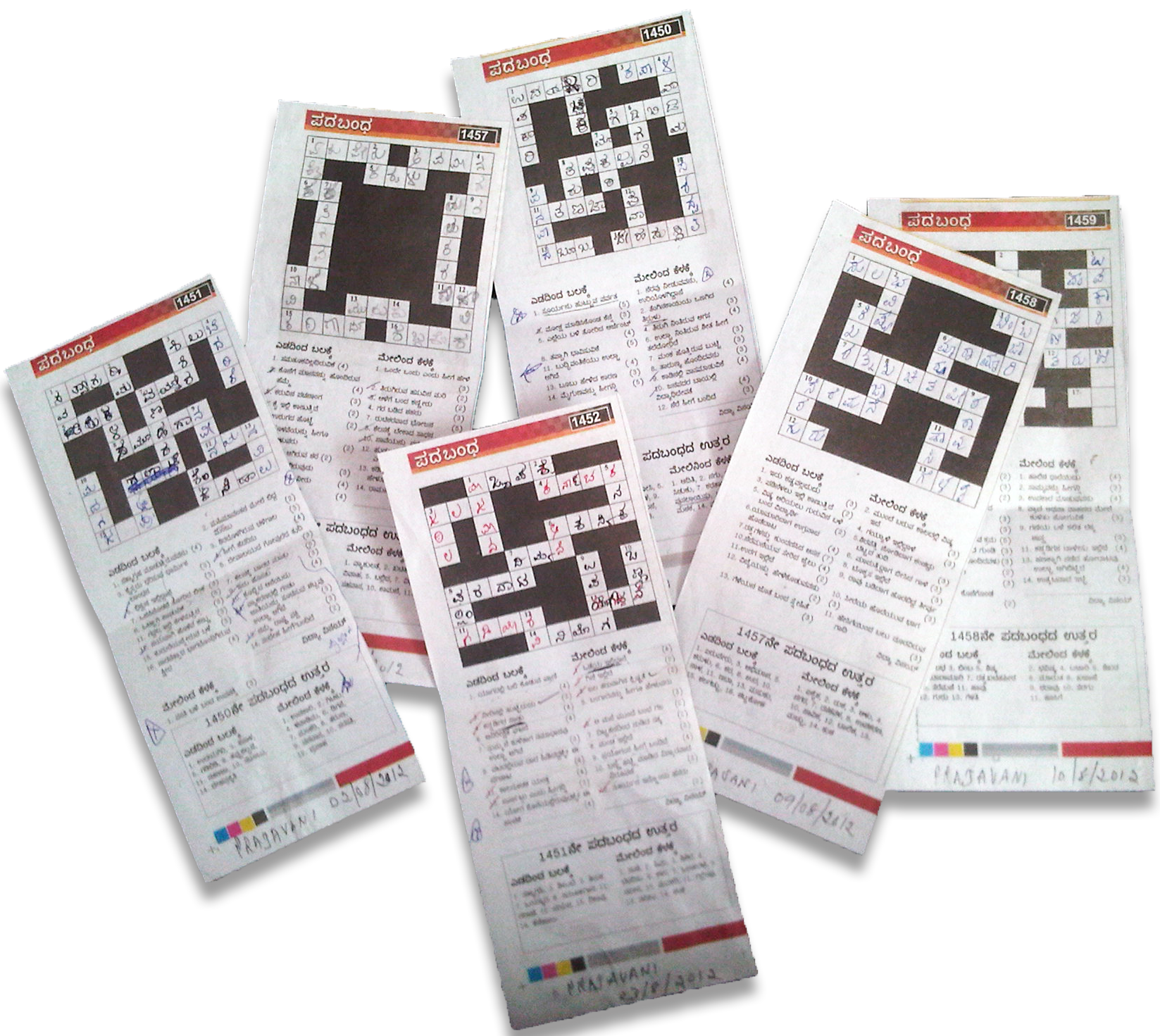
I came across Kannada crosswords being published in mainstream publications:

a 9x9 in PrajavaaNi (from the Deccan Herald group) presently running numbered over 1450,

kannada-crosswords-5prajavani 
(click the image above to enlarge)

a 9x9 KannaDa Prabha (from the New Indian Express Group), presently running numbered over 6250,

kannada-prabha-crossword

a 7x7 in UdayavaaNi (from Manipal based UdayavaaNi group) presently running numbered over 4150.

udayavani

All the three have symmetric grids, more than half blackspace in many cases, triple unches, and sometimes, whitespace islands not linked to other parts of the crossword. I tried all three but found PrajavaaNi, a daily puzzle set by Ms.Vidya Vinay, the most intriguing since the other two did not seem to have any cryptic side to their wordplay[1].

prajavani-crossword-grids

The clue sheet headings are a little more elaborate compared to English: Across is Left to right, Down is Up to down for Down. All three Kannada publications use this wording.

I observed a rummy thing in Kannada crosswords which is not kosher in English crosswords: in an English crossword DEER being reversed as REED is ok, but DEAR cannot be reversed as RAED. But the Kannada crosswords I solved had such instances of grid fills with no meaning, such as #7 below.

The most delightful surprises were some clues that displayed shades of wordplay similar to what we see in English ones:

  1. ಯೋಗ ಕೊನೆಯಲ್ಲಿರುವ ಈ ಹಂಚಿಕೆ (4) (Yoga koneyalliruva ee hanchike)= This distribution has yoga at the end of it
  2. ಪಟದಲ್ಲಿರುವ ದಾರ ಹಿಡಿದಕ್ಕೆ ಈ ಪೇಚಾಟ (4) (PaTadalli daara hiDidakke ee pechaaTa)= This disturbance/dislocation/embarrassment is due to the chart holding the string
  3. ವಸತಿ ಬಳಿ ಬಂದ ಉಪಪತ್ನಿ (3) (vasati baLi banda upa-patni)= The minor wife who came to the house
  4. ಮಹಿಮವಂತನ ಮೇಲೆ ಬಿದ್ದ ಮಂಜು (2) (mahimavantan mele bidda manju) Dew/frost that fell on the famous person
  5. ಸೂರ್ಯನು ಹುಟ್ಟುವ ಪರ್ವತ (4)(suryanu huTTuva parvata)= The mountain where the sun is born(rises)
  6. ನೆರವು ನೀಡುವವನು, ಉರಿಯೋಳಗಿದ್ದಾನೆ (4) (neravu neeDuvavanu, uriyoLagiddane)= Person who helps, is in fire
  7. ತಿರುಗಿ ನಿಂತಿರುವ ಅಗಸ (4) (tirugi nintiruva agasa)= A washerman who is standing, turned/ a washerman who is facing away
  8. ದೊಡ್ಡ ಹಾರೆಯಿದು (3) (doDDa haareyidu) = This is a big garland
  9. ಮಾರುತಿದ್ದಾಗ ಬೀಸಿದ ಗಾಳಿ (3) (maarutiddaga beesida gaaLi) = The wind that blew when selling

No.3 was sheer magic, though the anagram indicator was missing. This is not a rare omission - many a times, anagram and container/contained indicators are not given with clues in Kannada crosswords.

The answers:

  1. ವಿನಿಯೋಗ viniyoga (as in the Sanskrit/Hindi विनियोग) means distribution, investment or putting into, and has yoga as its ending.
  2. ಪರದಾಟ  pardaat means travel (=dislocation), and consists of the word play of insertion of anagram (without indicator) ದಾರ (daara=thread) as ರದಾ inside ಪಟ (paTa=chart)
  3. ಸವತಿ savati=minor (junior/second) wife (as in Hindi सौतन) which is an anagram of ವಸತಿ (vasati=house).
  4. ಹಿಮ hima=dew/frost (as in Sanskrit/Hindi हिम), which is a synonym of ಮಂಜು and is hidden in ಮಹಿಮವಂತನ, a famous person
  5. ಉದಯಗಿರಿ udayagiri (उदयगिरि) there are several places called Udayagiri in South India, which roughly translates to the sun-rise mountain.
  6. ಉಪಕಾರಿ upakaari (उपकारी), person who helps, the outer two characters of this word spell out ಉರಿ (fire) as mentioned in the clue.
  7. ಳವಾಡಿಮ does not mean anything, to my knowledge and subject to correction, but is a reverse of ಮಡಿವಾಳ (Madivala= washerman), also the name of a lake and locality in Bangalore, which probably like the Washermanpet (ண்ணாரபேட்டை/ Vannaarappettai ) in Chennai or Dhobi Talao (धोबी तलाव / धोबी तालाब) in Mumbai was where all the laundering took place in days of yore, and probably continues.
  8. ಗಜರಿ gajari (a type of flower garland equivalent to गजरा, in Hindi), the reference to big may be an allusion to the ಗಜ (गज) which is an elephant (=mammoth/large)
  9. ಮಾರುತ maaruta (मारूत = wind) hidden in the Kannada word ಮಾರುತಿದ್ದಾಗ (maarutiddaga) = when selling

Solve These

Kannada clues set by Kishore:

1. ಭೈರವಿ ರಾಗದಲ್ಲಿ ಹೀಗೆಕೂಡ  ಕರೆಯಬಹುದು ಸೂರ್ಯನನ್ನು (2)
(Bhairavi raagadalli heegekooDa kariyabahudu Suryannu - You can also call Surya thus in the Bhairavi raaga)


2. ಯಾವ ದಿಕ್ಕಿನಲ್ಲಿ ಹೋದರು ಈ ಜಿಲ್ಲೆಯ್ ಹೆಸರು ಓದಬಹುದು (3)
(Yaava dikkhinalli hodaru ee zilleya hesaru odabahudu -Whichever direction you go, you can read this district name)


3. ಈ ಊರಿನ ವಡೆ ಬಹಳ ಹೆಸರಾಗಿದೆ (3)
(Ee oorina vaDe bahaLa hesaraagide - The vaDa (an eatable) from this town is very well known)

Notes:

[1] Except one clue in UdayavaaNi (ಹೇಗಾದರೂ ಬಂಗಾರ – hegaadaru bangaara = gold anyway, with an answer ಕನಕ=kanaka=gold), the answer being a palindrome as indicated by the 'anyway' in the clue.

[2] Another thing that made my day with the PrajavaaNi crossword is the fact that it is adjacent to the Henry cartoon strip, called ಗುಂಡಣ್ಣ, GundaNNa= round elder brother (euphemism for a bald chap) in the Kannada paper. The Henry cartoon was created in 1932 by Carl Anderson and used to appear on the 'filler portions' of Mandrake and Phantom comics published by Indrajal Comics, a rage with kids in India in the seventies and eighties.

Related Posts:

If you wish to keep track of further articles on Crossword Unclued, you can subscribe to it in a reader via RSS Feed. You can also subscribe by email and have articles delivered to your inbox, or follow me on twitter to get notified of new links.

Friday, 20 April 2012

Alphabet Jigsaw Puzzles

As promised in the post on cold-solving, here’s a closer look at a special type of cryptic crossword in which cold-solving plays a significant role - the Alphabet Jigsaw puzzle.

Buzzer This article has been written by Bhavan, also known as the setter Buzzer in The Hindu Crossword. Bhavan lives on the Gold Coast and duels daily with a variety of crosswords from the world over. From his experience of solving and recent foray into creating Alphabet Jigsaws, Bhavan shares with us tips to crack these seemingly unconquerable puzzles and gives us a view of challenges a setter might face while creating AJs, with suggestions to get around them.

What are AJs?AJ-puzzle

Alphabetic Jigsaw puzzles or AJs are typically made up of 26 clues. Each clue is labelled with a letter of the alphabet instead of a numbered slot in the grid. The answer to each clue begins with that same letter.

In a standard cryptic crossword, the solver knows from the beginning where each answer needs to be entered in the grid. In an AJ puzzle, that step also needs to be resolved by the solver, fitting the answers into the grid like in a jigsaw.

Therefore, for a solver, tackling an AJ puzzle is a double challenge and consequently a two-step process:

  1. Solving the clues like in a regular cryptic.
  2. Fitting the answers into the grid without the advantage of knowing where each answers goes.

Background

There seems to be some uncertainty about the origin of this puzzle.

AraucariaCrosswords.com says:

John Graham (Araucaria) is credited with creating this new format of crossword, the 'alphabetical jigsaw' in which the clues are labelled not with numbers but with letters which are the first letters of the solutions; when solved, the answers are to be placed "jigsaw-wise, however they may fit," though of course only one arrangement will work.

Puzzler.com says:

The AJ puzzle appeared for the first time in magazine format in the August 1973 issue of Puzzler. A version of this puzzle, created by John Galbraith Graham (Araucaria) may have appeared in The Guardian at an earlier date, but this has not been verified.

AJ puzzles are a recurring feature nowadays in many publications like The Guardian, The Financial Times, The Daily Telegraph, The Independent. A recent example is the Financial Times 2011 Christmas special by Gozo - a double AJ, in which every letter of the alphabet had two clues. CrOZworld, the magazine published by Australian Crossword Club, carries an AJ puzzle every month.

Puzzles To Try

This AJ puzzle from Puzzler is a good introduction for new solvers. The answers are in the same sheet:
Puzzler Alphabet Jigsaw

These AJ puzzles are from the Guardian, set by Araucaria:

Guardian Prize Crossword No. 25125
Guardian Prize Crossword No. 25262
Guardian Prize Crossword No. 25580

Solving Tips

As a solver encountering an AJ puzzle for the first time, some of these questions will run through your mind:

  • Is it possible that I will be able to cold-solve all the clues because there are no crossings for help?
  • Assuming I somehow accomplish that step where do I start with fitting the answers in?
  • If I can't get all the answers before I start with the jigsaw what are my options?

It looks impossible at first glance but there are few things in your favour:

  1. You have starting letters for all the clues. This is a bigger plus than you realize initially.

  2. A fair setter will ensure that the grid design allows you to try and fit some of your answers – especially the long ones. This means you will not need to cold-solve all the clues before beginning to fit them in.

  3. The minimum number of answers you need to cold-solve depends to a large extent on the shape of the grid and the number of unique length answers. It is not unusual to begin with the longest answers first.

  4. Using the letters available as a result of entering your first answer(s), you can tackle the next set of clues. As you repeat this step, your options narrow down enough to attempt any unsolved answers as well as fit them into the grid.

  5. Sometimes the puzzle will have more than 26 clues with one or more letters giving you two answers. Comparing the answer lengths for such clues with the grid, you can easily identify where they go without even having to solve them.

    As an example, if you look at the Guardian Crossword No. 25262 linked above, you will see that the letters B and J are repeated.

    Take the J clues. The answer to one is 12 letters and the other is 7. The only place in the grid where this can happen is at the very top (row 1, column 3).

    alphabet-jigsaw-1

    Similarly for the B clues with answer lengths of 7 and 5, the only slot in the grid is row 9, column 11.

    alphabet-jigsaw-2

Setter’s View

[As a budding setter, my own experience with AJ puzzles is limited, but penning down the problems I faced and the way I overcame some of them.]

As a setter creating an AJ puzzle, you’ll need to bear a few more things in mind beyond what you would with a regular cryptic.

  1. First and foremost is the grid. While the way you frame the clues themselves is only limited by your imagination, it is your job to ensure that answers have a fair distribution in terms of lengths to help the solvers with fitting them into the grid.

    Look at the first grid. No matter how fair and unambiguous your clues are, chances are your solvers will quickly abandon the puzzle after cold-solving a few clues.

    setting-alphabet-jigsaw-crossword-1

    This second grid on the other hand has a much better distribution of word lengths. The 11 letter answers give a good starting point for your solvers.

    setting-alphabet-jigsaw-crossword-2

  2. Be prepared to spend more time than your average grid fills. It is not going to be easy to find relatively non-obscure words especially with Q, X, Y, Z.

  3. Even when you finalise the words it is going to be a manual trial and error process to fit them into the grid. Software like Crossword Compiler will help you to a certain extent in terms of suggesting possible words.

  4. You can use a grid that contains more than 26 clues and still make an AJ puzzle. The excess clues give you the option to repeat some of the starting letters in your answers. That gives you some leeway in terms of trying to fit the unique answers and also allows your solvers to fix positions for some of the letters in the grid easily.

Useful Links

This article on fifteensquared discusses how to solve an AJ puzzle using Guardian 25484 (Araucaria) as an example.

Update (23rd April 2012): The Stickler (David Stickley), a setter for the Australian Crossword Club, has shared with us an AJ puzzle set by him. Solve it here. More AJ setting tips by him here.

Related Posts:

If you wish to keep track of further articles on Crossword Unclued, you can subscribe to it in a reader via RSS Feed. You can also subscribe by email and have articles delivered to your inbox, or follow me on twitter to get notified of new links.

Tuesday, 3 April 2012

What does cold-solving mean?

cold-solving "The perils of cold-solving a cryptic definition clue!"
"We hope the paper sticks to grids that do not need so much cold-solving."

Common expressions in any crossword forum. If the term 'cold-solving' has perplexed you before, read on to understand what it means.

To 'cold-solve' a clue is to derive its answer without help from crossing answers in the grid. When you start with the first entry into the crossword grid, or when you run an eye over all the clues deducing the answers mentally, you are cold-solving.

"How many clues in this crossword did you solve cold?" can be a way to estimate the puzzle's difficulty. It can also be a marker of the solver's skill.

In theory, it should be possible for every clue in a standard cryptic crossword to get cold-solved since a good cryptic clue is expected have an unambiguous answer. The same does not hold for a quick crossword clue – a quick clue might lead to more than one answer and checking plays an important role in determining which one fits into the grid.

Some hard cryptic puzzles such as the Listener and Azed introduce additional complexity like deliberate misprints in answers, no word lengths, etc. Cold-solving acquires greater significance in such puzzles, as the point at which a solver can start to make entries in the grid depends on a subset of clues that have been cold-solved.

[We'll take a closer look at one such type of crossword in the next post.]

Related Posts:

If you wish to keep track of further articles on Crossword Unclued, you can subscribe to it in a reader via RSS Feed. You can also subscribe by email and have articles delivered to your inbox, or follow me on twitter to get notified of new links.

Thursday, 24 March 2011

Possibly the oldest Nina

[Wondering what a Nina is? Read this.]

Ninas in cryptic crosswords go back a long time. The one I'm writing about appeared in July 1967 – this is so far the earliest known occurrence of a Nina in a cryptic crossword.

You must hear the story behind it before you see the grid.

Alfred Bately, Head Of Maths at Westcliff High School for Boys in Essex in the 1960s, was an ace solver of The Times crossword. When he was due to retire in July 1967, his colleague wrote to the The Times crossword editor to ask if, on the day of his departure, they could include an appropriate clue in the crossword.

The crossword is not a place for passing on personal messages, was the crossword editor's crushing response.

On the last day of summer term at school, the staff of Westcliff High School began doing the Times crossword. They guessed something was up when 1A produced the answer GOODBYE, and then clue after another led to grid-fills associated with the Maths teacher. Evidently the crossword editor wasn't the heartless creature they had taken him to be. The Times hadn't dedicated just one clue to Alfred Bately, they had constructed a Nina for him.

While the rest of the staff was working on the crossword, Alfred Bately was away. A fresh copy of The Times was quickly procured and the blank crossword left for him to decode. We can well imagine how delighted he must have been on spotting the Nina.

Here is the image of this special crossword taken from the 75th anniversay book of Times crosswords, with the grid filled in Peter Biddlecombe's hand. His "o" marks around the grid indicate the thematic answers.

Times Crossword 11,602 - with a Nina 
                       Times Crossword 11,602: Grid with Nina [click the picture to enlarge]

Many thanks to Peter for sharing the details about the Times crossword Nina of 1967.

Related Posts:

If you wish to keep track of further articles on Crossword Unclued, you can subscribe to it in a reader via RSS Feed. You can also subscribe by email and have articles delivered to your inbox, or follow me on twitter to get notified of new links.

Thursday, 2 December 2010

Useful Tools For Crossword Setters

anax03

Guest author Dean Mayer (Anax) talks about tools that he finds most useful as a crossword setter. By the end of this article, you will have an overview of the features these setting tools provide, their differences and some tips to help you decide which one to buy.

Anax is a professional cryptic crossword setter for the top daily crosswords in UK - The Independent, the FT as Loroso and anonymously in The Times. He blogs here and tweets as @anaxcrosswords.

Generally, there is such a thing as good freeware, but when it comes to creating publishable crosswords the only realistic option is to buy a professional package, and for serious setters there are just two big names – Crossword Compiler and Crosswordman. For ease of reference I’ll refer to the former as CC and the latter as TEA (based on its former name of TEA and Sympathy). They both offer an extensive range of features; equally they both have fundamental differences, which is the reason I use both! More of that later.

I’ll try to run through what each of these packages does/doesn’t offer, but from the outset it’s worth mentioning that a new release of TEA is on the way. Although I can’t go into detail, I can say there are significant improvements to what is already an outstanding piece of software, and many of these improvements revolve around the sophisticated wordplay tricks employed by (typically) thematic barred puzzle setters. I know this because, after contacting author Ross Beresford with a small tweak suggestion, he told me a new release was in the pipeline.

So – what does “serious” mean?

OK, if you’ve put together a crossword and want a publication to accept it they will, at the very least, need high resolution grid artworks and typographically faultless clues. In most cases, though, and particularly as regards newspapers, they will already be using either CC or TEA and will expect submissions in one of those formats. Even if newspapers aren’t your target, the ability to export all elements of your work at high quality is of huge benefit. But there’s so much more to it than just artwork. Creating a cryptic crossword (especially) is a labour of love, and full-featured crossword software can actually inspire you to create even better work. Let’s start with CC.

Crossword Compiler

The basic package currently costs €39, but there are a range of add-ons including WordWeb Pro (dictionary and thesaurus), various word lists and a Pro Grid Filler which is most useful for heavily or fully cross-checked puzzles where a manual fill can be extremely difficult. Bought separately these would amount to the princely sum of €188 but you can go all-in for a very reasonable €129 (£109). Is that expensive? I don’t think so. In terms of what it offers the crossword setter it is at least equivalent to what PhotoShop offers the image manipulator for something like £600. Remember, CC is a professional package used by the majority of newspapers – it’s not a toy!

What does it offer? Well, when you launch the software you’ll see this:

01 Crossword Compiler launch

You can see immediately how wide a variety of puzzles it’s designed to help you to produce. For me, that alone is worth the entrance fee. What about those “Other templates”? Whenever you create a puzzle you have full control over its appearance – cell size, line colours and weights, block colours, fonts etc. Any of these can be saved as a template, so when you go to create a new puzzle (let’s say ‘Round Tour’ from that list) all of those previously specified parameters will be in place.

Within any grid design you can assign special values to cells. A numbered cell can use a letter instead, or be left blank – useful for some thematic puzzles – or it can appear in a different colour or have a circle in it. You also have the choice of whether or not to have these format options visible in the solution grid.

Most of the puzzle types have a generous selection of pre-designed grids, but you can also make your own. Selecting the ‘Cryptic or quick’ puzzle you are presented with (I’ve scrolled down to highlight a grid):

02 gridselect

“Fill in alternative blocks” allows you to launch with a basic lattice of alternate rows and columns of 15-letter lights which you can then split up as you wish – “Design the grid myself” launches a completely blank grid. For now I’ll continue with the selected grid above, which launches as:

03 earlygridfill

In this grid I’ve inserted a few answers and highlighted the next one I want to fill; here is one of CC’s most useful features. In choosing the answer here I must be careful about the M which appears in the second intersecting down answer. If I selected DISAMBIGUATE for the highlighted answer it would be impossible to find anything for -M-B---, but CC can tell me this via its search pane:

04 autofind1

Clicking the little grid icon at the bottom of the pane firstly removes any answers that would cause a cross-checking problem, and also highlights the answer which will give the highest number of potential cross-checking answers:

05 autofind2

It doesn’t mean SIGN LANGUAGE is what I’ll choose, but at least the unusable DISAMBIGUATE has gone. When it comes to writing clues CC is helpful in providing a good dictionary and thesaurus (for the record, TEA’s version is pretty much identical in content) and the Clue Edit instruction invokes:
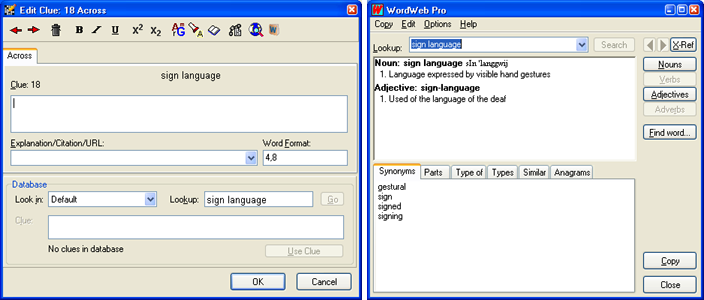
0607 cluepane-wordweb

Immediately evident in the second window (accessed via the top right icon of the toolbar) are the various tabs via which you can select e.g. examples of your answer and even anagrams. To the left of the WordWeb Pro icon is a facility which directs you to online dictionaries where your answer is listed. Two other icons are significant; the “chain” icon lets you link answers whose components are separated in the grid, e.g.:

0809 gridfill2 links

The “book” icon brings up a modest selection of indicators for 1- or 2-letter components. It also lists anagram and some other wordplay indicators which are useful, but it’s at this point TEA comes into its own as it is far superior when it comes to suggesting how answers can be split into wordplay components and how those components can be indicated.

OK, so let’s zoom ahead and see what we can do with a completed puzzle. Above the entry PARTNERS in the sample grid is a button which says “Web Publish”. This brilliant feature starts by offering a huge number of options for how you want your interactive online puzzle to look. The overall applet dimensions, grid cell size, clue panel width, colours, fonts, whether or not to include ‘Reveal’ buttons, timer, even an automatically generated PDF version – all of this and more is at your disposal. Once you’ve made your choices, click “Upload to web” and your puzzle presents itself online, at which point you can add a title, author name, instructions, even a picture if you want one. You can select to make your puzzle public (can be searched by anonymous users) or private (only accessible to those for whom you provide a link) and there you are – an online puzzle for the pleasure of your fans. It’s a doddle.

Well, I say ‘doddle’. It isn’t always a smooth process and if you’ve already got your browser in action before you press “Upload to web” you may get a “Cannot display the web page” message. Just to avoid that frustration, exit your browser first – I do that and never have any problem. Once your puzzle is online, also remember to copy and paste the URL somewhere. You can of course access an admin area to call up the puzzle but making a note of it beforehand is usually more practical.

You can also export your puzzle offline in various formats. For reference I always produce a complete puzzle in a Word doc, with grid, clues, numbered solution and clue explanations; all of these can be copied to the clipboard separately.

You can also export the puzzle as a PDF, or in any of the “display” formats such as AcrossLite, or as simple TXT, or (in the case of grids) a variety of image formats. This grab gives an idea of the options:

10 export

It’s pretty comprehensive! The only not-so-good feature is PDF – while everything works, personally I find the resulting layout a bit clumsy and it’s not very easy to adapt it (there aren’t many formatting options anyway). If you want to generate PDFs I recommend clipboarding everything into Word and using a free PDF generator such as NitroPDF, which produces the file via the print dialogue.

Despite the imperfect PDFs and the limited wordplay facilities it’s hard to give this package anything other than 10 out of 10. In daily use it’s deliciously simple to use and you’re very unlikely to think to yourself “There’s something missing here”. And as for the price… well, I mentioned PhotoShop. I’m also very much into music recording and as soon as you get into professional software as used by professionals the costs become astronomical. CC is professional, and €129 for all of these goodies is exceptional value.

Crosswordman

In terms of puzzle types TEA isn’t a patch on CC, but it isn’t supposed to be. Its creator Ross Beresford has a Listener crossword background and the highly sophisticated nature of this puzzle genre echoes all the way through TEA. The software consists of three main (separately purchasable) products – Sympathy Crossword Construction, TEA Crossword Helper and Wordplay Wizard – I can’t emphasise enough that buying all three is what you really need to get the full enjoyment. If you already have CC it could be argued you don’t really need TEA Crossword Helper, but since the entire package costs £129.95 it’s worth the £25 of that for TEA, if only for the convenience of not having to switch between applications!

INCIDENTALLY – for both CC and TEA, after ordering online you receive a download link for the software; you don’t need to sit around waiting for a CD-ROM to arrive (although that is an option).

When you launch TEA this is what you get:

11 TEA launch

There are fewer toys to play with than CC but, as you can see, everything revolves around puzzles for which you will be writing clues. Preset grids are available and, of course, you can design your own – and you also get the standard sets of Times and FT grids. Note that both of these are incomplete; the Times recently launched a handful of new grids and new ones have been appearing in the FT too; these will be incorporated in the new release of TEA.

Once you have selected a grid you can also choose which of the inbuilt word lists to use, and TEA’s implementation of this is, I think, better than CC in that all of the word lists appear together rather than under separate tabs:

12 searchpane1

There is also the ability to check the dictionary entry for an answer by highlighting it in the list and keying Ctrl + Enter, which is helpful in deciding if the definitions point towards a good clue in conjunction with whatever wordplay elements you uncover. The “Sport” word list is one I created, so TEA’s dictionary won’t feed off its entries. The same applies to entries which have an italicised dictionary citation – you’ll need to refer to the appropriate dictionary for a definition (but most of us have at least one dictionary, don’t we, if we’re ‘serious’ crossword setters?).

Like CC you can chicken out and let the software fill the grid, but TEA recognises that giving the setter no choice in this process may be a bad thing, so you can opt for an interactive fill. This is especially clever:

13 interactivefill

TEA examines the grid and calculates which light should be looked at first to (hopefully) ensure maximum fillability. It then “scores” each potential answer to show which will offer the greatest number of options as you continue the fill.

Filling the grid is fun enough, but TEA’s first major difference versus CC is the way you can search its wordlists. Built into its engine are various parameters which you can use to look for anagrams, part anagrams, specific letter patterns and much more. I like to produce the occasional pangrammatic crossword, and when I have just a couple of slots left it’s great to be able to insert a string such as:

14 searchpane2

TEA instantly offers SILVER FOX and SULFOXIDE as entries which match my requirement for a 9-letter word starting S-something-L and containing the letters F and X somewhere. And supposing I want to make a themed crossword where several anagrammed answers contain the name of a tree? Easy – I choose a tree, plant it in the search string and away we go:

15 searchpane3

There are a great many search templates to use, employing choice lists, variables and macros, and sometimes it’s a fascinating exercise just to play around with those. An example from the help file illustrates a search input as L[^AEIOU]... - in other words it will look for 5-letter answers starting with L but with a consonant as the second letter. Digits can be used to “lock” particular letters, so .11...11.. will produce a list of answers where the second, third, seventh and eighth letters are the same, as in FOOTSTOOLS, whereas .11...22.. will read as the same pattern but with a different double letter towards the end of the word, as in BOOKSELLER. Because most of the patterns can be used in combination you end up with an almost endless array of search possibilities.

The tricks are not confined to patterns for individual lights. Gimmicks can be added to puzzle fill, such as letters latent or misprints using this dialogue:

16 gimmicks

Once again, it’s worth mentioning that further gimmicks will be available when the new version of TEA is released.

As for the grid fill, I’d say there is only one area where I think CC has the upper hand, and that’s the process of linking lights to form single answers. It can be done in TEA, of course, but the CC version is far more straightforward. However, I believe that in the new release it will be possible to highlight separate lights in the grid, in any order, search for answers fitting the resulting pattern and automatically link them, so it could turn out that TEA will win that contest.

When an answer has been placed in the grid, there is no need to click an icon to begin writing its clue. A correctly placed double click on the answer itself will invoke the clue-writing pane:

17 cluetext

As the tabs indicate, TEA offers plenty of scope for ‘unusual’ extras for an answer or its corresponding light, but below the ‘Clue’ window is a button of particular importance. The Clue Workshop (sold separately as Wordplay Wizard) is an aspect of TEA that isn’t just good – it can, and probably will, help you to become a better cryptic clue writer. I’ve been setting cryptics for more than thirty years, but Clue Workshop has a habit of showing me ideas which I may have missed had I been working without it.

18 clueworkshop

Arranged in order of the number of wordplay components, the Workshop offers an often bewildering array of breakdowns which recognise deletions, charades, anagrams, reversals, containers, alternate letters and more. You’ll notice that each offering features items in red and blue text. A right click of blue items reveals a list of abbreviations pertinent to that letter or pair of letters. This list also indicates how commonly known those abbreviations are, so you can select one according to your target audience or according to what is sanctioned by your crossword editor. A right click of the red items leads to wordplay indicators for anagrams, charades, containers, reversals etc.

Although I haven’t gone into a huge amount of detail about this aspect of TEA, it is in my opinion an aspect of the software which is massively important for setters of all standards. Although, to be honest, I wouldn’t recommend it (because the rest of the package is so good) Clue Workshop is available as a separate module which you can use outside of TEA.

Puzzle export from TEA is perhaps not as extensive as CC but what it offers is generous enough to cover everything you are likely to need:

19 export

Since one of the export options is Across TEXT it is easy to create the full puzzle format ready for use in AcrossLite.

CC and TEA both display your work in progress, but do it differently. In CC you open a separate window to see the clues written so far, while TEA presents a full page with title, grid, preamble and clues on view. Neither is superior to the other, but it’s something to bear in mind if one option is preferable to the other.

Which one to buy?

To be absolutely honest, if your budget can stretch that far you really should go for both, as both packages are packed with useful features, a small number of which are unique but well worth having. However, buying both will set you back about £250 (on average I suppose that equates to about two published UK newspaper crosswords), so what if it really comes down to one or the other?

If you want to concentrate on sophisticated, inspired cryptic crosswords TEA looks to be the only option. The only (fairly small) downside to this is that newspapers tend to prefer submissions in CC – I set for the Times, FT and Independent and all of these request crosswords as CC files. I’d say the Independent is the most insistent because the online puzzle uses CC’s Java applet; the Times and FT do their own thing.

For me, I have to say I couldn’t manage with just one of the two. Overall, CC edges it in terms of simplicity and ease of use, while TEA has those features which make the clue-writing process hugely enjoyable and inspiring. I actually had an ancient demo version of TEA for several years, but later chose the full download of CC because at the time I was producing sudoku puzzles for my own website. Just over a year ago, after seeing that TEA had developed significantly compared to my old demo, I downloaded that too.

Before I toddle off for a coffee and resumption of my latest brain-killer, I should mention that CC and TEA aren’t the only packages out there. Crossword Maestro and Crossword Weaver are two others which spring to mind, but I’ve never used them so can pass no comment – perhaps others would like to chip in?

Links:

Crossword Compiler: http://www.crossword-compiler.com/
Crosswordman: http://www.crosswordman.com/

Related Posts:

If you wish to keep track of further articles on Crossword Unclued, you can subscribe to it in a reader via RSS Feed. You can also subscribe by email and have articles delivered to your inbox, or follow me on twitter to get notified of new links.