Showing posts with label evaluation. Show all posts
Tuesday, 10 March 2020

Prize Puzzle: Hindi Crossword 7 – Solution and Winner

We have received your answers and your feedback to Prize Puzzle: Hindi Crossword 7. It is time to give out the solution, reflect on your responses, and announce the name of a lucky winner.

Hindi Crossword 7 - Grid with Solution

आर-पार

क्रमांक संकेत उत्तर टिप्पणी
1 थोड़ी मुश्किल है, थोड़ा झेलिये,
और शब्द बताइये एक मेरे लिए (2)
मुझे मु (of मुश्किल) + झे (of झेलिये); Definition: मेरे लिए
2 आप और मैं अंग्रेज़ी भुगतते हैं,
ये रेल या बस में साथ चलते हैं (5)
हमसफ़र हम (आप और मैं) + सफ़र (भुगतते in English); Definition: ये रेल या बस में साथ चलते हैं
5 देसी खाने को जब सीने से ना लगाया
तब आँखों ने क्या किया? (2)
देखा 'देसी खाने' without 'सी ने'; Definition: आँखों ने क्या किया
7 गंभीर रॉय, शुरू से
घोष के सर के पीछे पड़े (2)
घोर र (start of रॉय) after (घो head of घोष); Definition: गंभीर
8 ये हुआ तो शेष,
कुछ हकलाया तो शिशु? (2)
बचा The answer, when stuttered, becomes बच्चा (शिशु); Definition: शेष
10 लड़की यूँ हिली
कि टहनी मिली (3)
लकड़ी Anagram (यूँ हिली) of लड़की; Definition: टहनी
12 गाय के सर पर तिनके का टुकड़ा पड़ा है,
बूझो तो जाने कि उसकी रफ़्तार क्या है? (2)
गति To ग (the head of गाय) is attached ति (a piece of तिनके); Definition: रफ़्तार
13 सूजी नहीं! ये होना,
मतलब चले जाना (3)
रवाना रवा (सूजी) + ना (नहीं); रवाना होना means चले जाना
15 करुणा के लिए हाथ,
कुछ ममता के साथ (3)
करम कर (हाथ) with म (कुछ ममता); Definition: करुणा
17 आपने तकल्लुफ़ बिन,
शुरुआत में रखी संस्कृत लेकिन
जब अंत का अवसर आया
मुझे हरियाणवी से रंगा पाया (3)
तुमने तु (संस्कृत 'लेकिन') + मने ('मुझे' हरियाणवी से रंगा); Definition: 'आपने' तकल्लुफ़ बिन i.e. informally
20 बनके राजा इंदौर का,
खोया हिस्सा लाहौर का (3)
होकर होलकर (राजा इंदौर का) lost ल (हिस्सा 'लाहौर' का); Definition: बनके
22 मशहूर शायर अमरोही
की कलाम बड़ी अनोखी (3)
कमाल Anagram (बड़ी अनोखी) of कलाम; Definition: मशहूर शायर अमरोही
23 नहीं नहीं, लगाना पड़ेगा मानद प्रत्यय
जभी परिवार के वरिष्ठ सदस्य मिल गये (3)
नानाजी ना + ना + जी (मानद प्रत्यय); Definition: परिवार के वरिष्ठ सदस्य
25 एक आँख वाली निगले थोड़ी मिश्री
ताकि वह बन सके एक सुंदर स्त्री (3)
कामिनी कानी (एक आँख वाली) swallows मि (a bit of मिश्री); Definition: सुंदर स्त्री
27 बेवक़ूफ़ दफ्तरकर्मिंयों के मुखड़ों को आग लग जाएगी
तब कहीं जाके वो साफ़ बन जाएगी (3)
बेदाग बे द (the fronts of बेवक़ूफ़ and दफ्तरकर्मिंयों) + आग; Definition: साफ़
28 सोने का पर्याय,
जो सीधा-उल्टा समान नज़र आये (3)
कनक कनक is a palindrome, and a synonym (पर्याय) of सोना
30 बहस में उलझे कुछ अक्षर
उनको रिहा कर या बर्दाश्त कर (2)
सह Anagram of हस from बहस; Definition: बर्दाश्त कर
31 एक प्राणी का नाम तुम कहना
जो कूदके बन सकता है वरना... (3)
वानर Anagram of वरना; Definition: एक प्राणी
33 सीता शायद ऐसी थी,
धीरे धीरे बोलती थी,
पंक्ति का पहला अक्षर लेती थी,
और भोली भाली बनती थी (2)
सीधी First parts of the first two lines: सी and धी; Definition: भोली भाली
35 मामी का एक हिस्सा और दादी का एक हिस्सा,
दोनों असल मे क्या है, यही है किस्सा (2)
मादा मा (मामी का एक हिस्सा) + दा (दादी का एक हिस्सा). Both मामी and दादी are female.
36 इसको पहनोगे आप यदि,
तो दिखेगी एक छोटी नदी (2)
चश्मा d&cd; you wear a चश्मा to see, and चश्मा is also a rivulet
37 पहले-पहल मेजर हरिवंश राय बाहर निकलता,
और बहुत दयालु दिखता (4)
मेहरबान Acrostic - initial letters from 'मेजर हरिवंश राय बाहर निकलता'; Definition: दयालु
38 कुछ मेघ नाकाम होते है,
लेकिन वह ठोस होते है (2)
घना Hidden in 'मेघ नाकाम'; Definition: ठोस

नीचे की ओर

क्रमांक संकेत उत्तर टिप्पणी
1 मुझे कुछ लफ्ज़ पहले जोड़ के दिखाओ,
कली के लिए एक और शब्द बताओ ( 3)
मुकुल Acrostic - initial letters from 'मुझे कुछ लफ्ज़'; Definition: कली
2 प्रत्येक सरहद-वासी ऐंठा हुआ है
वह राज़ छुपाए बैठा हुआ है (2)
हर Wordplay 1: Hidden (छुपाए बैठा हुआ है) in 'वह राज़' 2. Wordplay 2: Hidden (वासी) jumbled (ऐंठा हुआ है) in 'सरहद'; Definition: प्रत्येक
3 संगीत के सुर सात ही,
मगर सातों में बद्ध अवरोही (4)
सरगम Hidden (बद्ध) reversed (अवरोही) in 'मगर सातों'; Definition: संगीत के सुर सात
4 अरबी की छाल फेंक दो,
छिपा हुआ ख़ुदा देख लो (2)
रब Remove (छाल फेंक दो) of 'अरबी' to find a hidden रब (ख़ुदा)
6 ले कोठरी के भीतर रखना,
फिर इसे निगल जाना (1,2)
खा लेना ले inside खाना (कोठरी); Definition: निगल जाना
7 जो उसकी जान तक ले जाए वर,
बारातियों के बीच मिले वो जानवर (2)
घोड़ी CD - reference to the Indian wedding tradition of the groom arriving on a mare.
9 समाचार में दिखे समान,
ये है इस संख्या की पहचान (2)
चार समाचार with no समा (i.e. समा न); Definition: संख्या
11 जिसको खाने से बात का वजन बढ़ जाता है,
उसका पेट काटने से कम हो जाता है! (3)
कसम क[स]म = कम; Definition: जिसको खाने से बात का वजन बढ़ जाता है, a reference to कसम खाना
14 बहुत अच्छे! जब मिली पहली कमाई
सामान ले जाने का साधन ले आई (3)
वाहक वाह (बहुत अच्छे)+ क (the first of 'कमाई'); Definition: सामान ले जाने का साधन
16 नसीरुद्दीन शाह की पत्नी को हाथ लगे
बहुमूल्य हीरे जवाहरात के खान मिले (4)
रत्नाकर रत्ना (नसीरुद्दीन शाह की पत्नी)+ कर (हाथ); Definition: बहुमूल्य हीरे जवाहरात के खान
17 तुरंत लाओ नाश्ते के पहले वाले निवाले
तो तुमको एक अलग तरह का उपमा मिले (3)
तुलना First bits of 'तुरंत लाओ नाश्तों Definition: upma = simile, comparison
18 "आज़ाद हिन्द फौज" के नायक
बने अभिनेता जीतेन्द्र दिल से, कुछ हद तक (3)
नेताजी Hidden within (दिल से, कुछ हद तक) 'अभिनेता जीतेन्द्र'; Definition: "आज़ाद हिन्द फौज" के नायक
19 "चलते चलते" तुम याद रखना,
कभी यह लफ्ज़ ना कहना (4)
अलविदा CD - reference to the lyrics of the song 'चलते चलते...कभी अलविदा ना कहना'
20 त्यौहार में होगा जिसका दहन,
वो है प्रह्लाद के पिता की बहन (3)
होलिका CD - reference to the legend of Holika
21 गड़बड़ नीरज का किया,
नाम निशा का दिया (3)
रजनी Anagram (गड़बड़) of नीरज; Definition: निशा
24 "गणना न कर" मानो याचना है म्हारी
कल्पत किस्सों में अक्सर होती हूँ इच्छाधारी (3)
नागिन गणना न कर = ना गिन; Definition: कल्पत किस्सों में अक्सर होती हूँ इच्छाधारी, alluding to shape-shifting snakes in folklore
26 कुछ हद तक शामिल नहीं
फिर भी यह संगम सही (3)
मिलन Hidden in 'शामिल नहीं'; Definition: संगम
27 एक-एक चुटकी बेसन, हल्दी, तिल और राई के डालो,
सब जुड़ जाएं तो अच्छा बना लो (4)
बेहतर Acrostic - pick and join the tops from 'बेसन हल्दी तिल राई'; Definition: अच्छा
28 नैतिक वचनों में निमग्न हैं इस रक्षक के वर्ण
जिसके प्रख्यात भेंटकर्ता हैं दानवीर कर्ण (3)
कवच The letters (वर्ण) of this protector (इस रक्षक) are hidden (निमग्न) in 'नैतिक वचनों'; Definition: जिसके प्रख्यात भेंटकर्ता हैं दानवीर कर्ण, alluding to the story from Mahabharata
29 एक रस्सी के अंतिम हिस्से लो
दोनो बांध के खिंची हुई कर दो (2)
कसी Pick and tie together the last letters from 'एक रस्सी'; Definition: खिंची हुई
31 11 जैसा ही एक और बार,
ये आधे से कम स्वादानुसार (2)
वादा under 50% of 'स्वादानुसार'; Definition: synonym of 11d (कसम)
32 चना जोर की चाट जो ना खाए,
उसे सृष्टि कहकर बुलाया जाए (3)
रचना Anagram (चाट) of (चना जोर) without जो; Definition: सृष्टि
34 गधी! मेले में कुछ ढूंढ ले
जवाब पाओगी हौले हौले (2)
धीमे Find the answer inside 'गधी मेल'; Definition: हौले हौले
35 नाम को कर डाला रद्दी,
फिर भी मिली प्रसिद्धि (2)
मान Anagram (कर डाला रद्दी) of नाम; Definition: प्रसिद्धि

The Theme

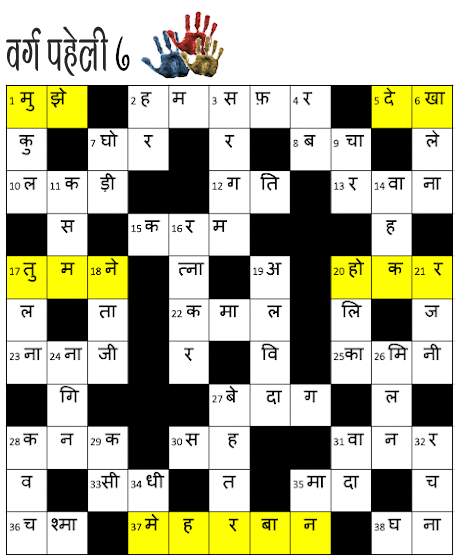
The grid packs within it a Nina: तुमने मुझे देखा होकर मेहरबान, the opening line of Rafi’s song from the film Teesri Manzil (1966).
Hindi Crossword 7 - Grid with Theme

Our alert solvers who identified the theme correctly:

Himanshu Rajurkar
Narayan Mandyam
Vasant Srinivasan
Supriya Mithal

Looking back at the puzzle…

This puzzle was voted as tougher than our previous ones [1, 2, 3, 4, 5, 6] by many of you – and we can see why. Clueing as couplets is not just hard for the setter, it also adds a layer of complexity for the solver.

We trust you enjoyed the challenge nevertheless. One kind solver wrote:

More than the novelty of a Hindi cryptic, I liked the usage of couplets in setting the clues. This was extremely creative and led to some funny clues as well (if you just were to read these as mere couplets instead of clues). In particular, I found these quite funny: 7D, 35D, 27A and these very clever: 2A, 17A, 8A.

…which made me recall how setting / reviewing these clues had me chuckling!

Conjunct consonants: A chicken-and-egg problem

This crossword highlighted a peculiar predicament we face with Hindi grids, in the use of conjunct consonants. We make an effort to place words with conjunct consonants in the grid as they bring in variety and freshness, but these characters tend to go into unchecked slots - it is nearly impossible to find crossings for them. You would notice this happening with चश्मा (36a), रत्नाकर (16d).

So, even though 36a and 16d are 50% checked, the checked vs unchecked cells for them are unequally balanced because of the nature of characters filling them.

Many solvers stumbled over the answers for 36a and 16d in this puzzle.

There is no clear way out of this situation, except that as setters, we can be mindful of keeping the clues for such words accessible.

Aisa karam na kijiye…

The unchecked first cell for 15a and its not-too-obvious definition (करुणा) seems to have caused confusion. This clue received the maximum variations in the submitted solutions: मरम, नरम. कृपाम…

Upma uproar

In your responses, 17d (तुलना) was easily the most talked about clue of this crossword. The setter's trick here was to position "upma" as the breakfast dish on the surface, when actually referring to "comparison" in its cryptic reading.

तुरंत लाओ नाश्ते के पहले वाले निवाले
तो तुमको एक अलग तरह का उपमा मिले (3)

Many solvers cited this as their LOI, and they reacted to the penny-drop with a range of responses: "very deep", "very smart" to “gender error” – upma is masculine when we talk of breakfast (सूजी का उपमा) , but feminine in the sense of comparison (जिसकी उपमा ना दी जा सके). Should the gender on the surface match that of the answer? The jury is out on this one, but I understand if this is considered unfairly misleading, much like the "to" connector issue in English cryptics.

Such a mismatch can be circumvented by framing the clue differently (or shall we say, एक अलग तरह का) to avoid a gender reference altogether. Note to self for the future.

No two-threes, please!

A regular solver sent in this request:

…please spare us the two and three letter words and if possible, create a software to solve online, as One Across group. It is such a nuisance, to get a printout and the flipping and flitting between the clues and the grid…

You might as well have asked us for a million dollars and world peace. Much as Kishore and I would like to address these wishes, doing so is beyond our capabilities. To set a Hindi crossword grid with the fundamentals of symmetry, checking, connectivity in place, without any word suggestion software to help, is a task so tough that it takes enormous will and effort to bring it to fruition. Please read this article to see what we are up against: Why Hindi and cryptic crosswords do not mix. The only way we manage is with two and three letter words surrounding the longer ones. I can hardly imagine how we would set without these little helpers!

Software to solve Hindi crosswords interactively: if such software already exists, or someone can help to build one, we would love to try it out. Please let us know.

Those who solved it all…

Kudos to the solvers who got all, or nearly all, answers correct:

Sanjay Sinha Lakshmi Vaidyanathan
Vidyadhar Gadgil Himanshu Rajurkar
Vinayak Rao Ekbote Narayan Mandyam
Ramki Krishnan Vasant Srinivasan
Raju Umamaheshwar N Anantakrishnan
Shalini Vasant Balwant Singh
Supriya Mithal  

A special applause for first time/non-regular cryptic solvers. Even if you did not make the shortlist, it is impressive that you solved as much as you did. I hope you enjoyed tackling the puzzle even if each clue did not fall.

The draw of luck

Of the 13 above, 11 got every detail right - one lucky winner of them will get the prize. Let's see who...

For the draw, we used a Java program with the Random class and executed it online. The program and the draw in action are available in the embedded video. [RSS/email subscribers: You may have to go to the blog for the video.]

Hearty congratulations, Sanjay Sinha! Please write to me and claim your prize.

Related Posts:

If you wish to keep track of further articles on Crossword Unclued, you can subscribe to it in a reader via RSS Feed. You can also subscribe by email and have articles delivered to your inbox, or follow me on twitter to get notified of new links.
Thursday, 28 April 2016

Definition/Wordplay Etymology Crossover

Definition Wordplay Etymology CrossoverTake a close look at this clue:

Away from home, in the open, dies in battle (7) OUTSIDE
OUT (in the open) (DIES)*; Definition: away from home

The etymology of OUTSIDE is OUT + SIDE, so the clue partly recycles the definition of OUTSIDE in its wordplay OUT (DIES)*.

Try another:

What's used as a religious setting on a piece of furniture (7) RETABLE
RE (on) TABLE (piece of furniture); definition: what's used as a religious setting

The word RETABLE originates from medieval Latin retrotabulum which stands for 'rear table'. In this clue's wordplay, RETABLE splits along its natural etymological join (RE+TABLE), with TABLE retaining its furniture meaning.

Both of those clues show signs of definition/wordplay etymology crossover.

Understanding "definition/wordplay etymology crossover"

When the wordplay of a cryptic clue is etymologically related to its answer, it is a case of definition/wordplay etymology crossover.

You have a definition/wordplay etymology crossover on hand if:

  • The answer is SPACESHIP, the wordplay is SPACE + SHIP
  • The answer is LULLABY, the wordplay is LULL + [b]ABY
  • The answer is MECHANIC, the wordplay is (MACHINE)* + C
  • The answer is ENCLOSES, the wordplay is mEN CLOSE Something [T]

Is this wrong?

In double definition clues, it is widely accepted as good clueing practice to avoid etymology crossover between the two definitions. The same isn't universally followed with other clue types.

In his CU interview, David Stickley mentioned the "no definition/wordplay etymology crossover" rule as applicable to US cryptics, while being acceptable as a setter's tool in UK and Australia. I notice though that some setters of UK cryptics too avoid this device.

In his blog, Australian setter David Astle calls out such clues as "hookworms" in round-ups of weakly constructed clues.

Definition/wordplay etyomology crossover often results in wordplay that is not very cryptic. Crafting a smooth surface exacts less imagination from the setter when the wordplay echoes the definition.

What do you think?

Fine or flawed – what's your take?

Solve These

Three words, two clues for each word: one with definition/wordplay etymology crossover, the other without. Enjoy solving and spotting which one.

Rampant war arising always without peacekeepers (7)
One's taken flight to travel across the Channel (7)

Gangster abandoning accepted rule (4)
Turned on by jolly type (4)

Lost hour of sleep's restored (8)
To expect little is being negative (8)

[Thanks to setter Aakash Sridhar (Axe/Exa) for contributing all the clues for this post.]

Related Posts:

If you wish to keep track of further articles on Crossword Unclued, you can subscribe to it in a reader via RSS Feed. You can also subscribe by email and have articles delivered to your inbox, or follow me on twitter to get notified of new links.

Monday, 25 April 2016

&Lit Clues That Do Not Deceive

andLit Clues That Do Not DeceiveOne of the hallmarks of a strong cryptic clue is a misleading definition. Some definitions are so creatively done that they stick long after one has solved the puzzle.

Guardian 26720 (Arachne): Part of autumn operation employs army swimmers (9) OCTOPUSES
OCT (part of autumn) OP (operation) USES (employs); definition: army swimmers

An important component that helps with disguising the definition is the alternate route to the answer. In the OCTOPUSES clue, "...autumn operation employs..." primes the solver to think of "army" of the military kind, steering the mind away from the "arm-y" interpretation.

Camouflage of this sort can be very challenging to execute in an &lit / semi-&lit clue. No alternate route exists in this clue type to contribute to surface misdirection. Additional constraints are at play: besides being accurate, the definition must also coincide with the wordplay without coming across as forced.

As a result, often, the &lit definition ends up being so direct it can be solved as a straight clue.

Independent 9103 (Klingsor): This country abuts Russia's borders in east (7) UKRAINE   
UK (this country) R[ussi]A IN E

THC 11583 (Vulcan): That which manages dirty clothes at home (7,7) WASHING MACHINE
(WHICH MANAGES)* around IN (at home); semi-&lit

The clues above are solvable from the surface meaning alone. As self-contained definitions, they are absolutely brilliant. But as cryptic clues, they do not venture to deceive.

Solvers: Do you notice a lack of misdirection in &lit clues?
Setters: When you write an &lit clue, do you keep an eye on the obviousness of the definition?

If, for the sake of a good &lit, the setter has to sacrifice one element out of accuracy / surface sense / deception – I guess it is wisest to let go of deception!

I leave you with a couple of &lit-type clues that work beautifully without giving away the answer:

FT 14737 (Alberich): A tall tree tumbles, trapping one? That will do (10) ALLITERATE
(A TALL TREE)* around I; D-by-E semi-&lit

Sunday Times 4650 (Dean Mayer): One trusted to get "creative" with books? (3,7) ART STUDENT
A (one) (TRUSTED)* NT (books)

Solve These

Enjoy solving these lovely &lit clues notwithstanding the straightish definitions.

Indy 8031 (Dac): In this, one may be flung out of car hitting tree (5)
FT14828 (Alberich): Lad regularly plunging into water, after small round object? (5,5)
Clue by Rufus: Make hale? (4)

Related Posts:

If you wish to keep track of further articles on Crossword Unclued, you can subscribe to it in a reader via RSS Feed. You can also subscribe by email and have articles delivered to your inbox, or follow me on twitter to get notified of new links.

Wednesday, 9 March 2016

Coincidence or Plagiarism: How do we tell?

Plagiarism or Coincidence in Crossword PuzzlesThe crossword world has been abuzz with this FiveThirtyEight report for the past few days. The investigation and its aftermath have spawned several threads of conversations about plagiarism in puzzles.

In this case, the data is so overwhelming that it leaves no doubt - but often the difference between plagiarism and coincidence is not so marked. A few clues with shades of similarity, a brilliant clue that was done before, an identical theme, even a full puzzle almost like another – any of it can happen by sheer chance.

In 2015, two consecutive Guardian prize puzzles by different setters carried the same theme of US Presidents – the grid fills naturally shared common entries, and what was arguably the cleverest clue in both employed the same wordplay device.

In 2009, two American crossword setters produced crosswords with a theme that, on the face of it, doesn't look like it could get repeated: phrases with the word RAVEN embedded inside. Both puzzles had near-identical theme entries in the exact same places in the grid. Matt Gaffney, the setter of one of those puzzles, wrote about how such a thing could happen independently and coincidentally.

Earlier when I spotted similar clues across crosswords, I used to blog about it (Déjà Vu, The Times Squires). I discontinued doing so as finding such commonality turned out to be too frequent to be post-worthy. Talented wordsmiths can surely see without external prompting that a TARANTULA is "natural at spinning" or a RHINO is a "one-horn animal" – it surprises me no more to find these words clued by different setters in the same style.

Arden Anax Clue Similarity

Some words (extra risotto, anyone?) are grid-friendly and will show up often in crosswords. Some words can be treated for clueing in only so many ways. Sometimes the ways of word breakup are many but two setters pick the same idea since it produces a great surface.

In clue-writing contests such as CCCWC, which do not make the entries public till after the deadline, participants cannot possibly copy/get inspiration from other participants' clues. And yet, declare the clue word CLEMENTINE and three entrants turn in "Papal cross? (10)".

So how do we identify a case of wilful copying?

If a setter does actually lift/tweak another setter's work, it is hard to tell when the instances of resemblance are few and the clues in question aren't markedly different from the setter's usual style. Only the setter knows!

I believe that we should be careful in using the P-word unless the evidence is very strong, such as:

  • Repetitions over a large volume of puzzles
  • Wide variation in quality of puzzles/clues by the setter
  • A pattern of resemblance to others' work especially in the long grid fills, where the potential for copying is the highest

The recent case reveals another tell-tale sign: expressing a disregard for the puzzle that your own work closely resembles. Not a fan, never have been a fan? If these repetitions were by chance, the setter/editor would like the crosswords that happen to be uncannily similar to his own!

Sometimes even a single clue can raise suspicions of copying. Say an amateur setter whose clues are generally unremarkable writes a brilliant clue on social media. There will be those who notice this anomaly and search for the clue online. If they find that this clue resembles a winner on another CWC, they will suspect. If this happens over and over, they will be sure. There may not be charges of theft made openly, but people watch, people know!

With publicly available puzzle databases and advanced search tools online, plagiarising puzzles/clues is easy. What is also easy is getting caught. The same puzzle databases and advanced search tools are available to consumers of puzzles. Puzzle solvers are smart and curious and driven to unraveling mysteries. Plagiarism in puzzles, if attempted, is bound to come out sooner or later.

Related Posts:

If you wish to keep track of further articles on Crossword Unclued, you can subscribe to it in a reader via RSS Feed. You can also subscribe by email and have articles delivered to your inbox, or follow me on twitter to get notified of new links.

Tuesday, 30 June 2015

Parallels Between Cryptanalysis and Crossword Solving

Fialka Cipher Machine During World War II, recruiters for Bletchley Park had looked for crossword solvers to join them, as it was believed that crossword experts would be good codebreakers. [The story is that in 1942, a challenge was issued to solve a Daily Telegraph crossword in under 12 minutes. Shortlisted candidates were invited for a live crossword test, after which six solvers were recruited.]

Bletchley Park's successes during the war proved that their crossword-inclined hiring policy worked. But have you wondered if this correlation was incidental? Interestingly, NSA's chief cryptologist William Friedman might have wondered so – in the treatise Military Cryptanalysis (originally dated 1938, 4th Edition dated 1952), under the heading "Mental equipment necessary for cryptanalytic work", he made a strong case against correlating cryptanalysis with crossword solving.

The present author deems it advisable to add that the kind of work involved in solving cryptograms is not at all similar to that involved in solving crossword puzzles, for example. The wide vogue the latter have had and continue to have is due to the appeal they make to the quite common interest in mysteries of one sort or another; but in solving a crossword puzzle there is usually no necessity for performing any preliminary labor, and palpable results become evident after the first minute or two of attention.

He went on to elaborate on the points of difference between the two skills (section I, p2).

Now try this: exclude that specific warning and replace 'cryptanalytic' with 'crossword solving', 'cryptogram' with 'puzzle', etc. in the manual's description of the "mental equipment". Do you also see that large excerpts of the text could pass off as a guide for crossword solvers?

I was especially struck with these parallels while reading Simon Singh's The Code Book, a narrative about the evolution of cryptography. In the hunt for structure and hidden meanings in text, in the battle of wits between codemakers and codebreakers, the similarities between cryptanalysis and crossword solving are hard to miss. A few examples of cryptanalytic techniques and their crossword parallels:

Frequency analysis

Every letter of a language has distinct character. The frequency with which the letter appears in text, the way it positions itself with respect to other letters in the alphabet, the types of letter clusters it appears in – all make the letter uniquely identifiable.

The frequency distribution of letters (singly or in sequences), a powerful tool for cracking substitution ciphers, has similar applicability in crossword solving – though we usually process this information instinctively rather than formally.

The appearance of more than one low-frequency letter (J K Q X Z) alerts the solver that the grid could be a pangram.

Longer letter sequence frequencies provide strong hints about possible answers in the crossword grid. Solvers watch for clusters like IN-, RE-, TH-, -ING, -TION in answers since they are occur commonly in English. When tackling a checked answer slot, say one that starts with ?H- or ends with -T?C, one can eliminate many letters from matching the ? because the resulting clusters do not appear in natural English words. 

Wartime cryptanalysts exploited the knowledge that certain words occur more frequently in military communication than in normal conversation. Likewise, experienced crossword solvers are well up on crosswordese and expressions typical of crosswords e.g. phrases normally used with 'your' in the real world tend to appear with ONE'S in crosswords (e.g. PUT ONE'S FOOT IN ONE'S MOUTH).

Cillies

At Bletchley Park, the term cilly was used for predictable message keys that the cryptanalyst could guess based on the radio operator's habits: for example, an operator might have the habit of using consecutive letters such as QWE on the keyboard. Another type of cilly was the repetition of a message key by an operator, presumably the initials of a loved one.

Deciphering messages based on hunches about cillies is similar to cracking crossword clues based the setter's signature style. An Anax puzzle is more penetrable if you are aware that he often disguises verbal indicators as nouns, an AfterDark puzzle might unravel faster if you look out for something special in his grid.

Cribs

Cryptanalysts used the term crib to refer to any known or suspected plaintext in an enciphered message. They would foretell cribs from the time and source of a message (e.g. a 6am message from X station would be a weather report), and this knowledge would give them a way to break the rest of the code.

Guessing a crossword's theme and possible answers based on the date and setter/publication is similar to using a suspected crib in cryptanalysis. We apply such information all the time to figure out a puzzle even before we have read any clues. Factors like an out-of-turn appearance by a setter, a special date of publication or a crossword numbering milestone, give us ideas about what to expect in the grid fills.

Vigenère Cipher with Running Key

The Vigenère Cipher with running key (i.e. key as long as the ciphertext) was considered unbreakable when it was first designed. Codebreakers soon found that this cipher too, like its predecessors, does not guarantee security if the key has structure and consists of recognizable words.

The process of breaking the Vigenère Cipher with running key goes like this: start with a crib (e.g. the), refer to the Vigenère Square to derive the key and check if the derived key looks meaningful. If it does, fill in other gaps and proceed to derive the rest of the message by alternating between the plaintext and the key. If you reach an impasse (i.e. meaningless text in either the plaintext or key), backtrack and resume on another track till you end with meaningful key as well as plaintext.

The snapshot below from The Code Book shows three routes a cryptanalyst might take to decipher a message with this approach. In the first, the plaintext is gibberish and cannot be right. The second looks possible but if we proceed on that route, it soon ends in deadlock. The last, with the plaintext string 'at the', seems the most promising – and it does turn out to be the right one.

Deciphering the Vigenère Cipher 

The cipher's plaintext is analogous to crossword answers in one direction (Across or Down), the key to its intersecting answers in the perpendicular direction. When we use a grid-centric approach to solving, we essentially do the same as cracking the Vigenère Cipher: derive answers based on factors like enumeration (e.g. 4,2,7 might be NEXT TO NOTHING), and validate that they fit into the grid generating workable crossings.

In the grid below, without glancing at the clues, one can tell that something is not right with the filled-in Down answers as this grid will end in deadlock at 14Across. At this point the solver would revise the Down answers, just as a cryptanalyst would discard the key trial if it led to such a pattern in the plaintext.

Partly Solved Grid

While cryptanalysis shares its approach with crossword solving, some forms of encipherment have shades of cryptic clueing. Navajo, for example, which was based on a native American language and formally developed for secret communication by US Marines. This language had a complex structure which made it unintelligible to anyone who did not know the rules for parsing it. The code used creative substitutions for military terms (e.g. platoons = mud clans, mortars = guns that squat), similar to lateral clue definitions. Some words that could not be translated directly to Navajo were split and encoded using a phonetic alphabet or through homophones. Nicknames were added to the Navajo lexicon to refer to nations - Australia became 'Rolled Hat', Spain was 'Sheep Pain' – somewhat like rhyming slang.

Related Posts:

If you wish to keep track of further articles on Crossword Unclued, you can subscribe to it in a reader via RSS Feed. You can also subscribe by email and have articles delivered to your inbox, or follow me on twitter to get notified of new links.

Tuesday, 3 February 2015

Buzzer Trivia

What quirks and patterns do Buzzer's crosswords for The Hindu reveal? We've examined puzzles by Gridman, Neyartha, Sankalak, and Arden earlier – now Buzzer takes center stage.

The first thing that leaps out is the personal touch in Buzzer's work, starting from his first-ever THC clue:
Excited like a new setter shedding hesitation (5) ABUZZ; A BUZZ[er]

Buzzer's themed puzzles too reflect a certain signature style – the THC setters theme and the B-clues theme are strong examples. Running a few data analysis trials gives us riveting new points for rumination.

Clue Volume & Length

Buzzer-CluePerPuzzle Buzzer is extremely economical with word usage in clues, measuring an average of only 6.40 words per clue. And his crosswords, on average, accommodate fewer clues than usual in a 15x15 blocked grid: 27.39 clues per puzzle.

Buzzer-THC-Setters-Comparison

Buzzer's shortest clue is a compact CD:
K-kid? (10) GRANDCHILD

His longest is this whopper with 17 words / 98 characters:
Mary Kom's own story is hard to digest, right with couple of setbacks but showing pluck ultimately (11) UNBREAKABLE
UNBEARABLE (hard to digest), with R moved back two places and K (pluck, ultimately) inserted

Something interesting can be seen when Buzzer's clue length distribution is placed next to that of other setters. In a batch of 1000 clues by Arden, Sankalak, Gridman and Buzzer, this is the kind of clue length distribution we'd find, with clues ranging from 1 word long to 16 words long.

Buzzer-ClueLengthDistribution
[Graph based on 134 puzzles by Arden, 72 puzzles by Sankalak, 528 puzzles by Gridman, 69 puzzles by Buzzer.]

Although Gridman and Buzzer have near-identical average clue length (~6.4), Buzzers clues are concentrated in the band of 5-8 words whereas Gridman's clues are scattered across other lengths. [For the statistically inclined, Buzzer's clue length variance is 3.79; Gridman's is a much higher 5.60.]

Solution Length & Vocabulary Freshness

77% of Buzzer's clues have single word answers. Of the 23% multi-word answers, the longest is a 8-word/30-character solution spread across two 15-letter grid slots. [Given a length of (4,2,3,6,3,6,2,4), guess the answer without the clue :-)]

Here's what Buzzer's split of solution by number of words looks like, in the context of similar data of other setters.

Buzzer-SolutionWordSplit

The percentage of solutions with over two words is higher for Buzzer than the other three setters.

It's still early days to measure Buzzer's solution word repetitions, but if we extrapolate slightly to 1963 clues (the base taken in the analysis for Sankalak's vocabulary freshness), we can benchmark the word repetition counts against other setters.

THCSetters-WordRepetition

Buzzer has been giving us new words to solve over 96% of the time, just short of Sankalak's 97%. The only word he might want to put a cap on is AJAR!

Clue Type Insights

Buzzer has tracked the wordplay used each clue, which gives us valuable information into his style. 72% of his clues are based on a single clue type (e.g. anagram only), the remaining 28% use a combination of more than one clue type (e.g. anagram + container).

Buzzer's overall clue type distribution is below - the dark bar shows the percentage of usage in clues based on a single clue type, the light bar shows the percentage of usage in clues based on a combination of clue types:

Buzzer-ClueTypeDistribution

Buzzer's clue type distribution is as one would expect in a typical cryptic crossword: charades, anagrams and containment the most used, in that order, together accounting for over 60% of wordplay. One striking feature is the relatively high use of partial homophones – close to a third of Buzzer's homophones appear in combination clue types, such as:

[Charade + Homophone] A number reportedly eat a painkiller (7) ANODYNE
A NO (number) DYNE (~dine; eat)

There's a generous helping of definitions by example (DBE): 13 clues in 69 puzzles are "pure" DBE cryptic definitions or reverse wordplay clues. Many others have the normal wordplay + definition structure, in which the definition segment is by example.

[CD type] Señor's accent (5) TILDE
[Reverse wordplay type] Ordinary tree as seen in street? (6-2-3-4) MIDDLE-OF-THE-ROAD; s[TREE]t
[Normal wordplay + DBE] Quiet function held inside the Louvre perhaps (6) M(USE)UM

In case you've wondered whether there is any correlation between the length of the answer and the number of words per clue, Buzzer's data says no. When the number of letters in the solution, arranged from smallest to largest, is plotted against the clue length, the line for clue length does not ascend.

Check out the solution length (letters) vs clue length (words) graphs for Buzzer's clues based on a single clue type: Acrostics (21 clues), Anagrams (290 clues), Charades (303 clues), Cryptic Definitions (87 clues).

Buzzer-ClueLengthSolutionLength

If anything, there's a dip in clue length with an increase in charade solution length – that's because these clues have used bigger charade segments, as in:
Excellent landlord I say (7,6) CAPITAL LETTER

Another (rather expected) observation is the longer clue lengths for acrostics.

Clue Text Wordle

The clue text wordle is turning out to be a tool to showcase words that are the cornerstone of cryptic clue writing: "one", "around", "time" and "old", in particular, since they have appeared among the most-used words in every setter's clue database tested.

The larger the text, the more frequent the appearance of the word in clues by Buzzer:

Buzzer-ClueTextWordle

For all the differences in style, the word usage patterns of our setters, when aggregated, are quite alike.

To extend the observation about "may" vs "perhaps", though:
Gridman and Sankalak, as noted before, favour "may" over "perhaps". Arden is not categorical in preferring either, but Buzzer, with a prominent "perhaps" and a minuscule "may" on the wordle, has his loyalties firmly with "perhaps"!

Related Posts:

If you wish to keep track of further articles on Crossword Unclued, you can subscribe to it in a reader via RSS Feed. You can also subscribe by email and have articles delivered to your inbox, or follow me on twitter to get notified of new links.

Tuesday, 27 January 2015

Arden Trivia

Since 2010, The Hindu Crossword has seen a shift in its puzzle contribution format. From a small group of long-time setters who supplied 6+ crosswords per month, the crossword team expanded to include new setters who set just a puzzle or two per month. A few of them moved on after a year or so with The Hindu, our dear Sankalak passed away, and newer setters came on board.

Two THC setters who debuted in July 2011 have created a sizeable number of puzzles by now, and I thought it would be an interesting exercise to take a closer look at patterns in their puzzles.

The spotlight today is on Arden's work – a set of 134 crosswords created by him till date for The Hindu.

[Also read Gridman Trivia, Neyartha Trivia and Sankalak Trivia]

Clue Volume & Length

Arden-Clues-Per-Puzzle Many observe that Arden's style is similar to Sankalak's, and clue volume metrics apparently second that. Of the three setters' works analysed on the blog earlier, Arden's averages of clues per puzzle (29.36) and words per clue (7.20) are closest to Sankalak's.

Arden-CPP-ACL

A careful reading reveals something more. Though their averages are similar, Arden tends to write more clues in the 3-word to 8-word range, while Sankalak's clues show a wider length variation – more clues under 3 words as well as over 8 words. [When Sankalak Trivia was published, Sankalak had remarked that the biggest surprise to him was the finding about clue length, as his general attempt was to keep clue words to the minimum.]

To put things in perspective: in a batch of 1000 clues by Arden, Sankalak and Gridman, here's the kind of clue length distribution we'd find, ranging from 1-word clues to 16-word clues.

ClueLengths-Arden-Sankalak-Gridman 

[Graph based on 134 puzzles by Arden, 72 puzzles by Sankalak, 528 puzzles by Gridman.]

No surprise that Gridman, with an average clue length < 6.5, has the tallest bars for under 6-word clues, with the pattern reversing beyond that mark.

Arden's shortest clue is a two-word double definition:
THC 10822: Queer game (5) RUMMY

His longest clue by word count [16 words]:
THC 11197: We in India have too much of it — but dismissing opponents in a game is tough (7) H(OODL[es])UM

…and by character count [88 characters]:
THC 10534: Initially rechargeable energy storage system follows a characteristic, which she betrays (9)TRAIT R E S S

Solution Length

Arden tends to put in fairly long solutions in his grids. He uses no 3-letter solutions, and often clubs two slots in the grid with a "See <clue ref>" to make a bigger grid entry.

The graph below shows the %age distribution of Arden's solution lengths, which vary from 4 to 21 letters.

Arden-SolutonLength

Interestingly, despite the leaning towards lengthy solutions, Arden does not write too many clues for 11-letter words/phrases.This is another trait in common with Sankalak's graph which shows a dip for 11-letter answers.

THC-Setters-SolutionLengths-Expanded

Arden's longest solutions are of 21 letters, spanning more than one clue slot in the grid.

THC 10853: A thing doctor gave for care is a worry (1,6,2,5,7) A MATTER (OF GRAVE)* CONCERN
THC 11069: It's FM's headache now - bill to enumerate shortfall (7,7,7) CURRENT AC+COUNT DEFICIT

Since Arden writes more clues leading to 8-14 letter solutions than Sankalak/Gridman, does he also use more phrases as solutions?

No, says the data.

THC-Setters-SolutionWordSplit 

Arden tends to opt for single word grid fills where another setter might clue a phrase. 1 in 8 of Arden's clues has a multi-word solution; in Gridman's clues, the ratio is close to 1 in 4.

Clue Text Wordle

Which words does Arden frequently use in his clue text? This wordle gives us that information – the bigger the text size, the higher the occurrence of the word in Arden's clues.

Arden-Wordle 
*For meaningful results, common words like articles & prepositions have not been included in the visualization.

What do we find?

  • "One" is the most prominent word, a feature of Sankalak's and Gridman's wordles too. Neyartha's looks different in that respect.
  • Arden uses "get" and its variants frequently, in charades, as container indicator, as connector between wordplay and definition.
  • While Gridman and Sankalak clearly favour "may" over "perhaps", Arden goes for "perhaps" almost as much as "may"!
  • "Time" shows up often in Arden's clues, giving T/AGE/ERA in the answer. Guess who else used "time" as much?

Related Posts:

If you wish to keep track of further articles on Crossword Unclued, you can subscribe to it in a reader via RSS Feed. You can also subscribe by email and have articles delivered to your inbox, or follow me on twitter to get notified of new links.