Showing posts with label guest posts. Show all posts
Wednesday, 24 April 2019

Crossword Software To Make Puzzles With Multiple Letters Per Cell

In the article Crossword Grids That Hold More Than One Letter Per Cell, cryptic setter eXternal (Steve Bartlett) gave us a detailed tour of “rebus” crosswords, with tips for setting and solving such puzzles. In this article, he walks us through software that can be used to create crosswords with the many-letters-per-square gimmick.

Steve is the editor of Enigmatic Variations crossword in The Telegraph. He also sets advanced puzzles in the series of The Listener and Inquisitor, and standard cryptic puzzles for The Daily Telegraph (as proXimal), The Independent (as eXternal), Financial Times (as ARTEXLEN), The Herald (as Boz) and The National (as Claymore).

Handing over the reins to Steve for this article…thank you!

- Shuchi

It is quite simple to create a puzzle with more than one character per cell by using crossword-creating software. I will describe how to do this using Qxw, which can be downloaded for free from Quinapalus. I use this tool for all my barred puzzles and thoroughly recommend it, as it enables the setter to produce complex puzzles relatively easily.

I'll demonstrate how to use Qxw to produce puzzles with multiple letters per cell with reference to a couple of puzzles I created: one called Odd One Out in collaboration with Serpent for The Inquisitor series in The i; and one called Disappearances, which appeared in the Enigmatic Variations series in The Sunday Telegraph in 2017.

Odd One Out by eXtent

Serpent and I decided to theme a barred puzzle on Brexit. We wanted a grid which would include IVR codes of members of the EU in single cells. The number of letters in IVR codes for these members ranges between 1 and 3 — for example, Portugal is P, Czech Republic is CZ and Ireland is IRL.

Below is an outline of the grid we prepared:

Odd One Out by eXtent - The Inquisitor - Grid Outline

In order to get the three letters IRL in one cell, we needed to do the following:

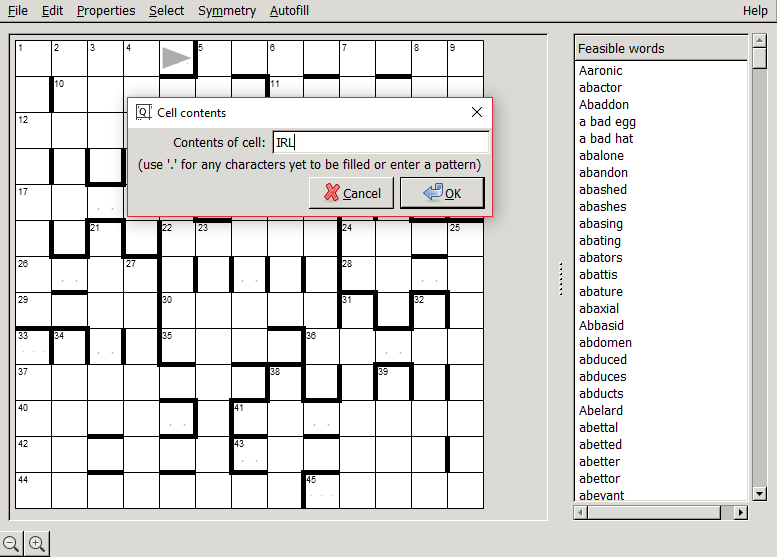
Click on Edit — Cell contents. Then just enter IRL in the dialog box.

Qxw - Edit - Cell Contents

Qxw - Edit - Cell Contents - IRL

Qxw then suggests a number of feasible entries (show in the panel on the right) for insertion.

We simply repeated this procedure for other cells around the grid for each of the two- and three-letter IVR codes. The final grid appeared as follows:

Odd One Out by eXtent - Filled Grid

A blog of the puzzle by HolyGhost at Fifteensquared can be found using this link: Inquisitor 1588: Odd One Out by eXtent.

Disappearances by proXimal

I had decided to base a puzzle on a theme of the decline or disappearance of stores from High Streets. The phrase THE HIGH STREET lends itself really well to being used in a barred crossword, as it has 13 letters and such grids are often 12x12 or 13x13. I decided to have THE HIGH STREET as a thematic unclued entry running down the central column of a 13x13, with names of shops which have disappeared produced by clashes on both sides of THE HIGH STREET. The clashes could be nicely thematically represented just by leaving the clashing cell blank, thus the stores are disappearing.

So, I started with a grid as follows:
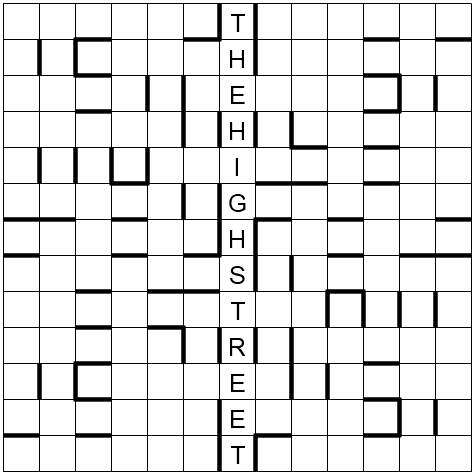
Disappearances by proXimal - THE HIGH STREET

I decided to have five shops either side of THE HIGH STREET to produce a nice range and an interesting challenge for the solver. Firstly, I searched for shops which would lend themselves easily to being divided, to be produced from clashing words using Across and Down entries, but also ones that were relatively well-known. One of the most famous which I decided to use is WOOLWORTHS, which could be split as WOOL and WORTHS.

There is a useful pattern-matching tool on the internet called Qat, designed by Quinapalus, who also developed Qxw; I used Qat to check which words could end in WORTHS and which could start with WOOL. The picture below shows the search for words ending in WORTHS (using search term *worths):
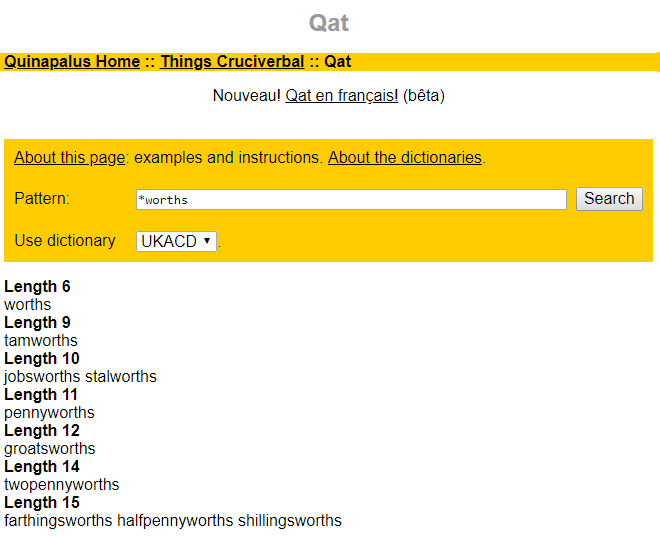
Qat - Word Pattern Search

I liked the look of JOBSWORTHS and decided to have this entry in the grid to provide a clash in the last cell of a five-cell entry; the number of words starting with WOOL, to provide the Across clash, was much higher.

Back to Qxw, I put JOBS in the entry at 27 Down with the last cell blank to accommodate WORTHS in one cell. To enable Qxw to work with clashing entries, one does the following:

1. Select the cell which you want to use (shown in yellow below), by clicking Select and then Current cell, when the cursor is in the cell.

2. Click on Properties — Selected cell properties. Then tick the box which says Override default cell properties and further down, change 'Lights intersecting here' to 'need not agree'.
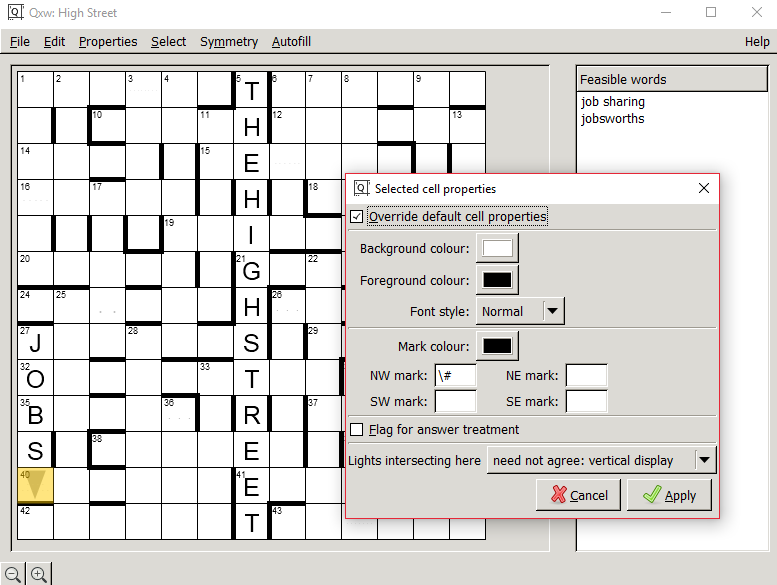
Disappearances by proXimal - Qxw - Intersecting Cells Need Not Agree

This now meant that I could specify an entry beginning with WOOL at 40 Across, with the four letters of WOOL being accommodated in the first cell, to clash with WORTHS provided by the down entry. In order to do this, the following is required:

Click on Edit — Cell contents. Because I have previously specified that the cell can accommodate clashes, a box appears which allows us to enter multiple letters for the Across and Down entries meeting in this cell.

Disappearances by proXimal - Cell Contents

Hence, once I had specified that the contents of the cell for the Across entry should be WOOL, Qxw provides me with a number of feasible entries: WOOLDINGS, WOOLFELLS, WOOLIEST, WOOLPACKS, WOOLSHEDS, WOOLWORTH.

I then repeated the same process in various cells around the grid to accommodate the nine other shops. The completed grid appeared as follows:
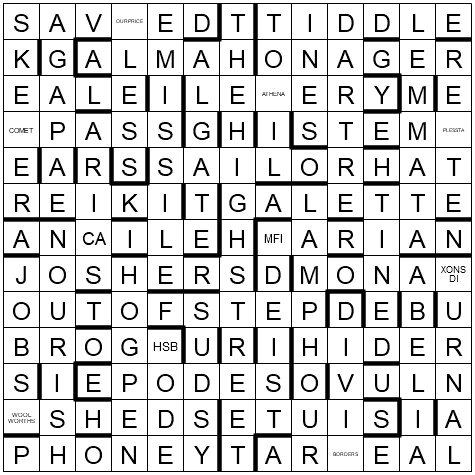
Disappearances by proXimal - Filled Grid

So, for example, SKEETER at 1 Down clashes with COMPASS at 16 Across to create COMET. In this puzzle I also wanted to have real words left when the clashing cells were deleted, so the deletion of the COMET clash would leave words SKEER and PASS in the final grid.

A blog of the puzzle by Dave Hennings at Fifteensquared can be found using this link: Enigmatic Variations No. 1296: Disappearances by proXimal.

Related Posts:

If you wish to keep track of further articles on Crossword Unclued, you can subscribe to it in a reader via RSS Feed. You can also subscribe by email and have articles delivered to your inbox, or follow me on twitter to get notified of new links.

Monday, 12 November 2018

Crossword Grids That Hold More Than One Letter Per Cell

This NYT Wordplay article Yes, You Can Write More Than One Letter in a Square and an ensuing twitter discussion got me to discover some fascinating grid-fill gimmicks used in advanced cryptics. One such is to set aside the one-letter-per-cell norm that we take as a given in blocked grid puzzles.

The word or group of letters that goes inside a single cell is called a "rebus". [Long ago, rebuses were probably "squashwords" – more on that later in the article.]

If the idea of many-letters-per-cell is new to you, then you're probably brimming with questions at this point. When did this trick originate? How does the setter go about crafting a puzzle with rebuses? What should the solver do to crack such a puzzle?

Cryptic setter eXternal (Steve Bartlett) offers us insights into these questions. In this article, he looks at the history and development of puzzles in which individual cells contain more than one letter, and supplements his research with rare images of decades-old puzzles.

Steve sets advanced puzzles in the series of The Listener, Inquisitor and Enigmatic Variations. In addition, he sets standard cryptic puzzles for The Daily Telegraph (as proXimal), The Independent (as eXternal), Financial Times (as ARTEXLEN), The Herald (as Boz) and The National (as Claymore).

Note: The article primarily uses Listener examples, for consistency and because it has the longest history of the barred series.

Over to you, Steve.

- Shuchi

Many Letters in a Square: Dive into History

1. Listener (1950): #1047 Space Saver by Babs
    Compressed repetitions; LILO = LI/O

Here is a Listener crossword and solution from 1950, one of the oldest-known crosswords to employ the many-letters-per-square trick.

Listener 1047 Space Saver by Babs
[click #1047 to enlarge]

The preamble of the puzzle states that only half the number of squares is to be used for each answer, hence an answer of four letters has a light containing only two squares.

For example, the answer to 1 Across:
Refuse the odd bits (8)
is RIFF-RAFF. This to be entered in four cells as R,I/A,F,F, with the I and A sharing the same cell, divided with a slash.

This crosses with 2 Down:
Disinfectant used to make Eliza ladylike (4)
in which the answer IZAL is hidden in 'Eliza ladylike' and entered as I/A,Z/L, using just two cells for the entry.

Listener 1047 Space Saver Solution

The preamble gives several examples of how the answers should be entered, to help the solver understand this unusual entry method.

Grid Fill Examples in Preamble

2. Listener (1951): #1118 One or Two. by Stephanus  
    Random distribution: one letter in a cell or two

A Listener crossword from the following year, 1951, uses a simpler concept. A short preamble merely states that a 'space' contains either one or two letters.

Listener 1118 One or Two Stephanus
[click #1118 to enlarge]

For example, the answer to 5 Across:
Post of Prometheus' hope - and fateful pain? (8)
DELIVERY is entered as DE/LI/V/E/R/Y, in six squares.

This crosses with 6 Down:
What's put the L in AIR? A tree, at least (6)
in which the answer LINDEN (L in DEN) is entered as LI/N/DE/N in four squares.

Interestingly, the solution notes allow an alternative, as the V of DELIVERY and N of LINDEN are unchecked, meaning that DE/L/IV/E/R/Y and L/IN/D/E/N would be equally valid. We seldom see such ambiguities in today's barred crosswords.

Listener 1118 Solution

3. Listener (1961): #1640 Three-in-hand by ffancy
    Alphabetical sum

This example hails from a decade later, 1961. The puzzle has a complicated preamble to explain that each square accommodates three letters. This puzzle uses a gimmick commonly seen in modern barred puzzles, where Across and Down answers clash. Cell entries are derived from the letters of clashing Across and Down answers and the alphabetical sum of these two letters.

Listener 1640 Three-in-Hand
[click #1640 to enlarge]

For example, 1 Across CRACKER clashes with 1 Down KILDERKIN in the first cell. K and C are written in corners of this cell, with the sum C(3)+K(11)=N(14) in the centre.

1640-Solution

A further point to note is that, unlike the previous examples, the 1961 puzzle is thematic. The solution leads to a quote on diagonals from cell 11 — PLEASE TO REMEMBER THE FIFTH OF NOVEMBER etc., using the central cell entries derived from the clashing letters.

So far, the examples have not attempted to coin a term for this particular genre. They merely describe in the preamble what needs to be done to solve and fill the grid.

4. The (Almost) Impossible Crossword Book (1984)
    The name’s Squashword

The next example is from Gyles Brandreth's The (Almost) Impossible Crossword Book (1984), with the actual puzzle probably dating much earlier.

Shared Squares by Convar - Squashwords

Beside the title, appears the line, 'Shared Squares is a squashword'. This might lead us to believe that there was once such a term in usage for puzzles where squares contain more than one letter.

5. Listener (1998): #3479 Belt Up by MynoT
    Symbols for Clashes

The next example is from 1998, after The Listener crossword had moved to its current home in The Times.

3479 Listener Belt Up by MynoT
[click #3479 to enlarge]

Here the clashes are generated using more than one letter contributed from crossing answers. This is typical of modern barred thematics, with the clashes resulting in a thematic word.

For example, the clue to 9 Across is:
Car's before them to perform — by the grace of god (4) DODGEM
DO + DG(Dei gratia) + 'EM

The clue to 4 Down is:
Note's small money (3) MINIM
MINI + M

Both answers are too long for the available space (6 letters for 4 cells; 5 letters for 3 cells) and clash in the crossing cell, with the clash of GEM from DOD/GEM and INI from M/INI/M to give GEMINI, entered as the sign of the zodiac.

Aside from the entry lengths (rather than answer lengths) being given, we can also note that there is no reference to clashes in the very short preamble. The solver must deduce the fact that some answer are overlong and therefore clash.

Listener 1998-10-03 #3482 Belt Up Solution

6. Listener (2002): #3673 Journey by Gioconda
    Abbreviations for Clashes

The final example comes from 2002 and has four entries sometimes clashing in one cell. As opposed to the previous example, answer lengths rather than entry lengths are provided.

Listener 3673 Journey by Giconda
[click #3673 to enlarge]

In this puzzle, 2 Across has four clues but only two lights. The solver can thus deduce that the first two clues will clash somewhere in the first light and the second pair will clash somewhere in the second light.

The first light of 2 Across is made up of 6 cells, but the answers to the first two clues have lengths of 5 and 7 = 12. Therefore, there will be a clash of 7 letters in one cell along that light.

The first two clues of 2 Across are:
Endless joke about half clad women (5) JADES
JES{t} around AD

Amount of water in pool crushed a dog-pen (7) PONDAGE
A DOGPEN*

Therefore, we have JADESPONDAGE to enter in the first light of 2 Across. We can see that DESPOND is a likely 7-letter candidate to be the clash in the third cell.

Then, we look at the Down clues on the column where the large clash from 2 Across occurs, ie column E. The first two clues in column E have answer lengths of 3 and 8 = 11, but a light length of only 4. Therefore, a clash of 8 letters will occur. The first two clues of column E are:

Court Henry with soft centre (3) HOF
H+{s}OF{t}

Cast off sledge bearing frightened Hugo (8) SLOUGHED
SL(HUGO*)ED

Therefore, we have HOFSLOUGHED to enter in the first down light in column E. The clash occurs in the second cell down, the same location as the clash in the across light, providing OFSLOUGH as the contribution to the clash. This is how the solver arrives at SLOUGH OF DESPOND, to be abbreviated as SOD as instructed by the preamble.

Listener 2002-06-29 #3673 Solution

Clashes from multiple entries form places visited by Christian in The Pilgrim's Progress.

This is only a tiny overview of the multitude of ways in which setters have used this gimmick over the past 70 or more years. The puzzles where clashes of more than one letter spell out thematic words or names are particularly common and are often used to set the theme in advance of a further endgame which needs resolving.

Tips for many-letters-per-cell setters

In addition to the generic dos and don'ts of cryptic setting, be mindful of the following points when creating a crossword with more than one letter per cell.

1. Keep an eye on checking

Remember that overlong entry clashes reduce the amount of checking in the puzzle. It is more helpful to the solver if you minimise the proportion of the answer which clashes, or apply some technique to offset the effects of reduced checking.

As an example, take a theme of Santa's reindeer to be produced by clashing answers. When deciding how to generate DANCER, a nice 50/50 split of DAN/CER could be achieved with DAN/GEROUSLY and NECROMAN/CER (~27% clashing). The solver will have more help with checking from cells already populated than using, say, DAN/DY and UL/CER (~60% clashing).

You can also offset the effects of reduced checking by offering easier clues for those answers that might otherwise be troublesome for the solver – for example, through whole anagrams or hidden words.

2. Decide: Answer lengths or number of squares?

When setting many-letters-per-cell puzzle, you have a decision to make about clue enumeration: should you give the lengths of answers or the number of squares available for each entry?

If answer lengths are given, the solver has more guidance as to which answers are likely to clash. For example, in the clashing entries for DANCER to appear (see above), the number of cells needed to enter NECROMAN/CER will be 9, but the answer length is 11. Hence if the setter decides to give the answer length (11), the solver knows this is a clashing entry, as the number of available cells is fewer than the answer length.

It is a lot more common to provide entry lengths (ie number of available cells), so that the solver has to work out which are the gimmick clues.

3. Represent the clashes elegantly

Finally, you also need to decide how the clashes are to be represented in the grid. It is a little inelegant and fiddly to expect the solver to enter a seven-letter word, say, in a single cell.

Solutions to the problem could be for the solver to insert a symbol, abbreviation, first letter of answer or to leave the cell blank.

The method should ideally fit with the theme of the puzzle.

Tips for many-letters-per-cell solvers

From the solver's point of view, the more quickly the theme is uncovered, the easier the solve becomes. So you should be on the lookout for:

  • answers which obviously extend for longer than the given number of cells
  • likely crossing clues which could create a clash

Sometimes only a couple of clashes are needed to get an idea of what the theme might be. Once you have zeroed in on the theme, you can consider the identities of the other thematic items which might be hidden in clashes.

eXternal Steve Bartlett
My thanks to Dave Hennings, Roger Phillips and John Tozer for their help in the research for this article.

– Steve Bartlett


A follow up article will talk about using crossword software to make puzzles with multiple letters per cell. Stay tuned!

Update (25-Apr-2019): The follow-up article: Crossword Software to Make Puzzles with Many Letters per Cell.

- Shuchi

Related Posts:

If you wish to keep track of further articles on Crossword Unclued, you can subscribe to it in a reader via RSS Feed. You can also subscribe by email and have articles delivered to your inbox, or follow me on twitter to get notified of new links.

Monday, 14 July 2014

Writing Easy Clues is not Easy: A Behind-The-Scenes Report

easy-crossword-clues [Last week, Anax posted this delightful clue on twitter:

    It should ensure dental health in the future (also in the past) (10)

The answer, as you've probably worked out, is TOOTHPASTE: TOO (also) + TH(PAST)E. With its explanatory definition and undisguised wordplay, the clue is the kind that'd get solved at sight by a seasoned solver.

So the clue is easy, but it is no less elegant for that. Look at the way the cryptic elements come together in an expressive surface, how the phrases "in the future" and "in the past" balance each other.

It is not easy to write an easy clue, says Anax. Read on for more from him on the topic. – Shuchi]

Much has been written (or at least I've banged on about it myself often enough) about the common novice setter mistake of equating 'hard' to 'good' when it comes to clue-writing, but it's rather hard to explain how a good easy clue should be written.

Anagrams and hidden answers are usually a logical place to start, but most commercial outlets set limits on the number of each which is permitted in a single puzzle and, in any case, clever use of wordplay indicators can make even the most obvious clue deceptively tricky. For me there are two elements/approaches to easy clue-writing:

  1. When breaking the answer down into components – charade, container etc – going with the first idea that jumps out.
  2. Not disguising everything. A part of the answer may be AND, OR, IN, HAS etc; there's no harm in presenting these elements exactly as they are.

We might also consider brevity and/or using only the simplest of wordplay indicators, but these have their own pitfalls. A brief clue isn't necessarily easy and, while simple wordplay indicators are fine, the results can be rather crosswordy.

The TOOTHPASTE clue, I admit, didn't have anything to do with the first approach. After thinking of less obvious things that could be applied with a brush, I'd honed in on TOOTHPASTE and spotted THE SOAP, wondering if it might form the basis of a nice anagram clue. It didn't, so I started looking at other ways to break it down, and at that point TOO + TH(PAST)E was the first candidate. I hadn't imagined keeping both THE and PAST exactly as they appear in the answer, but 'in the past' is such a stock phrase it felt daft to attempt any disguise. The result is an almost shockingly easy clue, but it feels right. You could probably come up with a far better definition, but the wordplay is about as natural as you can get. And, of course, 3 wordplay elements plus container indicator totalling only 3 more letters than the answer is a bonus for fans of concision.

Over the past couple of years, many solvers who used to feel let down by easy puzzles have come to appreciate how much skill is involved in writing them. In terms of what devices you can use and how intricate your clue-writing can be, it's a bit like a cricketer going to the crease with a half-size bat. When I mentioned to Shuchi the idea of an article about easy clues she asked if I could get a few together; after a full day of trying to match the simplicity of the TOOTHPASTE clue I came up with nothing.

Setters such as Roger Squires, Don Manley and, to an extent, John Halpern, employ this skill day in day out, and I envy them.

As I've mentioned at the end I completely failed to write any clues as simple as the TOOTHPASTE one, which shows just how hard it is!

[Thanks for the write-up, Anax. A few good easy clues for you all to savour:

By Rufus: Found bliss intermingled with hate (9)
By Sankalak: An extremely small measure — not grams, silly! (8)
By Afrit: This can be read just as it is, so you needn't do so! (8)

- Shuchi]

Related Posts:

If you wish to keep track of further articles on Crossword Unclued, you can subscribe to it in a reader via RSS Feed. You can also subscribe by email and have articles delivered to your inbox, or follow me on twitter to get notified of new links.

Tuesday, 9 April 2013

Clueing really long solutions in a crossword

In his guest post on 2 November 2012, Gordon Holt discussed the technique of using anagrams to clue long words or phrases in a cryptic crossword. Here, he looks at how other clueing devices may come into play with long solutions that span 15 letters or more.

Gordon Holt aka Otterden is a crossword setter for the British weekly New Statesman.

long crossword solutions The construction of a clue for a lengthy solution is often problematic for a compiler because clueing for several letters together can tend to be awkward and tortuous. In the absence of an overall anagram that works, an amalgam of various other devices may be necessary, and it is not often possible to string these together fluently in a strict item-by-item charade format. However, if a charade is possible, it gives the clue some sort of structure giving a solver a reasonable chance to unravel it.

A simple example:

Excitable reviewer friend acted over censoriously (15)
The answer is HYPERCRITICALLY: HYPER (excitable) CRITIC (reviewer) ALLY (friend)

A more complex example containing five different elements:

Bad temper display after a party member on phone goes on and on  (9,6) 
This leads to PERPETUUM MOBILE: PER (a) PET (bad temper display) UU (party: Ulster Unionists) M (member) MOBILE (phone)

Multi-word long answers also give the compiler a chance to devise wordplay in which the building blocks of the charade cross the word-breaks in the solution.

Clues for long entries which use a mixture of other clueing devices are quite possible of course, but require considerable ingenuity to set, especially if a smooth face reading is striven for. A splendid recent example, using three insertions and a deletion, by the great Araucaria of The Guardian:

School friends' payment kept by head female in a church garment shortened, one with a tin with nothing in it (6-7,11)
The answer is PARENT-TEACHER ASSOCIATION: RENT (payment) in i.e. kept by PATE (head) + HER (female) in A CASSOC[k] (church garment shortened) I (one) A TIN round O (nothing).

Dealing with of a long quotation is another problem area for setters, but sometimes the task of breaking one down into separately clued bits and pieces can be avoided. For instance, the famous Shakespearean 30-letter line from Hamlet TO BE OR NOT TO BE, THAT IS THE QUESTION could be dealt with in a fun way by saying:

Familiar quote might have been heard when casting for Spiderman
Here the homophonic reference is to Tobey (Maguire), the actor selected for the role in the Spiderman films.

Another example is the 51-letter solution string from Shakespeare's As You Like It: ALL THE WORLD'S A STAGE AND ALL THE MEN AND WOMEN MERELY PLAYERS. This could be clued as:

'Global' declaration heard in London this summer providing planetary overview
This clue may need some explanation for non-UK solvers: in 2009 when the puzzle was published in UK's New Statesman, the seasonal presentation at the famous Globe theatre was As You Like It.

As I mentioned in my previous post, one problem with solutions which run into multiple words, particularly where some are of one, two or three letter length, is that with a bit of thought and only a few checking letters it may be possible for a solver to get to the answer without needing help from the actual clue wordplay...and all of a compiler's hard work is sidestepped!

It may be possible to clue a long solution word by double definition and a fun example which readers might like to solve is:

Sensible quality of Frankenstein's monster (5-10)

Related Posts:

If you wish to keep track of further articles on Crossword Unclued, you can subscribe to it in a reader via RSS Feed. You can also subscribe by email and have articles delivered to your inbox, or follow me on twitter to get notified of new links.

Tuesday, 4 December 2012

Konkani crossword

It is time for the concluding part of the trilogy on crosswords in Indian languages by our multilingual friend Kishore. In this post, Kishore gives us an introduction to the fascinating nature and history of Konkani, a language spoken by a comparatively small subset of the Indian population, and sets for us what might be the first-ever cryptic crossword in Konkani. - Shuchi

konkani After subjecting Kannada crosswords and Telugu crosswords to my dissection table, I thought - why not take up another language, a South Indian one at that. Malayalam and Tulu were ruled out as my knowledge of these was below absolute zero; so was Tamil, in line with the policy that one has to just open one’s mouth to confirm one’s ignorance of the subject. That made me redraw the map of South India, extend it a little more and bring in a language that I knew enough about to pretend to be an expert in. When North Indians and South Indians have a difference of opinion, I take the middle course and proclaim myself to be a West Indian, speaking a language that is used from Southern Maharashtra to Kochi, albeit along a thin strip of land.

A little background for those who would like to know more. The maim-bhas (mother tongue) is officially called Konkani (variant spellings: KonkNi , KokNi or Concanim) and also referred to as Amchigele (our language/people), further shortened to just Amchi by some. Other names include Gomantaki, Goenchi, and Goani, though the once-used name Goanese is now frowned upon. Spoken along a swathe of land about 750km long alongside the Arabian Sea, Konkani has various dialects that change every 100km or so. Starting from Malvani in the southern coastal districts of Maharashtra, it metamorphoses into the close-to-Marathi variety of Konkani spoken by the Hindus in Goa (where it is the state language). Goan Christians speak a dialect that has travelled to far off places like East Africa, the Middle East and Canada – this dialect shows some influence of Portuguese, with usage of words like Adeus, Juramento, and Kazar. Just south of Goa, in Karnataka’s Uttara Kannada district, you find the Karwari dialect giving way to the Navayati dialect in Bhatkal, which has been carried to Karachi by the diaspora. Further, south in the Dakshina Kannada district of Karnataka, the Mangalore Catholic and Goud Saraswath Konkani can be heard, with words borrowed from Kannada. Deep South, in Kerala, another dialect is spoken with some loan words from Malayalam.

Konkani belongs to the Indo-European family of languages, thought to have evolved from Prakrit and brought down to the west coast by migrants from Gaur area in present day Bihar and West Bengal. The nearest Indian language is Marathi, though Konkani speakers would argue vehemently against Konkani being called a dialect of Marathi. Konkani is a spoken language -that is it has no script of its own but thrives on borrowed scripts rangingfrom Devanagari to Roman to Kannada to Malayalam. This also means that whatever little is written in one script may not be accessible to all speakers as all speakers may not know all scripts. This, certainly, is a sorry state of affairs for a language which probably had one of the first printed dictionaries in India, courtesy the Jesuit clergy. Efforts are on to revive the language1, but these are few and far between and fall prey to the schism of different scripts.

As a humble effort to generate some interest, I thought of making a cryptic crossword in Konkani. I had a dilemma: whether to use an abugida like Devanagari or the alphabet-based Roman script. I eventually chose the Roman script, hoping that a larger number of persons would be able to participate2. The clues use a mix of dialects and, wherever possible, the Goan method of spelling. Hence, ‘x’ stands for “sh” and not “ksh”. Well, while the result was not hundred percent cryptic, quite a large number and variety of clues turned out to be cryptic.

While I am aware that the intersect of the cryptic crossword community and the Konkani-knowing people is pretty small, I hope this leads to one set taking interest in the other. I have provided the translation for those who don’t understand Konkani, though that, by itself, would not necessarily help them to solve the puzzle. Compared to a standard English crossword, there is a little too much black space, but I have tried to give it a distinctive Konkani flavour. So here goes, warts and all:

konkani-crossword-grid

Across

2 60 varxem zattana khavche goD khaaNa (5) The sweet-meat to eat when becoming 60 years old
5 Pada maNtana yevcho kopu (4) The anger one gets while singing
7 Nhavchaka upyogu korche hoD aidan (6) Large vessel used while bathing
9 Sakalhin kaLok vochun hye ieta (7) This comes in the morning, after the darkness goes away
11 Nantar-vaila poLoyati – see next clue
12/11 Dr Ramesh Kamthile Konkani cholche-chitra (4,4) Konkani movie made by Dr Ramesh Kamath
14 Bailyaan makxi dhanvtalo (7) One who runs after ladies
18 KunkaD hantulyan ieta, ki hye kunkaDachan ieta? (6) The hen comes from this, or does this come from the hen?
19 Kaam korcheak makxeatolo (4) One who shies from work
20 Hyo Isrealcho prodhani Goyanthu voggi zata (5) This Israeli prime minister is early in Goa

Down

1 Kaaxantu axchem protham dhravyo (5) The main metal in bronze
2 Goemcho reeti: aaj korcho kaam, phallyan kor (8) Goan way: What’s to be done today, do it tomorrow
3 Khavcheak javcho vimaan? (4) Eatable airplane?
4 Igorjeanto hyea povitra zata (5) This gets pure in the Church
6 SoggLeam meLLyari hyea sorna (4) This does not end, even when you get everything
8 Goenchen cantaar, hyea MangaLuraantu khatachi (5) Goan song, eaten in Mangalore
9 Bautismaak upyogkorche tirth (5) Sacred stuff used for baptism
10 Shevain piLchaak yantr (8) Machine to make string hoppers
13 VaaDi na hantu, badachi (4) Really, no interest in this
15 Maska ghalunk hye zavka (5) This is required to butter people
16 Khavche bamboo zhaad (5) Eatable bamboo plant
17 Mando, Dekhni and Dulpoda-pashin lokapriya yeh Batatya ---- (4) This potato composition is more popular than the Mando, the Dekhni and the Dulpod.

Note: Since the spellings are not standardised in Konkani, some solvers might have different spellings in their minds. I have tried to stick, as far as possible, to the Konkani dictionary compiled by Mohan Prabhu3 and the grammar as enunciated by AFX Maffei 4. Please excuse me if my spelling is different from yours.

For people with different points of view, I quote the Chief Minister of Goa, Manohar Parrikar
[source: Vauraddeancho Ixtt]:

Konknni bhaxecho nhoi punn proxnn asa to lipicho. Bhaxa mog korpa khatir asta, zhogddim korpa khatir nhoi ....
[It is not the question of the Konkani language, but of its script. Language is for loving, not for fighting…]

Links to other Konkani sites: Goan Konkani songs, Gulab magazine, Guencho Ulo, Goa World.

Merry Christmas and happy solving to all.
Dev Borem Korum.

Notes:

  1. Admirable efforts have been made by World Konkani Centre at Mangalore and Save My Language.
  2. In his introduction to Konkani grammar, Maffei puts it like this: “Now the Kanarese Alphabet is generally used, and although it does not express all Konkani sounds, yet it is better adapted for this than the Latin Alphabet. But as the Kanarese script is not known to a greater part of my brethren, for whom I write, I shall use the Latin Alphabet, with the required modifications...”
  3. Available at Konkani Foundation.
  4. Available at A Konkani Grammar on Open Library (this includes some books from the Holy Bible in English and Konkani, written both in the Kannada and Roman scripts)

The answer grid is printed below. For people unfamiliar with Konkani, two things might stand out. First, the comparatively frequent usage of the sound ‘z’ and ‘zh ’ in both the clues and answers. Look at this famous line from Genesis1:3: “Ani devan mollen: uzuad zaundi. Ani uzuad zallo”=”And God said: Let there be light. And there was light”. Second, some answers look like English words, but have nothing to do with the English word they look like.

konkani-crossword-answers

Related Posts:

If you wish to keep track of further articles on Crossword Unclued, you can subscribe to it in a reader via RSS Feed. You can also subscribe by email and have articles delivered to your inbox, or follow me on twitter to get notified of new links.

Friday, 2 November 2012

Clueing long solutions with anagrams

A guest post by Otterden aka Gordon Holt, who has been a crossword setter for the British weekly New Statesman magazine since 2004. The name 'Otterden' came from the fact that otters live in 'holts'! Before he turned to setting puzzles, Gordon Holt had a career in town planning and was the founder/editor of the profession's weekly newspaper.

abbreviations The inclusion of long solutions in cryptic crosswords, often titles, sayings, phrases, quotes etc. (let us say of 15 or more characters in length) can be quite compelling for puzzle setters. The main reason is that the use of lengthy composites can help to add interest and diversity to a puzzle, making solving more fun. Indeed, in compiling a themed crossword the use of longer entries may sometimes prove to be essential. Another positive is that long composites facilitate connectivity within the whole of a grid making it less likely that a solver will get stuck in one particular sector of a puzzle. There are downsides to be cautious of, though. If the clue is too easy much may be given away too early in terms of copious checking letters for other solutions in far-flung parts of a puzzle. Another danger is that if the solution is composed of a number of shortish words the pattern of enumeration alone can provide the key to solving, and a setter's elaborately worked out wordplay completely by-passed.

In deciding to include a long solution in a given puzzle a compiler is making a rod for his own back as clueing problems are far more likely to occur. It is possible that at the end of the day he or she will be forced to indulge in a complex series of wordplay devices in order to construct a satisfactory wordplay. In many cases succinct definitions of long solutions prove elusive. All of this may make the achievement of a clue with a fluent face reading difficult and may result in a clue that is awkward, tortuous and difficult to solve.

So, if there is an anagram available for the totality of the words in the solution all well and good. Unlikely maybe, but like most setters I always have a look for one at a very early stage in the clueing process. From my own experience by far the best result came when clueing one of my New Statesman puzzles. Here I had set myself the task of theming fictional characters who wore masks. Clearly, apart from Zorro, Batman etc., one of the solutions just had to be the 19 letter composite THE MAN IN THE IRON MASK.  The chance of there being a total anagram for nineteen letters was slim but after I had a quick look at the multitudinous jumbles of words provided by electronic anagram finders, it dawned on me that buried here were the words I am the throne man’s kin which, joy oh joy, was also exactly the situation of the title character.  So all I had to do was to add the ubiquitous 'perhaps' and I had an &Lit.

A particularly amazing cognate anagram of 23 letters is to be found in Michael Curl's Anagram Dictionary (this publication is unfortunately now out of print): A NOVEL BY A SCOTTISH WRITER leading to Ivanhoe by Sir Walter Scott.

No account is complete without mention of the celebrated 26-letter clue by Araucaria of The Guardian:

Poetical scene has surprisingly chaste Lord Archer vegetating (3, 3, 8, 12) THE OLD VICARAGE GRANTCHESTER

This may need some explaining to non-British solvers. The Old Vicarage, Grantchester is a poem by Rupert Brooke but later the home of Jeffery Archer, the British politician and author who at the time was keeping a low profile there after a sex scandal.

Of course, lengthy cognate anagrams of this sort are only going to be achievable once in a blue moon, but occasionally more conventional total anagrams are possible.

Some examples for readers to solve from past puzzles of mine:

Bones (knees and hips) are dislocated quite often on racehorses (9,8)
Was relieved to be off seeking image to change (5,2,8)
Brothers were aggrandising hero, perhaps (6,3,3,8)

---
In a further posting Otterden will discuss how, and how not to, clue long words with clueing devices other than anagrams. [Update (10th November 2013): Otterden's follow-up post – Clueing really long solutions in a crossword]

Related Posts:

If you wish to keep track of further articles on Crossword Unclued, you can subscribe to it in a reader via RSS Feed. You can also subscribe by email and have articles delivered to your inbox, or follow me on twitter to get notified of new links.

Saturday, 29 September 2012

How Kishore solved a Tenglish crossword

When Mark Twain said there is no such thing as a new idea, he knew what he was talking about. I wrote about the possibility of bilingual crosswords convinced that this was something radical. Apparently not. Kishore Rao points us towards a Tenglish (Telugu + English) bilingual crossword being published in a Telugu newspaper. This article is Kishore's narration of his serendipitous discovery of the crossword and his attempt to solve it.

Blogging has been sparse this month - my non-virtual life is taking up a big share of my time these days. Please bear with me. I have some interesting posts in the pipeline that I hope to publish over the next few weeks. Meanwhile, enjoy our inimitable Kishore's article which I must tell you is far easier to follow than his original flurry of emails with mysterious subjects like "Open this only after you have read my previous mail", "Read this after you read the previous two mails" and so on. Thank you for being comprehensible for a change Kishore :-)

- Shuchi

One day, having returned home from work and demolished some street food that wifey-dear had brought home for me, I was about to discard its newspaper wrapper, when I spied a crossword on its reverse. Sakshi-Newspaper-Tenglish-CrosswordFurther research with my limited reading abilities in Telugu brought forth the following discoveries:

The newspaper in question సాక్షి (Sakshi = (Eye)witness) was a daily and the crossword was un-numbered. Initially, I thought this was an one-off feature but discovered later that it was published regularly. I had not heard of this paper though my dalliance with Telugu is nearly four decades old. Wikipedia informs me that Sakshi was started in 2008 and has the second largest circulation in Andhra Pradesh at present. My search of other major Telugu newspapers did not yield any crosswords.

Strangely, the crossword was titled టిoglish (Tenglish). Apart from the oddity that this was clearly a portmanteau word created out of the combination of Telugu and English (as is common with many other similar words like Hinglish, to describe that cross-breed creature that results from the matrimony of an Indian language with English), and that the characters used were partly Telugu
and partly English characters, the choice of the first character was peculiar. Telugu, like most Indian languages has two separate characters for the soft and the hard un-aspirated త and ట (like त and ट in Hindi), which approximates to the 't' as pronounced in the French word 'entrée' [t] and the English word 'tomato' [ ʈ ], respectively. Hence, though the word Telugu is pronounced with a soft t త, the title of the crossword corresponds to the hard T.

As foreshadowed by the name, it turned out to be a bilingual puzzle. The headings to clues were crisply worded with aDDam (Across) and niluvu (Vertical); unlike the Hindi and Kannada ones which use phrases like 'up to down' or 'left to right'. The freeform grids were 10 x 10, had lots of black space with even 6 unches in some cases. What got my curiosity was that some clues not only had a number at the beginning and the enumeration number at the end, there seemed to be numbers within the clue itself! Well, some clues had numbers, and some didn't. Why the difference, I wondered...

The crossword addict in me pounced upon the puzzle as a test case of whether my Telugu was up to solving a crossword in that language. My Telugu comes from merely reading bus boards in Hyderabad and some similarity of the script with Kannada (of which I am no master), and I was not able to fully decipher it for the nonce. But even with the answers given alongside, I wondered how this Tenglish crossword worked.

Alas, my Telugu was not up to scratch and I had to resort to the tools of the modern day researcher: the suite from Google (Transliteration, Translate and regular Search Engine versions) to get it, besides referring to online dictionaries.

However, I thought this format of crossword deserved more attention and shot off an e-mail to Shuchi, laying my newly discovered crossword at her doorstep and confessing that I was baffled with the numbers in the clues. Just as I was pondering on whether to get into the newspaper laundering business (as the scrap I had was liberally stained with foodstuff), so that I could take a photo, I was able to get an online snapshot, thus sparing me the sponging and ironing.

tenglish-crossword 

One really feels an ass after clicking the Send button and realising that the dawn of epiphany had arrived a nanosecond too late. I had managed to decipher the numbers in the clues and patted myself on my back: the ghosts at Bletchley Park would have been proud of me.

The numbered clues worked like this:

The clues had a Telugu word, for which one had to think of an English word (the answer), from which the specified letters were to be extracted to give a subsidiary word as defined at the end of the clue.

Clue 1A reads ఊహించు (oohinchu = think) and leads to the English word 'speculate', where the 4th, 5th and 2nd letters spelt out the word 'cup' which, as mentioned in the clue, is called గిన్నె (ginne).

Clue 8A reads ప్రామాణికత (pramaNikata = validation/certification) and leads to the English word 'standard' where the 1st , 3rd and 5th letters spelt out the word 'sad', which as mentioned in the clue, is called దుఃఖo (duhkham).

Having solved all these clues, with a little help from Google Translate, I shot off another mail to Shuchi, and once again, history repeated itself. I had now broken through the veil of clues without numbers. Time to order the Kryptos from Langley, I mused, hoping the guys at the Company would not mind.

Just like the previously explained clues, these clues too had a main word and a subsidiary word, both in English, but in contrast to the ones above, instead of giving the letters to be picked from the main word, a different method was prescribed.

Clue 3D ఆకర్షించుట (aakarshinchuTa) has the answer 'attract'. Taking the last three letters as instructed, the word 'attract' becomes 'act' నటించు (naTinchu).

Clue 4A నేర్వరితనం (nerparitanam) has the answer 'skill'. By dropping the first letter as instructed, the word 'skill' becomes 'kill' చంపు (champu).

Clue 7A చక్రం (chakram) has the answer 'wheel'. By removing the first letter as instructed, the word 'wheel' becomes 'heel' మడము (maDamu).

This crossword was quite innovative and I was impressed by the unknown setter's ability to do this regularly as this requires not only a good vocabulary in both languages but also the skill to play with components of the words in two languages at the same time.

And this, my friends, is the way I got to spend a good three-fourths of an hour deciphering a crossword in a language I am not on very good speaking terms with.

Related Posts:

If you wish to keep track of further articles on Crossword Unclued, you can subscribe to it in a reader via RSS Feed. You can also subscribe by email and have articles delivered to your inbox, or follow me on twitter to get notified of new links.

Wednesday, 22 August 2012

Kannada crosswords

Kishore Rao chanced upon a Kannada crossword during his lunch break at work. His curiosity piqued, he solved the crossword, discovered other Kannada crosswords in mainstream publications, analysed them over a couple of weeks and soon this article took shape. I'm happy to share Kishore's insightful article with Crossword Unclued readers.

Kishore lives in Bangalore and is well-known on the Indian crossword circuit. He is an ace puzzle solver, math whiz, pun-crafter and polyglot – his repertoire includes familiarity with languages as diverse as Tamil, English, Swahili, Konkani and Sanskrit (he once gave a speech in Sanskrit in the Bangalore Town Hall!).

Over to you, Kishore. – Shuchi

Shuchi had recently brought up the topic of crosswords in Indian languages and even got the ball rolling on Hindi crosswords and clueing. Curiosity got the better of us cats and we started looking more closely at crossword puzzles in Indian languages. I looked for puzzles in Kannada (which is not my native language, or as it is quaintly called, my maternal lingo). My mother tongue, Konkani, is next only to Hindi in terms of the sheer length of the distance it is spoken across India. Konkani sadly lacks a script and makes do with a plethora of others systems of writing, from Roman and Devanagri to Kannada and Malayalam scripts, thus dividing the flock on a script basis (as if other bases were not enough).

Kannada has linguistic attributes similar to Hindi, and so brings with it the same difficulties of crossword setting as in Hindi.

[First, a confession: My Kannada is pretty bad. I left Bangalore in my first standard (Kannada medium) and came back for my tenth standard (English medium with Kannada as a compulsory language). When I came back, I did not know a word of Kannada or the script and had to come up to speed in about eight months. Even now, though my spoken Kannada passes muster, I do grope for words when I try a crossword.]

I came across Kannada crosswords being published in mainstream publications:

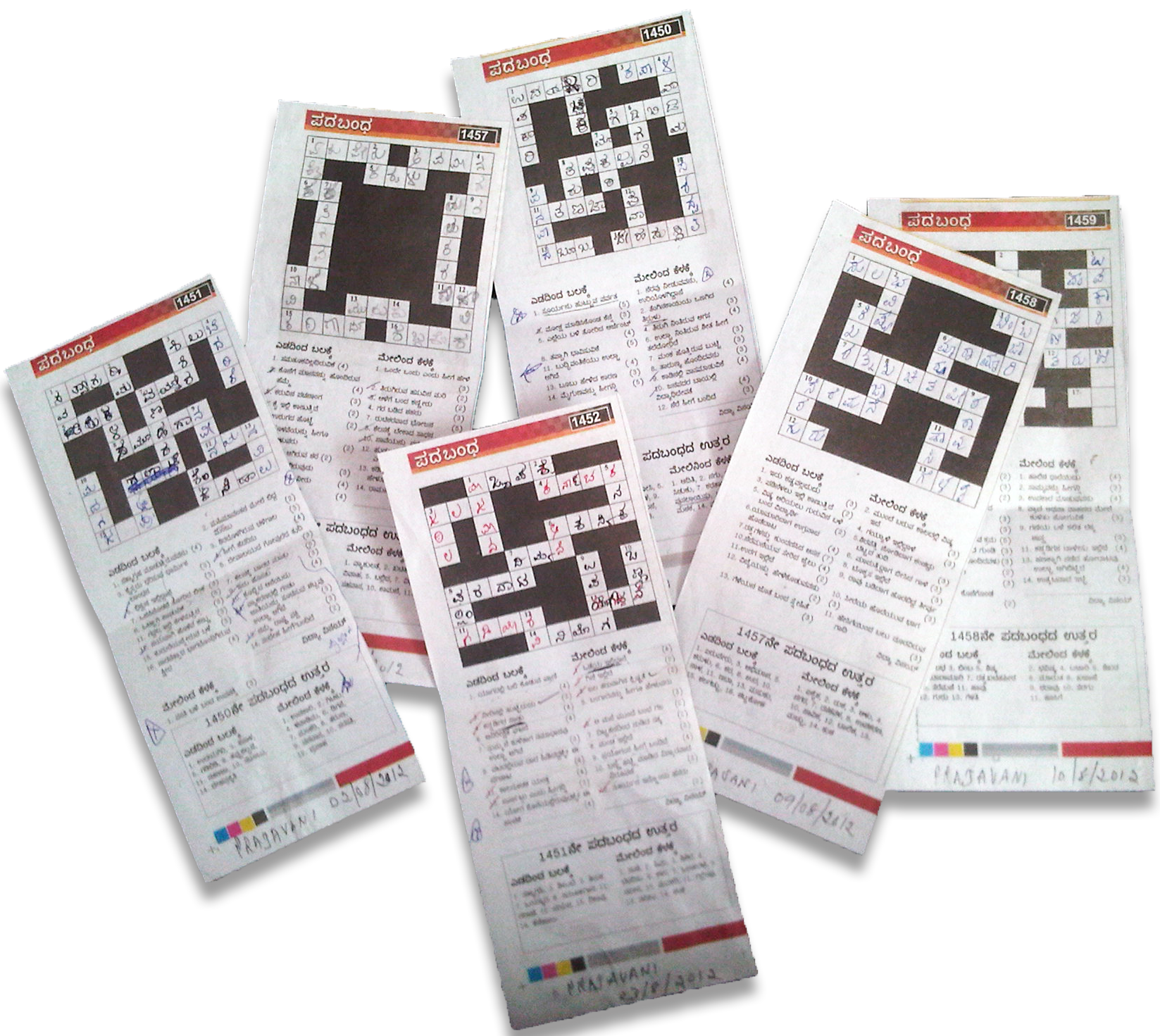
a 9x9 in PrajavaaNi (from the Deccan Herald group) presently running numbered over 1450,

kannada-crosswords-5prajavani 
(click the image above to enlarge)

a 9x9 KannaDa Prabha (from the New Indian Express Group), presently running numbered over 6250,

kannada-prabha-crossword

a 7x7 in UdayavaaNi (from Manipal based UdayavaaNi group) presently running numbered over 4150.

udayavani

All the three have symmetric grids, more than half blackspace in many cases, triple unches, and sometimes, whitespace islands not linked to other parts of the crossword. I tried all three but found PrajavaaNi, a daily puzzle set by Ms.Vidya Vinay, the most intriguing since the other two did not seem to have any cryptic side to their wordplay[1].

prajavani-crossword-grids

The clue sheet headings are a little more elaborate compared to English: Across is Left to right, Down is Up to down for Down. All three Kannada publications use this wording.

I observed a rummy thing in Kannada crosswords which is not kosher in English crosswords: in an English crossword DEER being reversed as REED is ok, but DEAR cannot be reversed as RAED. But the Kannada crosswords I solved had such instances of grid fills with no meaning, such as #7 below.

The most delightful surprises were some clues that displayed shades of wordplay similar to what we see in English ones:

  1. ಯೋಗ ಕೊನೆಯಲ್ಲಿರುವ ಈ ಹಂಚಿಕೆ (4) (Yoga koneyalliruva ee hanchike)= This distribution has yoga at the end of it
  2. ಪಟದಲ್ಲಿರುವ ದಾರ ಹಿಡಿದಕ್ಕೆ ಈ ಪೇಚಾಟ (4) (PaTadalli daara hiDidakke ee pechaaTa)= This disturbance/dislocation/embarrassment is due to the chart holding the string
  3. ವಸತಿ ಬಳಿ ಬಂದ ಉಪಪತ್ನಿ (3) (vasati baLi banda upa-patni)= The minor wife who came to the house
  4. ಮಹಿಮವಂತನ ಮೇಲೆ ಬಿದ್ದ ಮಂಜು (2) (mahimavantan mele bidda manju) Dew/frost that fell on the famous person
  5. ಸೂರ್ಯನು ಹುಟ್ಟುವ ಪರ್ವತ (4)(suryanu huTTuva parvata)= The mountain where the sun is born(rises)
  6. ನೆರವು ನೀಡುವವನು, ಉರಿಯೋಳಗಿದ್ದಾನೆ (4) (neravu neeDuvavanu, uriyoLagiddane)= Person who helps, is in fire
  7. ತಿರುಗಿ ನಿಂತಿರುವ ಅಗಸ (4) (tirugi nintiruva agasa)= A washerman who is standing, turned/ a washerman who is facing away
  8. ದೊಡ್ಡ ಹಾರೆಯಿದು (3) (doDDa haareyidu) = This is a big garland
  9. ಮಾರುತಿದ್ದಾಗ ಬೀಸಿದ ಗಾಳಿ (3) (maarutiddaga beesida gaaLi) = The wind that blew when selling

No.3 was sheer magic, though the anagram indicator was missing. This is not a rare omission - many a times, anagram and container/contained indicators are not given with clues in Kannada crosswords.

The answers:

  1. ವಿನಿಯೋಗ viniyoga (as in the Sanskrit/Hindi विनियोग) means distribution, investment or putting into, and has yoga as its ending.
  2. ಪರದಾಟ  pardaat means travel (=dislocation), and consists of the word play of insertion of anagram (without indicator) ದಾರ (daara=thread) as ರದಾ inside ಪಟ (paTa=chart)
  3. ಸವತಿ savati=minor (junior/second) wife (as in Hindi सौतन) which is an anagram of ವಸತಿ (vasati=house).
  4. ಹಿಮ hima=dew/frost (as in Sanskrit/Hindi हिम), which is a synonym of ಮಂಜು and is hidden in ಮಹಿಮವಂತನ, a famous person
  5. ಉದಯಗಿರಿ udayagiri (उदयगिरि) there are several places called Udayagiri in South India, which roughly translates to the sun-rise mountain.
  6. ಉಪಕಾರಿ upakaari (उपकारी), person who helps, the outer two characters of this word spell out ಉರಿ (fire) as mentioned in the clue.
  7. ಳವಾಡಿಮ does not mean anything, to my knowledge and subject to correction, but is a reverse of ಮಡಿವಾಳ (Madivala= washerman), also the name of a lake and locality in Bangalore, which probably like the Washermanpet (ண்ணாரபேட்டை/ Vannaarappettai ) in Chennai or Dhobi Talao (धोबी तलाव / धोबी तालाब) in Mumbai was where all the laundering took place in days of yore, and probably continues.
  8. ಗಜರಿ gajari (a type of flower garland equivalent to गजरा, in Hindi), the reference to big may be an allusion to the ಗಜ (गज) which is an elephant (=mammoth/large)
  9. ಮಾರುತ maaruta (मारूत = wind) hidden in the Kannada word ಮಾರುತಿದ್ದಾಗ (maarutiddaga) = when selling

Solve These

Kannada clues set by Kishore:

1. ಭೈರವಿ ರಾಗದಲ್ಲಿ ಹೀಗೆಕೂಡ  ಕರೆಯಬಹುದು ಸೂರ್ಯನನ್ನು (2)
(Bhairavi raagadalli heegekooDa kariyabahudu Suryannu - You can also call Surya thus in the Bhairavi raaga)


2. ಯಾವ ದಿಕ್ಕಿನಲ್ಲಿ ಹೋದರು ಈ ಜಿಲ್ಲೆಯ್ ಹೆಸರು ಓದಬಹುದು (3)
(Yaava dikkhinalli hodaru ee zilleya hesaru odabahudu -Whichever direction you go, you can read this district name)


3. ಈ ಊರಿನ ವಡೆ ಬಹಳ ಹೆಸರಾಗಿದೆ (3)
(Ee oorina vaDe bahaLa hesaraagide - The vaDa (an eatable) from this town is very well known)

Notes:

[1] Except one clue in UdayavaaNi (ಹೇಗಾದರೂ ಬಂಗಾರ – hegaadaru bangaara = gold anyway, with an answer ಕನಕ=kanaka=gold), the answer being a palindrome as indicated by the 'anyway' in the clue.

[2] Another thing that made my day with the PrajavaaNi crossword is the fact that it is adjacent to the Henry cartoon strip, called ಗುಂಡಣ್ಣ, GundaNNa= round elder brother (euphemism for a bald chap) in the Kannada paper. The Henry cartoon was created in 1932 by Carl Anderson and used to appear on the 'filler portions' of Mandrake and Phantom comics published by Indrajal Comics, a rage with kids in India in the seventies and eighties.

Related Posts:

If you wish to keep track of further articles on Crossword Unclued, you can subscribe to it in a reader via RSS Feed. You can also subscribe by email and have articles delivered to your inbox, or follow me on twitter to get notified of new links.

Friday, 20 April 2012

Alphabet Jigsaw Puzzles

As promised in the post on cold-solving, here’s a closer look at a special type of cryptic crossword in which cold-solving plays a significant role - the Alphabet Jigsaw puzzle.

Buzzer This article has been written by Bhavan, also known as the setter Buzzer in The Hindu Crossword. Bhavan lives on the Gold Coast and duels daily with a variety of crosswords from the world over. From his experience of solving and recent foray into creating Alphabet Jigsaws, Bhavan shares with us tips to crack these seemingly unconquerable puzzles and gives us a view of challenges a setter might face while creating AJs, with suggestions to get around them.

What are AJs?AJ-puzzle

Alphabetic Jigsaw puzzles or AJs are typically made up of 26 clues. Each clue is labelled with a letter of the alphabet instead of a numbered slot in the grid. The answer to each clue begins with that same letter.

In a standard cryptic crossword, the solver knows from the beginning where each answer needs to be entered in the grid. In an AJ puzzle, that step also needs to be resolved by the solver, fitting the answers into the grid like in a jigsaw.

Therefore, for a solver, tackling an AJ puzzle is a double challenge and consequently a two-step process:

  1. Solving the clues like in a regular cryptic.
  2. Fitting the answers into the grid without the advantage of knowing where each answers goes.

Background

There seems to be some uncertainty about the origin of this puzzle.

AraucariaCrosswords.com says:

John Graham (Araucaria) is credited with creating this new format of crossword, the 'alphabetical jigsaw' in which the clues are labelled not with numbers but with letters which are the first letters of the solutions; when solved, the answers are to be placed "jigsaw-wise, however they may fit," though of course only one arrangement will work.

Puzzler.com says:

The AJ puzzle appeared for the first time in magazine format in the August 1973 issue of Puzzler. A version of this puzzle, created by John Galbraith Graham (Araucaria) may have appeared in The Guardian at an earlier date, but this has not been verified.

AJ puzzles are a recurring feature nowadays in many publications like The Guardian, The Financial Times, The Daily Telegraph, The Independent. A recent example is the Financial Times 2011 Christmas special by Gozo - a double AJ, in which every letter of the alphabet had two clues. CrOZworld, the magazine published by Australian Crossword Club, carries an AJ puzzle every month.

Puzzles To Try

This AJ puzzle from Puzzler is a good introduction for new solvers. The answers are in the same sheet:
Puzzler Alphabet Jigsaw

These AJ puzzles are from the Guardian, set by Araucaria:

Guardian Prize Crossword No. 25125
Guardian Prize Crossword No. 25262
Guardian Prize Crossword No. 25580

Solving Tips

As a solver encountering an AJ puzzle for the first time, some of these questions will run through your mind:

  • Is it possible that I will be able to cold-solve all the clues because there are no crossings for help?
  • Assuming I somehow accomplish that step where do I start with fitting the answers in?
  • If I can't get all the answers before I start with the jigsaw what are my options?

It looks impossible at first glance but there are few things in your favour:

  1. You have starting letters for all the clues. This is a bigger plus than you realize initially.

  2. A fair setter will ensure that the grid design allows you to try and fit some of your answers – especially the long ones. This means you will not need to cold-solve all the clues before beginning to fit them in.

  3. The minimum number of answers you need to cold-solve depends to a large extent on the shape of the grid and the number of unique length answers. It is not unusual to begin with the longest answers first.

  4. Using the letters available as a result of entering your first answer(s), you can tackle the next set of clues. As you repeat this step, your options narrow down enough to attempt any unsolved answers as well as fit them into the grid.

  5. Sometimes the puzzle will have more than 26 clues with one or more letters giving you two answers. Comparing the answer lengths for such clues with the grid, you can easily identify where they go without even having to solve them.

    As an example, if you look at the Guardian Crossword No. 25262 linked above, you will see that the letters B and J are repeated.

    Take the J clues. The answer to one is 12 letters and the other is 7. The only place in the grid where this can happen is at the very top (row 1, column 3).

    alphabet-jigsaw-1

    Similarly for the B clues with answer lengths of 7 and 5, the only slot in the grid is row 9, column 11.

    alphabet-jigsaw-2

Setter’s View

[As a budding setter, my own experience with AJ puzzles is limited, but penning down the problems I faced and the way I overcame some of them.]

As a setter creating an AJ puzzle, you’ll need to bear a few more things in mind beyond what you would with a regular cryptic.

  1. First and foremost is the grid. While the way you frame the clues themselves is only limited by your imagination, it is your job to ensure that answers have a fair distribution in terms of lengths to help the solvers with fitting them into the grid.

    Look at the first grid. No matter how fair and unambiguous your clues are, chances are your solvers will quickly abandon the puzzle after cold-solving a few clues.

    setting-alphabet-jigsaw-crossword-1

    This second grid on the other hand has a much better distribution of word lengths. The 11 letter answers give a good starting point for your solvers.

    setting-alphabet-jigsaw-crossword-2

  2. Be prepared to spend more time than your average grid fills. It is not going to be easy to find relatively non-obscure words especially with Q, X, Y, Z.

  3. Even when you finalise the words it is going to be a manual trial and error process to fit them into the grid. Software like Crossword Compiler will help you to a certain extent in terms of suggesting possible words.

  4. You can use a grid that contains more than 26 clues and still make an AJ puzzle. The excess clues give you the option to repeat some of the starting letters in your answers. That gives you some leeway in terms of trying to fit the unique answers and also allows your solvers to fix positions for some of the letters in the grid easily.

Useful Links

This article on fifteensquared discusses how to solve an AJ puzzle using Guardian 25484 (Araucaria) as an example.

Update (23rd April 2012): The Stickler (David Stickley), a setter for the Australian Crossword Club, has shared with us an AJ puzzle set by him. Solve it here. More AJ setting tips by him here.

Related Posts:

If you wish to keep track of further articles on Crossword Unclued, you can subscribe to it in a reader via RSS Feed. You can also subscribe by email and have articles delivered to your inbox, or follow me on twitter to get notified of new links.